Mohave Rattlesnake

Mohave Rattlesnake

Crotalus scutulatus

Silhouette: Bill Bouton (source photo) & T. Michael Keesey (vectorization) · PhyloPic

LCLeast ConcernNTVUENCR
Daily sighting probability ~10% · With luck
at Joshua Tree National Park

In 3 days ~20% in a week ~40%

13 Verified sightings at Joshua Tree National Park From 2019 to 2026
170 In all 3 parks
August Best month
☀️🌙 Day & Night When it's spotted

About the Mohave Rattlesnake

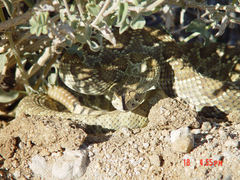
Crotalus scutulatus is species of rattlesnake, a venomous pit viper in the family Viperidae. The species is known commonly as the Mohave Rattlesnake. Other common English names include Mojave Rattlesnake and, referring specifically to the nominate (northern) subspecies: Northern Mohave Rattlesnake and Mojave Green Rattlesnake, the latter name commonly shortened to the more colloquial "Mojave green". Campbell and Lamar (2004) supported the English name "Mohave (Mojave) rattlesnake" with some reluctance because so little of the snake's range lies within the Mojave Desert. The spelling of the English name with an "h" has been advocated by multiple authors in recent years for various reasons. The most recent iteration of standard English names for North American reptiles, endorsed by the major herpetological societies in the United States and Canada, concludes that spelling with either a "j" or an "h" is correct, based on "whether the word is used in a Spanish or English context." Thus, their standard English names list adopted the "h" spelling.

Crotalus scutulatus is a highly venomous pitviper (family Viperidae, subfamily Crotalinae) found in the deserts of the southwestern United States and deep into mainland Mexico. It is perhaps best known for producing two distinctly different venom types in different populations.

Two subspecies are currently recognized. This account describes the widely distributed nominate subspecies, the Northern Mohave Rattlesnake, Crotalus scutulatus scutulatus. The other subspecies, C. scutulatus salvini, occurs in a relatively small area deep in mainland Mexico. Wikipedia →

Sounds

Recording0:15

United States · 2023

Chris (CP) and Pamela (PP) Pipes · iNaturalist · CC0

Global Distribution

Parks Where Found

# Park Country Daily sighting probability
1 Big Bend National Park 🇺🇸 United States
~10%
2 Saguaro National Park 🇺🇸 United States
~10%
3 Joshua Tree National Park 🇺🇸 United States
~10%

Zoos & Centres Where Found

# Zoo / Centre Country
1 San Diego Zoo 🇺🇸 United States In captivity
2 Omaha’s Henry Doorly Zoo and Aquarium 🇺🇸 United States In captivity
3 Phoenix Zoo 🇺🇸 United States In captivity
4 Detroit Zoo 🇺🇸 United States In captivity
5 Arizona-Sonora Desert Museum 🇺🇸 United States In captivity
6 Cameron Park Zoo 🇺🇸 United States In captivity
7 Chapultepec Zoo 🇲🇽 Mexico In captivity
8 Reptile Gardens 🇺🇸 United States In captivity
9 Parque museo La Venta 🇲🇽 Mexico In captivity
10 Siam Serpentarium 🇹🇭 Thailand In captivity

Before you go

What are the chances of seeing a Mohave Rattlesnake in Joshua Tree National Park?

With luck

About 10% of wildlife watchers report a Mohave Rattlesnake sighting in Joshua Tree National Park on a given day, based on 13 verified sightings from GBIF citizen-science data from 2019 to 2026. It is the 27th most-seen of the 39 reptiles we can rate there. Over three days the chance rises to about 20%, and over a week to about 40%, if each day is a fresh chance.

When is the best time to see a Mohave Rattlesnake in Joshua Tree National Park?

August

In that month about 30% of wildlife watchers report a Mohave Rattlesnake in Joshua Tree National Park on a given day, against under 5% in June and October–February, the lowest months.

What time of day is best to see a Mohave Rattlesnake?

Between 8 and 11 pm

Across all the parks we cover, that three-hour window holds the most Mohave Rattlesnake sightings with a recorded time, and about 7 in 10 of them come between 6 pm and 6 am: it is seen both by day and at night.

Is Joshua Tree National Park the best place to see a Mohave Rattlesnake?

Among the best

Of the 3 parks where we can rate Mohave Rattlesnake sightings, Joshua Tree National Park ranks 3rd at about 10%, level with the leaders once rounded. The best odds are in Big Bend National Park (United States, about 10%) and Saguaro National Park (United States, about 10%).

Which relatives of the Mohave Rattlesnake live in Joshua Tree National Park?

Same genus: Crotalus

The closest relatives of the Mohave Rattlesnake that you can see in Joshua Tree National Park (genus Crotalus, Rattlesnakes) are Southwestern Speckled Rattlesnake (about 50%), Sidewinder (about 20%) and Western Rattlesnake (about 20%), with each one's daily chance of a sighting.

Where does the Mohave Rattlesnake sighting chance come from?

GBIF citizen-science records

It is estimated from how often the Mohave Rattlesnake is recorded against all the reptiles logged in Joshua Tree National Park (13 verified sightings from 2019 to 2026), calibrated against known sighting rates. Figures are rounded to the nearest 10% because citizen-science data supports honest approximations, not decimals, and months with records from fewer than five people show "—". How it works.

← Back to Joshua Tree National Park