Blue-throated Bee-eater

Blue-throated Bee-eater

Merops viridis

Silhouette: Sheatherius · PhyloPic

LCLeast ConcernNTVUENCR
Daily sighting probability <5% · Rare
at Kaeng Krachan National Park

In 3 days ~10% in a week ~20%

104 Verified sightings at Kaeng Krachan National Park From 2019 to 2026
3,879 In all 11 parks
August Best month
🌅 Crepuscular When it's spotted

About the Blue-throated Bee-eater

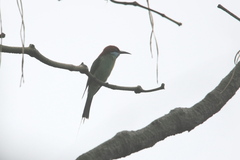
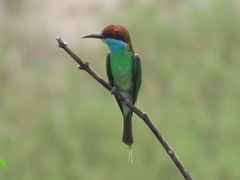
The blue-throated bee-eater (Merops viridis) is a species of bird in the bee-eater family. It is found in much of southeast Asia, in subtropical or tropical mangrove forests. Their diet consists mostly of bees, wasps, and dragonflies. Blue-throated bee-eater is a medium-large species of bee-eater with brightly coloured plumage consisting of a red-brown nape, dark green wings, light green breast, and their signature blue throat. The juvenile plumage has a dark green head and wings and light green breast, only developing their full plumage in adulthood. They have a rich variety of songs and calls, including long calls which allow them to communicate long distances in the forest.

The conservation status of the blue-throated bee-eaters is of "least concern" due to their large distribution and stability of its population as of 2024. However, deforestation may be its biggest threat, destroying its habitat and decreasing bird diversity generally.

The blue-throated bee-eater was formally described in 1758 by the Swedish naturalist Carl Linnaeus in the tenth edition of his Systema Naturae under the current binomial name Merops viridis. The type locality is the Indonesian island... Wikipedia →

Sounds

Call0:41

Philippines · 2026

© Kelle Moreau · XC1163234 · CC BY-NC-SA 4.0

Flight call0:26

Malaysia · 2026

© Ding Li Yong · XC1077548 · CC BY-NC-ND 4.0

Call0:57

Philippines · 2024

© Greg Irving · XC897387 · CC BY-NC-SA 4.0

Global Distribution

Parks Where Found

# Park Country Daily sighting probability
1 Kinabatangan Wildlife Sanctuary 🇲🇾 Malaysia
~60%
2 Sepilok 🇲🇾 Malaysia
~50%
3 Way Kambas National Park 🇮🇩 Indonesia
~40%
4 Tanjung Puting National Park 🇮🇩 Indonesia
~30%
5 Bako National Park 🇲🇾 Malaysia
~30%
6 Gunung Leuser National Park 🇮🇩 Indonesia
~20%
7 Danum Valley Conservation Area 🇲🇾 Malaysia
~20%
8 Taman Negara National Park 🇲🇾 Malaysia
~20%
9 Kaeng Krachan National Park 🇹🇭 Thailand
<5%
10 Khao Luang National Park 🇹🇭 Thailand
<5%
11 Khao Yai National Park 🇹🇭 Thailand
<5%

Cities Where Found

# City Country Daily sighting probability
1 Kuala Lumpur 🇲🇾 Malaysia
~30%
2 Singapore 🇸🇬 Singapore
~30%
3 Kuching 🇲🇾 Malaysia
~20%
4 Johor Bahru 🇲🇾 Malaysia
~20%
5 Guangzhou 🇨🇳 China
<5%
6 Bangkok 🇹🇭 Thailand
<5%

Before you go

What are the chances of seeing a Blue-throated Bee-eater in Kaeng Krachan National Park?

Rare

Under 5% of wildlife watchers report a Blue-throated Bee-eater sighting in Kaeng Krachan National Park on a given day, based on 104 verified sightings from GBIF citizen-science data from 2019 to 2026. It is the 233rd most-seen of the 360 birds we can rate there. Over three days the chance rises to about 10%, and over a week to about 20%, if each day is a fresh chance.

When is the best time to see a Blue-throated Bee-eater in Kaeng Krachan National Park?

August

In that month about 20% of wildlife watchers report a Blue-throated Bee-eater in Kaeng Krachan National Park on a given day, against under 5% in September to June, the lowest months. That is one of Kaeng Krachan National Park's wettest months, with about 200 mm of rain against 30 mm in December.

What time of day is best to see a Blue-throated Bee-eater?

Between 2 and 5 am

Across all the parks we cover, that three-hour window holds the most Blue-throated Bee-eater sightings with a recorded time, and about 6 in 10 of them come between 6 pm and 6 am: it is most active around dawn and dusk.

Which relatives of the Blue-throated Bee-eater live in Kaeng Krachan National Park?

Same genus: Merops

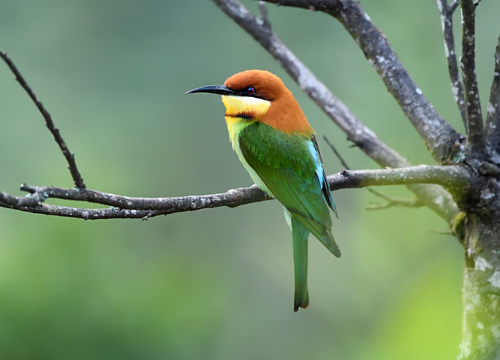
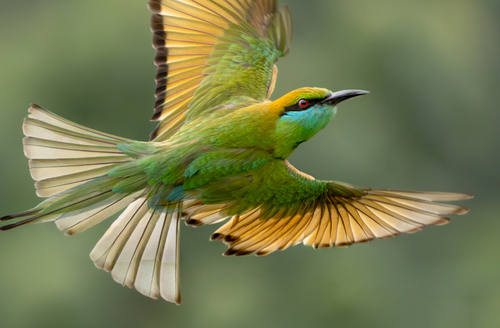
The closest relatives of the Blue-throated Bee-eater that you can see in Kaeng Krachan National Park (genus Merops, Typical Bee-eaters) are Chestnut-headed Bee-eater (about 20%) and Asian Green Bee-eater (about 10%), with each one's daily chance of a sighting.

Where does the Blue-throated Bee-eater sighting chance come from?

GBIF citizen-science records

It is estimated from how often the Blue-throated Bee-eater is recorded against all the birds logged in Kaeng Krachan National Park (104 verified sightings from 2019 to 2026), calibrated against known sighting rates. Figures are rounded to the nearest 10% because citizen-science data supports honest approximations, not decimals, and months with records from fewer than five people show "—". How it works.

← Back to Kaeng Krachan National Park