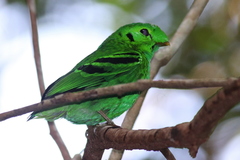
Green Broadbill

Green Broadbill

Calyptomena viridis

Silhouette: Marie-Aimée ALLARD · PhyloPic

LCNTNear ThreatenedVUENCR
Daily sighting probability <5% · Rare
at Kaeng Krachan National Park

In 3 days <5%

10 Verified sightings at Kaeng Krachan National Park From 2019 to 2026
1,153 In all 8 parks
September Best month
🌅 Crepuscular When it's spotted

About the Green Broadbill

The green broadbill (Calyptomena viridis) also known as the Asian green broadbill or the lesser green broadbill is a small bird in the family Calyptomenidae. It was formerly classified in the family Eurylaimidae, a group of closely related birds that share the name "broadbill".

There are three subspecies recognized: Calyptomena viridis viridis Raffles, 1822 - the Malay Peninsula, extirpated from Singapore Calyptomena viridis gloriosa Deignan, 1947 - Sumatra, Borneo, Nias, the Lingga Islands, and the Natuna Islands

Calyptomena viridis siberu Chasen & Kloss, 1926 - Mentawai Islands Prior to revisions by the International Ornithological Congress in 2022, the mainland subspecies went by the name caudacuta, while viridis referred to the Greater Sundaic subspecies. Based on several previous studies finding problems with this nomenclature, the International Ornithological Congress replaced caudacuta with viridis, while gloriosa replaced the former viridis.

The green broadbill is distributed in broadleaved evergreen forests of Borneo, Sumatra, and the Malay Peninsula where it frequents lowland and lower montane rainforest. The... Wikipedia →

Sounds

Call0:35

Indonesia · 2026

© Kim Chuah Lim · XC1175482 · CC BY-NC-SA 4.0

Song0:44

Singapore · 2021

© Okamoto Keita Sin · XC665348 · CC BY-NC-SA 4.0

Presumed display (notes in recording)1:20

Malaysia · 2016

© Frank Lambert · XC523360 · CC BY-NC-ND 4.0

Global Distribution

Parks Where Found

# Park Country Daily sighting probability
1 Khao Luang National Park 🇹🇭 Thailand
~50%
2 Taman Negara National Park 🇲🇾 Malaysia
~40%
3 Way Kambas National Park 🇮🇩 Indonesia
~30%
4 Danum Valley Conservation Area 🇲🇾 Malaysia
~10%
5 Khao Sok National Park 🇹🇭 Thailand
<5%
6 Sepilok 🇲🇾 Malaysia
<5%
7 Kinabalu Park 🇲🇾 Malaysia
<5%
8 Kaeng Krachan National Park 🇹🇭 Thailand
<5%

Zoos & Centres Where Found

# Zoo / Centre Country
1 Shedd Aquarium 🇺🇸 United States In captivity
2 Riverbanks Zoo 🇺🇸 United States In captivity
3 Lincoln Park Zoo 🇺🇸 United States In captivity
4 Johor Zoo 🇲🇾 Malaysia In captivity

Before you go

What are the chances of seeing a Green Broadbill in Kaeng Krachan National Park?

Rare

Under 5% of wildlife watchers report a Green Broadbill sighting in Kaeng Krachan National Park on a given day, based on 10 verified sightings from GBIF citizen-science data from 2019 to 2026. It is the 326th most-seen of the 360 birds we can rate there. Over three days the chance rises to under 5%, if each day is a fresh chance.

When is the best time to see a Green Broadbill in Kaeng Krachan National Park?

Any time of year

In every month with enough records, under 5% of wildlife watchers report a Green Broadbill in Kaeng Krachan National Park on a given day, so our monthly data shows no clear season.

What time of day is best to see a Green Broadbill?

Between 2 and 5 am

Across all the parks we cover, that three-hour window holds the most Green Broadbill sightings with a recorded time, and about half of them come between 6 am and 6 pm: it is most active around dawn and dusk.

Which relatives of the Green Broadbill live in Kaeng Krachan National Park?

Same family: Eurylaimidae

The closest relatives of the Green Broadbill that you can see in Kaeng Krachan National Park (family Eurylaimidae, Asian and Grauer's Broadbills) are Banded Broadbill (about 20%), Silver-breasted Broadbill (about 20%) and Black-and-red Broadbill (about 20%), with each one's daily chance of a sighting.

Where does the Green Broadbill sighting chance come from?

GBIF citizen-science records

It is estimated from how often the Green Broadbill is recorded against all the birds logged in Kaeng Krachan National Park (10 verified sightings from 2019 to 2026), calibrated against known sighting rates. Figures are rounded to the nearest 10% because citizen-science data supports honest approximations, not decimals, and months with records from fewer than five people show "—". How it works.

← Back to Kaeng Krachan National Park