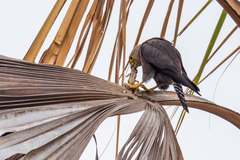
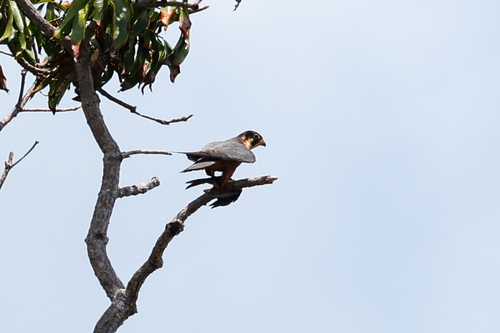
Dickinson's Kestrel

Dickinson's Kestrel

Falco dickinsoni

Silhouette: Shyamal · PhyloPic

LCLeast ConcernNTVUENCR
Daily sighting probability <5% · Rare
at Kafue National Park

In 3 days ~10% in a week ~20%

23 Verified sightings at Kafue National Park From 2019 to 2026
507 In all 13 parks
September Best month
☀️ Diurnal When it's spotted

About the Dickinson's Kestrel

Dickinson's kestrel (Falco dickinsoni) is a bird of prey of southern and eastern Africa belonging to the falcon family Falconidae. It is named after John Dickinson, an English physician and missionary who collected the type specimen. It is also known as the white-rumped kestrel. Its closest relatives are the grey kestrel and banded kestrel and the three are sometimes placed in the subgenus Dissodectes.

It is a fairly small, stocky kestrel with a large, square head. It is 27–30 cm (11–12 in) long with a wingspan of 61–68 cm (24–27 in) and a weight of 167–246 g (5.9–8.7 oz). The female is about 4% larger and 10-20% heavier than the male. The plumage is mostly dark grey with a pale head and rump. The tail is grey with narrow black bars and a broad subterminal band. The underside of the flight feathers are also barred. The cere and feet are yellow and there is bare yellow skin around the eye. The bill is dark grey and the eyes are brown. Juvenile birds are grey-brown with barred flanks and without the paler head and rump. They have a greenish cere and eye-ring.

It is usually silent but has a high-pitched alarm and contact call. At the nest, a soft, mewing call attracts... Wikipedia →

Sounds

Call0:37

Tanzania · 2011

© Martin St-Michel · XC94807 · CC BY-NC-ND 2.5

Global Distribution

Parks Where Found

# Park Country Daily sighting probability
1 Liwonde National Park 🇲🇼 Malawi
~30%
2 Gonarezhou National Park 🇿🇼 Zimbabwe
~20%
3 Moremi Game Reserve 🇧🇼 Botswana
~10%
4 Hwange National Park 🇿🇼 Zimbabwe
~10%
5 Mana Pools National Park 🇿🇼 Zimbabwe
~10%
6 Gorongosa National Park 🇲🇿 Mozambique
~10%
7 Mikumi National Park 🇹🇿 Tanzania
<5%
8 Kafue National Park 🇿🇲 Zambia
<5%
9 Lower Zambezi National Park 🇿🇲 Zambia
<5%
10 Ruaha National Park 🇹🇿 Tanzania
<5%
11 South Luangwa National Park 🇿🇲 Zambia
<5%
12 Chobe National Park 🇧🇼 Botswana
<5%
13 Kruger National Park 🇿🇦 South Africa
<5%

Before you go

What are the chances of seeing a Dickinson's Kestrel in Kafue National Park?

Rare

Under 5% of wildlife watchers report a Dickinson's Kestrel sighting in Kafue National Park on a given day, based on 23 verified sightings from GBIF citizen-science data from 2019 to 2026. It is the 261st most-seen of the 338 birds we can rate there. Over three days the chance rises to about 10%, and over a week to about 20%, if each day is a fresh chance.

When is the best time to see a Dickinson's Kestrel in Kafue National Park?

June and September

In those months about 10% of wildlife watchers report a Dickinson's Kestrel in Kafue National Park on a given day, against under 5% in July–August and October–May, the lowest months. Those are among Kafue National Park's driest months, with almost no rain against 290 mm in January.

What time of day is best to see a Dickinson's Kestrel?

Between 7 and 10 am

Across all the parks we cover, that three-hour window holds the most Dickinson's Kestrel sightings with a recorded time, and about 9 in 10 of them come between 6 am and 6 pm: it is a daytime animal.

Is Kafue National Park the best place to see a Dickinson's Kestrel?

8th of 13

Of the 13 parks where we can rate Dickinson's Kestrel sightings, Kafue National Park ranks 8th at under 5%. The best odds are in Liwonde National Park (Malawi, about 30%), Gonarezhou National Park (Zimbabwe, about 20%) and Moremi Game Reserve (Botswana, about 10%).

Where does the Dickinson's Kestrel sighting chance come from?

GBIF citizen-science records

It is estimated from how often the Dickinson's Kestrel is recorded against all the birds logged in Kafue National Park (23 verified sightings from 2019 to 2026), calibrated against known sighting rates. Figures are rounded to the nearest 10% because citizen-science data supports honest approximations, not decimals, and months with records from fewer than five people show "—". How it works.

← Back to Kafue National Park