Lechwe

Lechwe

Kobus leche

Silhouette: Jan A. Venter, Herbert H. T. Prins, David A. Balfour & Rob Slotow (vectorized by T. Michael Keesey) · PhyloPic

Daily sighting probability ~40% · Likely
at Kafue National Park

In 3 days ~80% in a week >90%

40 Verified sightings at Kafue National Park From 2019 to 2026
420 In all 3 parks
July Best month
☀️ Diurnal When it's spotted

About the Lechwe

The lechwe, red lechwe, or southern lechwe (Kobus leche) is an antelope found in wetlands of south-central Africa. The lechwe is native to Botswana, Zambia, southeastern Democratic Republic of the Congo, northeastern Namibia, and eastern Angola, especially in the Okavango Delta, Kafue Flats, and Bangweulu Wetlands. The species is fairly common in zoos and wild animal farms.

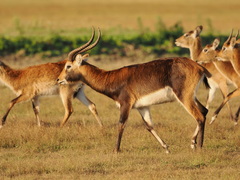
Adult lechwe typically stand 90 to 100 cm (35 to 39 in) at the shoulder and generally weigh from 50 to 120 kg (110 to 260 lb), with males being larger than females. They are golden brown with white bellies. Males are darker in colour, but exact hue and amount of blackish on the front legs, chest and body varies depending on subspecies. The long, spiral horns are vaguely lyre-shaped and borne only by males. The hind legs are somewhat longer in proportion than in other antelopes to ease long-distance running on marshy soil.

Lechwe are found in marshy areas where they are an important herbivore of aquatic plants, as well as grasses that are found in flooded meadows. They use the knee-deep water as protection from predators. Their legs are covered in a water-repellant substance... Wikipedia →

Sounds

Recording0:01

Zambia · 2023

© eliegaget · iNaturalist · CC BY-NC 4.0

Global Distribution

Parks Where Found

# Park Country Daily sighting probability
1 Moremi Game Reserve 🇧🇼 Botswana
~60%
2 Kafue National Park 🇿🇲 Zambia
~40%
3 Chobe National Park 🇧🇼 Botswana
~30%

Zoos & Centres Where Found

# Zoo / Centre Country
1 ZooParc de Beauval 🇫🇷 France In captivity
2 Lisbon Oceanarium 🇵🇹 Portugal In captivity
3 Cabarceno Natural Park 🇪🇸 Spain In captivity
4 Paris Zoological Park 🇫🇷 France In captivity
5 Zoo Pilsen 🇨🇿 Czechia In captivity
6 Fota Wildlife Park 🇮🇪 Ireland In captivity
7 Réserve africaine de Sigean 🇫🇷 France In captivity
8 Aquarium du palais de la Porte Dorée 🇫🇷 France In captivity
9 Zoo d'Amiens 🇫🇷 France In captivity
10 San Diego Zoo Safari Park 🇺🇸 United States In captivity
11 Taman Safari Indonesia 🇮🇩 Indonesia In captivity
12 Kragga Kamma Game Park 🇿🇦 South Africa In captivity
13 Knowsley Safari Park 🇬🇧 United Kingdom In captivity
14 Seaview Game & Lion Park 🇿🇦 South Africa In captivity
15 Badoca Safari Park 🇵🇹 Portugal In captivity
16 Parc zoologique de Montpellier 🇫🇷 France In captivity
17 National Zoological Garden of South Africa 🇿🇦 South Africa In captivity
18 Wildlife World Zoo 🇺🇸 United States In captivity
19 Selwo Aventura 🇪🇸 Spain In captivity
20 Safari de Peaugres Circuit Piéton 🇫🇷 France In captivity
21 Zoológico de San Juan de Aragón 🇲🇽 Mexico In captivity
22 Pombia Safari Park 🇮🇹 Italy In captivity
23 San Francisco Zoo 🇺🇸 United States In captivity
24 Ljubljana Zoo 🇸🇮 Slovenia In captivity
25 Zoologischer Garten Magdeburg 🇩🇪 Germany In captivity
26 Chapultepec Zoo 🇲🇽 Mexico In captivity
27 Attica Zoological Park 🇬🇷 Greece In captivity
28 Zoo Santo Inácio 🇵🇹 Portugal In captivity
29 Parc zoologique de Fréjus 🇫🇷 France In captivity
30 Seville Zoo 🇪🇸 Spain In captivity
31 Reserva Zoológica Oasys MiniHollywood 🇪🇸 Spain In captivity
32 Le Cornelle 🇮🇹 Italy In captivity
33 Paphos Zoo 🇨🇾 Cyprus In captivity
34 National Zoological Gardens of Sri Lanka 🇱🇰 Sri Lanka In captivity
35 VigoNature 🇪🇸 Spain In captivity
36 Adlergehege Berchtesgaden 🇩🇪 Germany In captivity
37 Gardaland Sea Life Aquarium 🇮🇹 Italy In captivity
38 Acuario Inbursa 🇲🇽 Mexico In captivity
39 Centro de Recuperação de Animais Silvestres 🇵🇹 Portugal In captivity
40 Safari Borysew Zoo 🇵🇱 Poland In captivity
41 Taman Safari Indonesia 2 🇮🇩 Indonesia In captivity

Before you go

What are the chances of seeing a Lechwe in Kafue National Park?

Likely

About 40% of wildlife watchers report a Lechwe sighting in Kafue National Park on a given day, based on 40 verified sightings from GBIF citizen-science data from 2019 to 2026. It is the 15th most-seen of the 29 mammals we can rate there. Over three days the chance rises to about 80%, and over a week to over 90%, if each day is a fresh chance.

When is the best time to see a Lechwe in Kafue National Park?

July

In that month about 70% of wildlife watchers report a Lechwe in Kafue National Park on a given day, against about 10% in November to May, the lowest months. That is one of Kafue National Park's driest months, with almost no rain against 290 mm in January.

What time of day is best to see a Lechwe?

Between 9 am and noon

Across all the parks we cover, that three-hour window holds the most Lechwe sightings with a recorded time, and about 9 in 10 of them come between 6 am and 6 pm: it is a daytime animal.

Is Kafue National Park the best place to see a Lechwe?

2nd of 3

Of the 3 parks where we can rate Lechwe sightings, Kafue National Park ranks 2nd at about 40%. The best odds are in Moremi Game Reserve (Botswana, about 60%).

Which relatives of the Lechwe live in Kafue National Park?

Same genus: Kobus

The closest relatives of the Lechwe that you can see in Kafue National Park (genus Kobus, Waterbucks, Kobs, and Lechwes) are Puku (about 70%) and Waterbuck (about 40%), with each one's daily chance of a sighting.

Where does the Lechwe sighting chance come from?

GBIF citizen-science records

It is estimated from how often the Lechwe is recorded against all the mammals logged in Kafue National Park (40 verified sightings from 2019 to 2026), calibrated against known sighting rates. Figures are rounded to the nearest 10% because citizen-science data supports honest approximations, not decimals, and months with records from fewer than five people show "—". How it works.

← Back to Kafue National Park