Rosy-throated Longclaw

Rosy-throated Longclaw

Macronyx ameliae

Silhouette: Sheatherius · PhyloPic

LCLeast ConcernNTVUENCR
Daily sighting probability ~10% · With luck
at Kafue National Park

In 3 days ~20% in a week ~40%

43 Verified sightings at Kafue National Park From 2019 to 2026
1,412 In all 11 parks
August Best month
☀️ Diurnal When it's spotted

About the Rosy-throated Longclaw

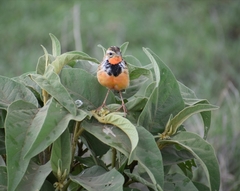
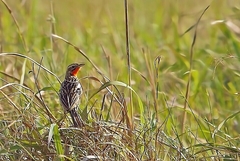
The rosy-throated longclaw, also known as the rosy-breasted longclaw (Macronyx ameliae) is a species of bird in the family Motacillidae. It is found in Angola, Botswana, Democratic Republic of the Congo, Kenya, Malawi, Mozambique, Namibia, South Africa, Tanzania, Zambia, and Zimbabwe. Its natural habitat is subtropical or tropical seasonally wet or flooded lowland grassland.

The Marquis Léonce de Tarragon described the species in 1845, its specific name honouring either his wife or mother who were both named Amélie. Richard Bowdler Sharpe named this species M. wintoni in 1891 after William Edward de Winton. Common names include rosy-throated longclaw, pink-throated longclaw and rosy-breasted longclaw.

Three subspecies are recognized: M. ameliae ameliae from Mozambique, Eswatini and eastern South Africa, M. ameliae wintoni from southwestern Kenya and northern Tanzania, and M. ameliae altanus from Botswana, Angola, Malawi, southwestern Tanzania, Zimbabwe and Zambia.

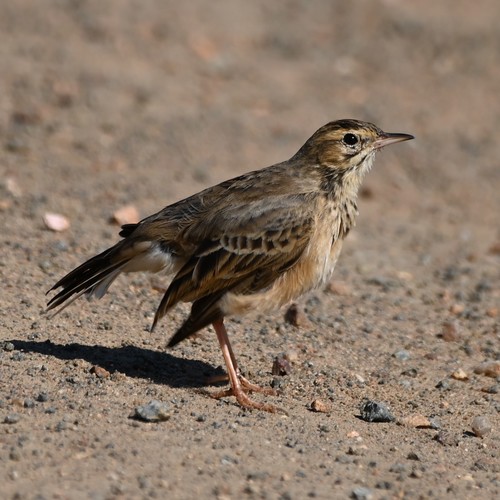
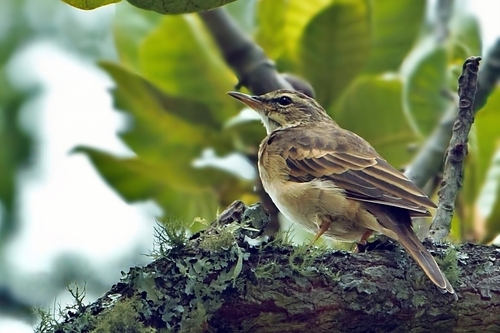
Adult birds are 19–20 centimetres (7.5–7.9 in) long with greyish-brown scalloped upper parts. The male has a pink throat and breast crossed with a broad black band across the chest, which is not evident outside... Wikipedia →

Sounds

Song1:02

Zambia · 2024

© Dries Van de Loock · XC958780 · CC BY-NC-ND 4.0

Song0:09

Tanzania · 2023

© isaac kilusu · XC777045 · CC BY-NC-SA 4.0

Song0:44

Tanzania · 2020

© Abdulrahman Adam · XC718794 · CC BY-NC-SA 4.0

Global Distribution

Parks Where Found

# Park Country Daily sighting probability
1 Masai Mara National Reserve 🇰🇪 Kenya
~20%
2 Ngorongoro Conservation Area 🇹🇿 Tanzania
~10%
3 Kafue National Park 🇿🇲 Zambia
~10%
4 Nairobi National Park 🇰🇪 Kenya
~10%
5 Amboseli National Park 🇰🇪 Kenya
~10%
6 Serengeti National Park 🇹🇿 Tanzania
~10%
7 iSimangaliso Wetland Park 🇿🇦 South Africa
<5%
8 Chobe National Park 🇧🇼 Botswana
<5%
9 Moremi Game Reserve 🇧🇼 Botswana
<5%
10 Lake Nakuru National Park 🇰🇪 Kenya
<5%
11 Tarangire National Park 🇹🇿 Tanzania
<5%

Cities Where Found

# City Country Daily sighting probability
1 Harare 🇿🇼 Zimbabwe
<5%

Before you go

What are the chances of seeing a Rosy-throated Longclaw in Kafue National Park?

With luck

About 10% of wildlife watchers report a Rosy-throated Longclaw sighting in Kafue National Park on a given day, based on 43 verified sightings from GBIF citizen-science data from 2019 to 2026. It is the 171st most-seen of the 338 birds we can rate there. Over three days the chance rises to about 20%, and over a week to about 40%, if each day is a fresh chance.

When is the best time to see a Rosy-throated Longclaw in Kafue National Park?

August

In that month about 20% of wildlife watchers report a Rosy-throated Longclaw in Kafue National Park on a given day, against under 5% in April, July and November, the lowest months. That is one of Kafue National Park's driest months, with almost no rain against 290 mm in January.

What time of day is best to see a Rosy-throated Longclaw?

Between 7 and 10 am

Across all the parks we cover, that three-hour window holds the most Rosy-throated Longclaw sightings with a recorded time, and about 8 in 10 of them come between 6 am and 6 pm: it is a daytime animal.

Is Kafue National Park the best place to see a Rosy-throated Longclaw?

3rd of 11

Of the 11 parks where we can rate Rosy-throated Longclaw sightings, Kafue National Park ranks 3rd at about 10%. The best odds are in Masai Mara National Reserve (Kenya, about 20%) and Ngorongoro Conservation Area (Tanzania, about 10%).

Where does the Rosy-throated Longclaw sighting chance come from?

GBIF citizen-science records

It is estimated from how often the Rosy-throated Longclaw is recorded against all the birds logged in Kafue National Park (43 verified sightings from 2019 to 2026), calibrated against known sighting rates. Figures are rounded to the nearest 10% because citizen-science data supports honest approximations, not decimals, and months with records from fewer than five people show "—". How it works.

← Back to Kafue National Park