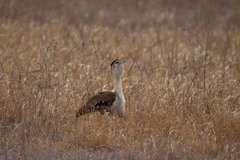
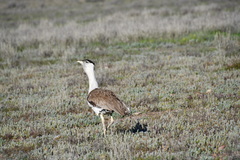
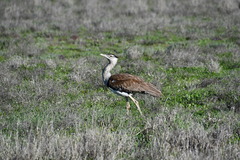
Australian Bustard

Australian Bustard

Ardeotis australis

Silhouette: L. Shyamal · PhyloPic

LCLeast ConcernNTVUENCR
Daily sighting probability <5% · Rare
at Kakadu National Park

In 3 days <5%

14 Verified sightings at Kakadu National Park From 2019 to 2026
173 In all 3 parks
October Best month
☀️ Diurnal When it's spotted

About the Australian Bustard

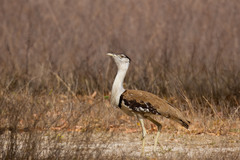
The Australian bustard (Ardeotis australis) is a large ground-dwelling bird that is common in grassland, woodland and open agricultural country across northern Australia and southern New Guinea. It stands at about one metre (3 ft 3 in) high, and its wingspan is around twice that length. The species is nomadic, flying to areas when food becomes plentiful, and capable of travelling long distances. They were once widespread and common to the open plains of Australia, but became rare in regions that have been used for farming. The bustard is omnivorous, mostly consuming the fruit or seed of plants, but also eating invertebrates such as crickets, grasshoppers, smaller mammals, birds and reptiles.

The species is also commonly referred to as the plains turkey, and in Central Australia as the bush turkey, particularly by Aboriginal people, who hunt it, although the latter name may also be used for the Australian brushturkey, as well as the orange-footed scrubfowl.

The species was first described by John Edward Gray in 1829, who assigned it the name Otis australis. Gray's specimen was obtained in New South Wales and was held in the General T. Davies collection. The whereabouts... Wikipedia →

Sounds

Call0:23

Australia · 2013

© Marc Anderson · XC156198 · CC BY-NC-ND 3.0

Global Distribution

Parks Where Found

# Park Country Daily sighting probability
1 Ningaloo Marine Park 🇦🇺 Australia
~20%
2 Cape Range 🇦🇺 Australia
~20%
3 Kakadu National Park 🇦🇺 Australia
<5%

Zoos & Centres Where Found

# Zoo / Centre Country
1 Territory Wildlife Park 🇦🇺 Australia In captivity
2 Alice Springs Desert Park 🇦🇺 Australia In captivity
3 Gorge Wildlife Park 🇦🇺 Australia In captivity
4 Hunter Valley Wildlife Park 🇦🇺 Australia In captivity
5 Featherdale Sydney Wildlife Park 🇦🇺 Australia In captivity
6 Caversham Wildlife Park 🇦🇺 Australia In captivity

Before you go

What are the chances of seeing an Australian Bustard in Kakadu National Park?

Rare

Under 5% of wildlife watchers report an Australian Bustard sighting in Kakadu National Park on a given day, based on 14 verified sightings from GBIF citizen-science data from 2019 to 2026. It is the 169th most-seen of the 186 birds we can rate there. Over three days the chance rises to under 5%, if each day is a fresh chance.

When is the best time to see an Australian Bustard in Kakadu National Park?

Any time of year

In every month with enough records, under 5% of wildlife watchers report an Australian Bustard in Kakadu National Park on a given day, so our monthly data shows no clear season. February has too few records to rate.

What time of day is best to see an Australian Bustard?

Between 3 and 6 pm

Across all the parks we cover, that three-hour window holds the most Australian Bustard sightings with a recorded time, and nearly all of them come between 6 am and 6 pm: it is a daytime animal.

Is Kakadu National Park the best place to see an Australian Bustard?

3rd of 3

Of the 3 parks where we can rate Australian Bustard sightings, Kakadu National Park ranks 3rd at under 5%. The best odds are in Ningaloo Marine Park (Australia, about 20%) and Cape Range (Australia, about 20%).

Where does the Australian Bustard sighting chance come from?

GBIF citizen-science records

It is estimated from how often the Australian Bustard is recorded against all the birds logged in Kakadu National Park (14 verified sightings from 2019 to 2026), calibrated against known sighting rates. Figures are rounded to the nearest 10% because citizen-science data supports honest approximations, not decimals, and months with records from fewer than five people show "—". How it works.

← Back to Kakadu National Park