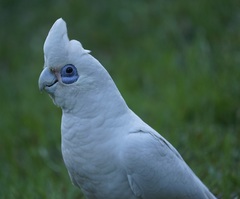

Little Corella

Little Corella

Cacatua sanguinea

Silhouette: Ferran Sayol · PhyloPic

LCLeast ConcernNTVUENCR
Daily sighting probability ~60% · Likely
at Kakadu National Park

In 3 days ~90% in a week >90%

1,480 Verified sightings at Kakadu National Park From 2019 to 2026
4,069 In all 18 parks
January Best month
☀️ Diurnal When it's spotted

About the Little Corella

The little corella (Cacatua sanguinea), also known as the short-billed corella, bare-eyed cockatoo, blood-stained cockatoo, and little cockatoo is a white cockatoo native to Australia and southern New Guinea. It was known as Birdirra among the Yindjibarndi people of the central and western Pilbara. They would keep them as pets, or traditionally cook and eat them. The downy feathers are used in traditional ceremonies and dances where they adorn head and armbands.

The first recorded description of the species was by English ornithologist John Gould in 1843. The little corella is a small white cockatoo growing to 35–41 cm (14–16 in) in length and weighs 370–630 g (13–22 oz), with a mean weight of 525 g (1.157 lb). It is similar in appearance to both the long-billed corella and the western corella, but the little corella is smaller, and unlike either of those species, it has upper and lower mandibles of similar length. It is easily distinguished from the long-billed corella by the lack of an orange throat bar. C. s. normantoni... Wikipedia →

Sounds

Flight call0:27

Australia · 2026

© Nick Talbot · XC1134265 · CC BY-NC-SA 4.0

Call0:11

Australia · 2021

© Marc Anderson · XC1001926 · CC BY-NC-ND 4.0

Song0:31

Australia · 2021

© James Lambert · XC694471 · CC BY-NC-ND 4.0

Global Distribution

Parks Where Found

# Park Country Daily sighting probability
1 Kakadu National Park 🇦🇺 Australia
~60%
2 Flinders Ranges National Park 🇦🇺 Australia
~50%
3 Hattah-Kulkyne National Park 🇦🇺 Australia
~40%
4 Cape Range 🇦🇺 Australia
~30%
5 Ningaloo Marine Park 🇦🇺 Australia
~20%
6 Royal National Park 🇦🇺 Australia
~20%
7 Noosa National Park 🇦🇺 Australia
~20%
8 Litchfield National Park 🇦🇺 Australia
~20%
9 Uluru-Kata Tjuta National Park 🇦🇺 Australia
~10%
10 Booderee National Park 🇦🇺 Australia
~10%
11 Wilsons Promontory National Park 🇦🇺 Australia
~10%
12 Springbrook National Park 🇦🇺 Australia
~10%
13 Grampians National Park 🇦🇺 Australia
~10%
14 Blue Mountains National Park 🇦🇺 Australia
~10%
15 Nitmiluk National Park 🇦🇺 Australia
~10%
16 Great Otway National Park 🇦🇺 Australia
<5%
17 Kosciuszko National Park 🇦🇺 Australia
<5%
18 Lamington National Park 🇦🇺 Australia
<5%

Cities Where Found

# City Country Daily sighting probability
1 Perth 🇦🇺 Australia
~50%
2 Sydney 🇦🇺 Australia
~30%
3 Brisbane 🇦🇺 Australia
~20%
4 Melbourne 🇦🇺 Australia
~20%
5 Hobart 🇦🇺 Australia
<5%

Zoos & Centres Where Found

# Zoo / Centre Country
1 Orana Wildlife Park 🇳🇿 New Zealand In captivity
2 Oasis Park 🇪🇸 Spain In captivity
3 Parc zoologique et forestier Michel-Corbasson 🇫🇷 France In captivity
4 Indianapolis Zoo 🇺🇸 United States In captivity
5 Lisbon Zoo 🇵🇹 Portugal In captivity
6 Ninoy Aquino Parks & Wildlife Center 🇵🇭 Philippines In captivity
7 Lone Pine Koala Sanctuary 🇦🇺 Australia In captivity
8 Alipore Zoological Gardens 🇮🇳 India In captivity
9 African Dawn Bird and Wildlife Sanctuary 🇿🇦 South Africa In captivity
10 World of Birds Wildlife Sanctuary and Monkey Park 🇿🇦 South Africa In captivity
11 Millcreek Bird Park 🇳🇿 New Zealand In captivity
12 Castellar Zoo 🇪🇸 Spain In captivity
13 Mote Marine Laboratory 🇺🇸 United States In captivity
14 Bird Kingdom 🇨🇦 Canada In captivity
15 Campbelltown Forest of Wild Birds 🇯🇵 Japan In captivity
16 Caversham Wildlife Park 🇦🇺 Australia In captivity
17 Schwanenkolonie 🇨🇭 Switzerland In captivity

Before you go

What are the chances of seeing a Little Corella in Kakadu National Park?

Likely

About 60% of wildlife watchers report a Little Corella sighting in Kakadu National Park on a given day, based on 1,480 verified sightings from GBIF citizen-science data from 2019 to 2026. It is the 7th most-seen of the 186 birds we can rate there. Over three days the chance rises to about 90%, and over a week to over 90%, if each day is a fresh chance.

When is the best time to see a Little Corella in Kakadu National Park?

March, September and November–January

In those months about 70% of wildlife watchers report a Little Corella in Kakadu National Park on a given day, against about 50% in July, the lowest month. Those are among Kakadu National Park's wettest months, with about 180 mm of rain a month against almost none in August. February has too few records to rate.

What time of day is best to see a Little Corella?

Between 1 and 4 pm

Across all the parks we cover, that three-hour window holds the most Little Corella sightings with a recorded time, and nearly all of them come between 6 am and 6 pm: it is a daytime animal.

Where does the Little Corella sighting chance come from?

GBIF citizen-science records

It is estimated from how often the Little Corella is recorded against all the birds logged in Kakadu National Park (1,480 verified sightings from 2019 to 2026), calibrated against known sighting rates. Figures are rounded to the nearest 10% because citizen-science data supports honest approximations, not decimals, and months with records from fewer than five people show "—". How it works.

← Back to Kakadu National Park