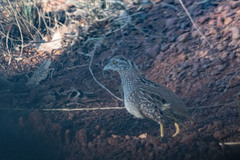
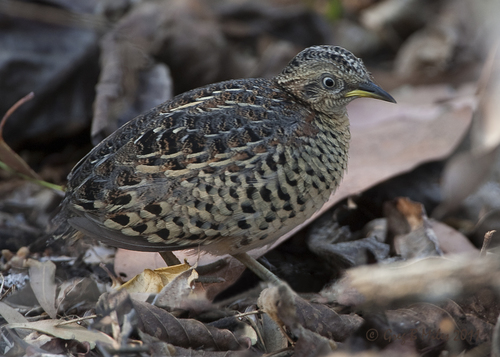
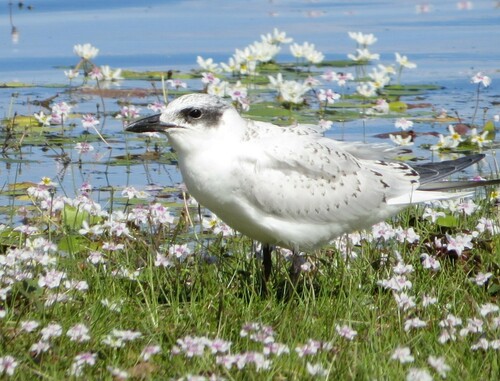
Chestnut-backed Buttonquail

Chestnut-backed Buttonquail

Turnix castanotus

Silhouette: PhyloPic

LCLeast ConcernNTVUENCR Endemic
Daily sighting probability <5% · Rare
at Kakadu National Park

In 3 days <5% in a week ~10%

13 Verified sightings at Kakadu National Park From 2019 to 2026
13 In 1 park
October Best month
☀️🌙 Day & Night When it's spotted

About the Chestnut-backed Buttonquail

The chestnut-backed buttonquail (Turnix castanotus) is a species of bird in the family Turnicidae. It is endemic to Australia. John Gould described the species in 1840, from a specimen collected by Benjamin Bynoe, ship's surgeon of HMS Beagle, from northwestern Australia, as Hemipodius castanotus. English zoologist George Gray placed it in the genus Turnix in 1870. William Robert Ogilvie-Grant corrected the name to Turnix castanonota in 1889. Three subspecies were described by Gregory Mathews, but all are now considered as invalid and merely individual variants.

"Chestnut-backed buttonquail" has been designated the official name by the International Ornithologists' Union (IOC). The species name is derived from the Ancient Greek words kastanon "chestnut" and noton "back". Gould called it "chestnut-backed hemipode" in 1848, noting the colonists called it "thick-billed quail". The buttonquail species were generally known as "quail" (hence "chestnut-backed quail" ) until the RAOU promoted the current usage of "buttonquail" in 1978, which was then universally adopted.

Native to northern Australia, the species ranges from the Dampier... Wikipedia →

Sounds

Call0:06

Australia · 2022

© Drew Davison · XC720427 · CC BY-NC-ND 4.0

Call0:22

Australia · 2018

© Nigel Jackett · XC428475 · CC BY-NC-SA 4.0

Global Distribution

Parks Where Found

# Park Country Daily sighting probability
1 Kakadu National Park 🇦🇺 Australia
<5%

More parks will be added in future updates.

Before you go

What are the chances of seeing a Chestnut-backed Buttonquail in Kakadu National Park?

Rare

Under 5% of wildlife watchers report a Chestnut-backed Buttonquail sighting in Kakadu National Park on a given day, based on 13 verified sightings from GBIF citizen-science data from 2019 to 2026. It is the 166th most-seen of the 186 birds we can rate there. Over three days the chance rises to under 5%, and over a week to about 10%, if each day is a fresh chance.

When is the best time to see a Chestnut-backed Buttonquail in Kakadu National Park?

Any time of year

In every month with enough records, under 5% of wildlife watchers report a Chestnut-backed Buttonquail in Kakadu National Park on a given day, so our monthly data shows no clear season. February has too few records to rate.

What time of day is best to see a Chestnut-backed Buttonquail?

Between 7 and 10 am

Across all the parks we cover, that three-hour window holds the most Chestnut-backed Buttonquail sightings with a recorded time, and about half of them come between 6 am and 6 pm: it is seen both by day and at night.

Where else can you see a Chestnut-backed Buttonquail?

Only Kakadu National Park, in our data

Kakadu National Park is the only park on Wallace's Line with enough records to rate Chestnut-backed Buttonquail sightings: under 5% of wildlife watchers there report one on a given day.

Where does the Chestnut-backed Buttonquail sighting chance come from?

GBIF citizen-science records

It is estimated from how often the Chestnut-backed Buttonquail is recorded against all the birds logged in Kakadu National Park (13 verified sightings from 2019 to 2026), calibrated against known sighting rates. Figures are rounded to the nearest 10% because citizen-science data supports honest approximations, not decimals, and months with records from fewer than five people show "—". How it works.

← Back to Kakadu National Park