Giant Cave Gecko

Giant Cave Gecko

Pseudothecadactylus lindneri

Silhouette: Jose Carlos Arenas-Monroy · PhyloPic

LCLeast ConcernNTVUENCR Endemic
Daily sighting probability ~20% · Possible
at Kakadu National Park

In 3 days ~40% in a week ~80%

12 Verified sightings at Kakadu National Park From 2019 to 2026
12 In 1 park
December Best month
🌙 Nocturnal When it's spotted

About the Giant Cave Gecko

The giant cave gecko (Pseudothecadactylus lindneri), also known commonly as the northern giant cave gecko, is a species of lizard in the family Diplodactylidae. The species is endemic to Australia. The specific name, lindneri, is in honor of Australian herpetologist David A. Lindner.

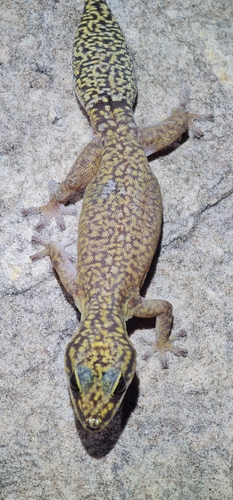
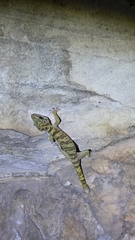
Adults of P. lindneri usually have a snout-to-vent length (SVL) of about 9.5 cm (3.7 in). The dorsal coloration is dark purplish brown, with lighter irregular crossbands. The crossbands are pale orange to cream-colored, and often do not meet neatly in the middle.

P. lindneri is found in Arnhem Land, Northern Territory, Australia. The preferred natural habitat of P. lindneri is caves and crevices in sandstone escarpments. P. lindneri is oviparous. Cogger HG (1975). "New lizards of the genus Pseudothecadactylus (Lacertilia: Gekkonidae) from Arnhem Land and northwestern Australia". Records of the Australian Museum 30 (3): 87–97. (Pseudothecadactylus lindneri, new species).

Cogger HG (2014). Reptiles and Amphibians of Australia, Seventh Edition. Clayton, Victoria, Australia: CSIRO... Wikipedia →

Global Distribution

Parks Where Found

# Park Country Daily sighting probability
1 Kakadu National Park 🇦🇺 Australia
~20%

More parks will be added in future updates.

Zoos & Centres Where Found

# Zoo / Centre Country
1 Wild Life Sydney 🇦🇺 Australia In captivity

Before you go

What are the chances of seeing a Giant Cave Gecko in Kakadu National Park?

Possible

About 20% of wildlife watchers report a Giant Cave Gecko sighting in Kakadu National Park on a given day, based on 12 verified sightings from GBIF citizen-science data from 2019 to 2026. It is the 25th most-seen of the 54 reptiles we can rate there. Over three days the chance rises to about 40%, and over a week to about 80%, if each day is a fresh chance.

When is the best time to see a Giant Cave Gecko in Kakadu National Park?

May and November–December

In those months about 30% of wildlife watchers report a Giant Cave Gecko in Kakadu National Park on a given day, against under 5% in January–April and October, the lowest months.

What time of day is best to see a Giant Cave Gecko?

Between 7 and 10 pm

Across all the parks we cover, that three-hour window holds the most Giant Cave Gecko sightings with a recorded time, and about 9 in 10 of them come between 6 pm and 6 am: it is mostly seen at night.

Where else can you see a Giant Cave Gecko?

Only Kakadu National Park, in our data

Kakadu National Park is the only park on Wallace's Line with enough records to rate Giant Cave Gecko sightings: about 20% of wildlife watchers there report one on a given day.

Which relatives of the Giant Cave Gecko live in Kakadu National Park?

Same family: Diplodactylidae

The closest relatives of the Giant Cave Gecko that you can see in Kakadu National Park (family Diplodactylidae, Australasian Geckos) are Dotted Velvet Gecko (about 20%) and Northern Spiny-tailed Gecko (about 10%), with each one's daily chance of a sighting.

Where does the Giant Cave Gecko sighting chance come from?

GBIF citizen-science records

It is estimated from how often the Giant Cave Gecko is recorded against all the reptiles logged in Kakadu National Park (12 verified sightings from 2019 to 2026), calibrated against known sighting rates. Figures are rounded to the nearest 10% because citizen-science data supports honest approximations, not decimals, and months with records from fewer than five people show "—". How it works.

← Back to Kakadu National Park