Common Prickly Gecko

Common Prickly Gecko

Heteronotia binoei

Silhouette: Jose Carlos Arenas-Monroy · PhyloPic

LCLeast ConcernNTVUENCR Endemic
Daily sighting probability ~30% · Possible
at Kakadu National Park

In 3 days ~70% in a week ~90%

36 Verified sightings at Kakadu National Park From 2019 to 2026
95 In all 5 parks
May Best month
☀️🌙 Day & Night When it's spotted

About the Common Prickly Gecko

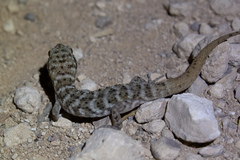
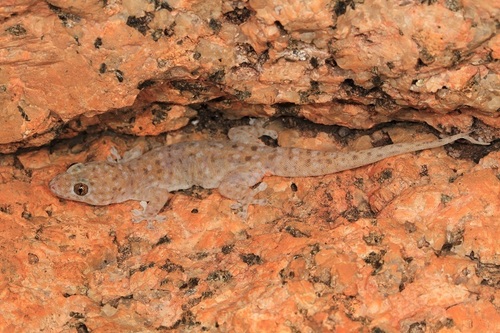
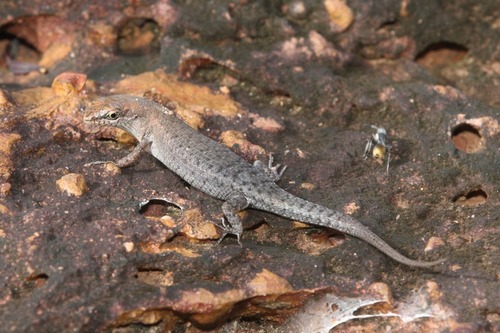
Heteronotia binoei, known commonly as Bynoe's gecko, is a species of lizard in the family Gekkonidae, and is endemic to Australia. One of the continent's least-habitat-specific geckos, it occurs naturally across much of the country, and has also established in areas where it does not occur normally, such as urban Perth, Western Australia. It is dark brown to reddish-brown, depending on the colour of the ground upon which it lives (to which it adapts for camouflaging), as well as irregular light bands with dark edges along its back.

Bynoe's gecko is one of a small number of vertebrate species that are known to reproduce by parthenogenesis, another reptilian example being the mourning gecko (Lepidodactylus lugubris) of Southeast Asia and Oceania islands (not Australia or New Zealand).

The specific name, binoei, is in honour of British naturalist Benjamin Bynoe (1803–1865), who was a naval surgeon aboard HMS Beagle with Charles Darwin. The Bynoe's gecko is a slender, long-tailed species which may grow to a total length (including tail) of 11–12 cm (4.3–4.7 in). It is covered with small scales which appear to be rough, but are soft to touch. It has slim... Wikipedia →

Global Distribution

Parks Where Found

# Park Country Daily sighting probability
1 Litchfield National Park 🇦🇺 Australia
~30%
2 Flinders Ranges National Park 🇦🇺 Australia
~30%
3 Kakadu National Park 🇦🇺 Australia
~30%
4 Cape Range 🇦🇺 Australia
~30%
5 Ningaloo Marine Park 🇦🇺 Australia
~20%

Cities Where Found

# City Country Daily sighting probability
1 Perth 🇦🇺 Australia
~10%

Before you go

What are the chances of seeing a Common Prickly Gecko in Kakadu National Park?

Possible

About 30% of wildlife watchers report a Common Prickly Gecko sighting in Kakadu National Park on a given day, based on 36 verified sightings from GBIF citizen-science data from 2019 to 2026. It is the 6th most-seen of the 54 reptiles we can rate there. Over three days the chance rises to about 70%, and over a week to about 90%, if each day is a fresh chance.

When is the best time to see a Common Prickly Gecko in Kakadu National Park?

January, May, July and September

In those months about 40% of wildlife watchers report a Common Prickly Gecko in Kakadu National Park on a given day, against under 5% in February–April and November–December, the lowest months.

What time of day is best to see a Common Prickly Gecko?

Between 7 and 10 pm

Across all the parks we cover, that three-hour window holds the most Common Prickly Gecko sightings with a recorded time, and about 6 in 10 of them come between 6 am and 6 pm: it is seen both by day and at night.

Is Kakadu National Park the best place to see a Common Prickly Gecko?

Among the best

Of the 5 parks where we can rate Common Prickly Gecko sightings, Kakadu National Park ranks 3rd at about 30%, level with the leaders once rounded. The best odds are in Litchfield National Park (Australia, about 30%) and Flinders Ranges National Park (Australia, about 30%).

Which relatives of the Common Prickly Gecko live in Kakadu National Park?

Same family: Gekkonidae

The closest relatives of the Common Prickly Gecko that you can see in Kakadu National Park (family Gekkonidae, Typical Geckos) are Common House Gecko (about 30%), House Gecko (about 20%) and Arnhem Land Spotted Dtella (about 20%), with each one's daily chance of a sighting.

Where does the Common Prickly Gecko sighting chance come from?

GBIF citizen-science records

It is estimated from how often the Common Prickly Gecko is recorded against all the reptiles logged in Kakadu National Park (36 verified sightings from 2019 to 2026), calibrated against known sighting rates. Figures are rounded to the nearest 10% because citizen-science data supports honest approximations, not decimals, and months with records from fewer than five people show "—". How it works.

← Back to Kakadu National Park