
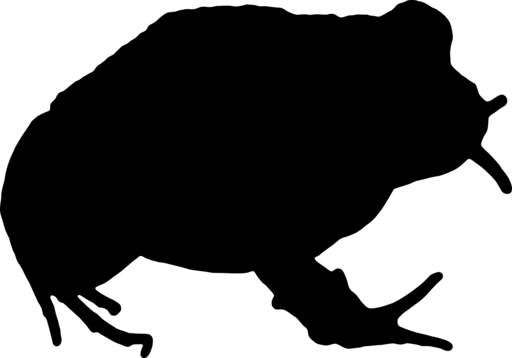
giant frog

giant frog

Ranoidea australis

Silhouette: Vijay Karthick · PhyloPic

Daily sighting probability ~20% · Possible
at Kakadu National Park

In 3 days ~40% in a week ~70%

10 Verified sightings at Kakadu National Park From 2019 to 2026
10 In 1 park
January Best month
🌙 Nocturnal When it's spotted

About the giant frog

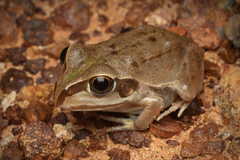
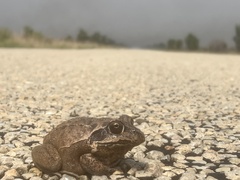
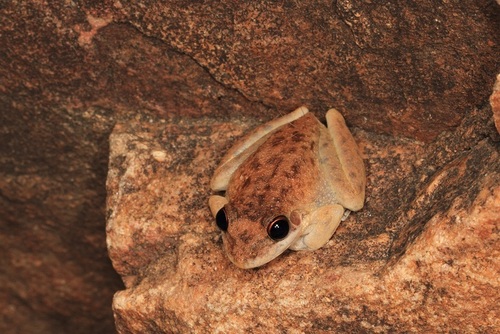
Cyclorana australis, commonly known as the giant frog, northern snapping frog, or round frog, is a burrowing species of frog native to Australia. It occurs from western Queensland through to northern Western Australia. These frogs reach up to 100 mm in length. They are variable in colour and patterning; adults range from grey to dull pink to green or more commonly brown on the dorsal surface, occasionally with darker markings. The skin on the dorsum has low warts and two longitudinal skin folds with a second pair on the flanks. The belly is white and finely granular. A dark brown streak starts from the tip of the snout and runs across the tympanum and ends over the shoulder. A similarly coloured bar runs under the eye and another runs the length of the upper jaw. The tympanum is partially covered with a skin fold and is distinct. The back of the thighs range from flesh-coloured to dark blue and the groin is a pale blue-green colour. The rear toes have a slight webbing and front toes are free from webbing.

This species inhabits floodplains, woodlands, and grasslands. During the wet season, it is commonly found during the day basking beside... Wikipedia →

Sounds

Advertisement call0:08

Australia · 2023

© Chris Harrison · XC892834 · CC BY-NC-SA 4.0

Global Distribution

Parks Where Found

# Park Country Daily sighting probability
1 Kakadu National Park 🇦🇺 Australia
~20%

More parks will be added in future updates.

Before you go

What are the chances of seeing a giant frog in Kakadu National Park?

Possible

About 20% of wildlife watchers report a giant frog sighting in Kakadu National Park on a given day, based on 10 verified sightings from GBIF citizen-science data from 2019 to 2026. It is the 8th most-seen of the 12 amphibians we can rate there. Over three days the chance rises to about 40%, and over a week to about 70%, if each day is a fresh chance.

When is the best time to see a giant frog in Kakadu National Park?

January

In that month about 50% of wildlife watchers report a giant frog in Kakadu National Park on a given day, against under 5% in March–April and June–September, the lowest months. That is one of Kakadu National Park's wettest months, with about 350 mm of rain against almost none in August.

What time of day is best to see a giant frog?

Between 7 and 10 pm

Across all the parks we cover, that three-hour window holds the most giant frog sightings with a recorded time, and about 8 in 10 of them come between 6 pm and 6 am: it is mostly seen at night.

Where else can you see a giant frog?

Only Kakadu National Park, in our data

Kakadu National Park is the only park on Wallace's Line with enough records to rate giant frog sightings: about 20% of wildlife watchers there report one on a given day.

Where does the giant frog sighting chance come from?

GBIF citizen-science records

It is estimated from how often the giant frog is recorded against all the amphibians logged in Kakadu National Park (10 verified sightings from 2019 to 2026), calibrated against known sighting rates. Figures are rounded to the nearest 10% because citizen-science data supports honest approximations, not decimals, and months with records from fewer than five people show "—". How it works.

← Back to Kakadu National Park