

Australian Rocket Frog

Australian Rocket Frog

Litoria nasuta

Silhouette: Robbi Bishop-Taylor · PhyloPic

LCLeast ConcernNTVUENCR
Daily sighting probability ~20% · Possible
at Kakadu National Park

In 3 days ~60% in a week ~90%

28 Verified sightings at Kakadu National Park From 2019 to 2026
44 In all 3 parks
March Best month
🌙 Nocturnal When it's spotted

About the Australian Rocket Frog

The striped rocket frog (Litoria nasuta), or in its native range known as the rocket frog, is a species of frog that occurs mostly in coastal areas from northern Western Australia to around Gosford in New South Wales at its southernmost point, with a disjunct population occurring further south at the Sydney suburb of Avalon. It also inhabits the southern lowlands and south east peninsula of Papua New Guinea.

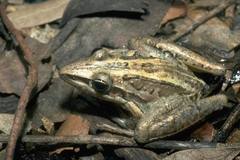
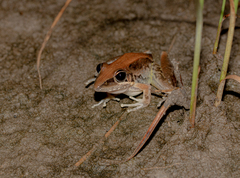
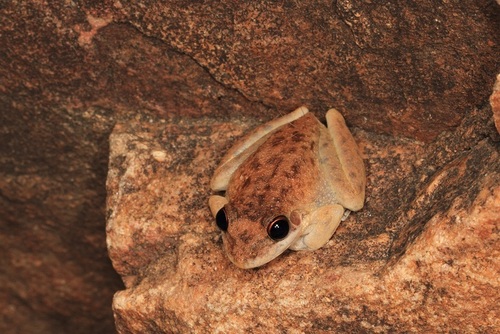
This species of frog is very variable in colour and patterning. It reaches 55 mm in length, has extremely long legs, and is very streamlined. Its dorsal surface is a shade of brown with longitudinal skin folds or warts that are darker in colour than the skin around them. The ventral surface is white and granular. A brown stripe starts from the nostril, goes across the eye, through the tympanum and ends between the armpit and groin. The tympanum is brown with a white circle surrounding it. The thighs are marked with black lines on a yellow background. Throats of breeding males are yellow. Although being a 'tree frog', this species spends most of its life as an adult on land, due to its inability to climb because of its small discs.

The striped rocket... Wikipedia →

Sounds

Advertisement call0:10

Australia · 2015

© Chris Harrison · XC892875 · CC BY-NC-SA 4.0

Advertisement call0:47

Australia · 2022

© Marc Anderson · XC883712 · CC BY-NC-ND 4.0

Recording1:21

Australia · 2022

© Tony van Kampen · iNaturalist · CC BY 4.0

Global Distribution

Parks Where Found

# Park Country Daily sighting probability
1 Litchfield National Park 🇦🇺 Australia
~20%
2 Kakadu National Park 🇦🇺 Australia
~20%
3 Daintree National Park 🇦🇺 Australia
~10%

Before you go

What are the chances of seeing an Australian Rocket Frog in Kakadu National Park?

Possible

About 20% of wildlife watchers report an Australian Rocket Frog sighting in Kakadu National Park on a given day, based on 28 verified sightings from GBIF citizen-science data from 2019 to 2026. It is the 4th most-seen of the 12 amphibians we can rate there. Over three days the chance rises to about 60%, and over a week to about 90%, if each day is a fresh chance.

When is the best time to see an Australian Rocket Frog in Kakadu National Park?

March

In that month about 50% of wildlife watchers report an Australian Rocket Frog in Kakadu National Park on a given day, against under 5% in February and December, the lowest months. That is one of Kakadu National Park's wettest months, with about 170 mm of rain against almost none in August.

What time of day is best to see an Australian Rocket Frog?

Between 7 and 10 pm

Across all the parks we cover, that three-hour window holds the most Australian Rocket Frog sightings with a recorded time, and about 9 in 10 of them come between 6 pm and 6 am: it is mostly seen at night.

Is Kakadu National Park the best place to see an Australian Rocket Frog?

Among the best

Of the 3 parks where we can rate Australian Rocket Frog sightings, Kakadu National Park ranks 2nd at about 20%, level with the leaders once rounded. The best odds are in Litchfield National Park (Australia, about 20%).

Which relatives of the Australian Rocket Frog live in Kakadu National Park?

Same genus: Litoria

The closest relatives of the Australian Rocket Frog that you can see in Kakadu National Park (genus Litoria) are Watjulum Frog (about 30%), Desert Tree Frog (about 20%) and Rockhole Frog (about 20%), with each one's daily chance of a sighting.

Where does the Australian Rocket Frog sighting chance come from?

GBIF citizen-science records

It is estimated from how often the Australian Rocket Frog is recorded against all the amphibians logged in Kakadu National Park (28 verified sightings from 2019 to 2026), calibrated against known sighting rates. Figures are rounded to the nearest 10% because citizen-science data supports honest approximations, not decimals, and months with records from fewer than five people show "—". How it works.

← Back to Kakadu National Park