Desert Tree Frog

Desert Tree Frog

Litoria rubella

Silhouette: Robbi Bishop-Taylor · PhyloPic

LCLeast ConcernNTVUENCR
Daily sighting probability ~20% · Possible
at Kakadu National Park

In 3 days ~50% in a week ~80%

22 Verified sightings at Kakadu National Park From 2019 to 2026
49 In all 3 parks
February Best month
☀️🌙 Day & Night When it's spotted

About the Desert Tree Frog

The desert tree frog (Colleeneremia rubella), or little red tree frog, is a species of tree frog native to Australia, southern New Guinea, and Timor. It is one of Australia's most widely distributed frogs, inhabiting northern Australia, including desert regions and much of temperate eastern Australia. It is one of the few Australian tree frogs to inhabit arid, tropical, and temperate climates.

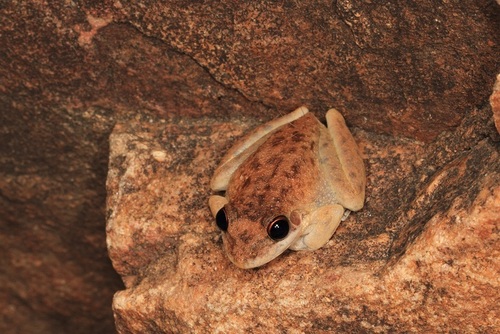
It is rotund, with a small, flat head. It has short arms and strong, short legs. Adults are 28–43 mm (1.1–1.7 in) in snout-vent length. Its ventral surface is white, and the dorsal surface ranges from light grey to dark red and has small black flecks. Adult specimens from Cooktown, Queensland, often show a pronounced metallic sheen on the dorsal surface, ranging in colour from bronze to gold. A dark band runs from the snout, across the eye, and along the flanks of the frog. The throats of males in breeding season are a dark grey colour. The groin is lemon-yellow, and the tympanum is visible. Baby frogs have an almost transparent abdomen, allowing a clear view of their abdominal organs.

The wide distribution and the large range of habitats it inhabits... Wikipedia →

Sounds

Advertisement call0:14

Australia · 2020

© Marc Anderson · XC883177 · CC BY-NC-ND 4.0

Recording0:22

Australia · 2025

© coanne · iNaturalist · CC BY-NC 4.0

Recording0:36

Australia · 2025

© j_wheeler22 · iNaturalist · CC BY-NC 4.0

Global Distribution

Parks Where Found

# Park Country Daily sighting probability
1 Flinders Ranges National Park 🇦🇺 Australia
~30%
2 Kakadu National Park 🇦🇺 Australia
~20%
3 Litchfield National Park 🇦🇺 Australia
~20%

Before you go

What are the chances of seeing a Desert Tree Frog in Kakadu National Park?

Possible

About 20% of wildlife watchers report a Desert Tree Frog sighting in Kakadu National Park on a given day, based on 22 verified sightings from GBIF citizen-science data from 2019 to 2026. It is the 5th most-seen of the 12 amphibians we can rate there. Over three days the chance rises to about 50%, and over a week to about 80%, if each day is a fresh chance.

When is the best time to see a Desert Tree Frog in Kakadu National Park?

January and February

In those months about 50% of wildlife watchers report a Desert Tree Frog in Kakadu National Park on a given day, against under 5% in August and October, the lowest months. Those are among Kakadu National Park's wettest months, with about 320 mm of rain a month against almost none in August.

What time of day is best to see a Desert Tree Frog?

Between 7 and 10 pm

Across all the parks we cover, that three-hour window holds the most Desert Tree Frog sightings with a recorded time, and about 7 in 10 of them come between 6 pm and 6 am: it is seen both by day and at night.

Is Kakadu National Park the best place to see a Desert Tree Frog?

2nd of 3

Of the 3 parks where we can rate Desert Tree Frog sightings, Kakadu National Park ranks 2nd at about 20%. The best odds are in Flinders Ranges National Park (Australia, about 30%).

Which relatives of the Desert Tree Frog live in Kakadu National Park?

Same genus: Litoria

The closest relatives of the Desert Tree Frog that you can see in Kakadu National Park (genus Litoria) are Watjulum Frog (about 30%), Australian Rocket Frog (about 20%) and Rockhole Frog (about 20%), with each one's daily chance of a sighting.

Where does the Desert Tree Frog sighting chance come from?

GBIF citizen-science records

It is estimated from how often the Desert Tree Frog is recorded against all the amphibians logged in Kakadu National Park (22 verified sightings from 2019 to 2026), calibrated against known sighting rates. Figures are rounded to the nearest 10% because citizen-science data supports honest approximations, not decimals, and months with records from fewer than five people show "—". How it works.

← Back to Kakadu National Park