Green Pygmy-Goose

Green Pygmy-Goose

Nettapus pulchellus

Silhouette: Sheatherius · PhyloPic

LCLeast ConcernNTVUENCR
Daily sighting probability ~50% · Likely
at Kakadu National Park

In 3 days ~90% in a week >90%

831 Verified sightings at Kakadu National Park From 2019 to 2026
899 In all 3 parks
December Best month
☀️ Diurnal When it's spotted

About the Green Pygmy-Goose

The green pygmy goose (Nettapus pulchellus) is a small perching duck which breeds in southern New Guinea and northern Australia. First described in 1842 by the ornithologist John Gould, its specific name is derived from diminutive of the Latin adjective pulcher "pretty". It is one of three species in the Afro-Asian genus Nettapus, an ancient and unusual group of ducks. No subspecies are recognised.

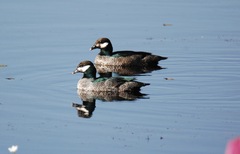
Ranging from 30 to 36 cm (12 to 14 in) in length, the green pygmy goose is one of the smallest species of duck. It has a 48 to 60 cm (19 to 23.5 in) wingspan. It has a small bill and a compact form. The breeding male has a predominantly dark green back and neck, and a dark gray crown. The cheeks are white, and the underparts are pale grey and white scalloped. The tail, primary flight feathers and primary coverts are black, while the secondary flight feathers are white. The secondary coverts are a dark iridescent green. This iridescence is lost outside of the breeding season and the plumage becomes duller. The species exhibits a degree of sexual dimorphism — the female has a barred rather than green neck but otherwise resembles the non-breeding male. Immature... Wikipedia →

Sounds

Call0:07

Australia · 2015

© Björn Söderlund · XC503285 · CC BY-NC-SA 4.0

Flight call0:13

Australia · 2022

© nick talbot · XC756131 · CC BY-NC-SA 4.0

Call0:06

Australia · 2012

© Marc Anderson · XC337661 · CC BY-NC-ND 4.0

Global Distribution

Parks Where Found

# Park Country Daily sighting probability
1 Kakadu National Park 🇦🇺 Australia
~50%
2 Litchfield National Park 🇦🇺 Australia
<5%
3 Daintree National Park 🇦🇺 Australia
<5%

Zoos & Centres Where Found

# Zoo / Centre Country
1 Ragunan Zoo 🇮🇩 Indonesia In captivity
2 Territory Wildlife Park 🇦🇺 Australia In captivity
3 Taronga Zoo 🇦🇺 Australia In captivity
4 Perth Zoo 🇦🇺 Australia In captivity
5 Bali Bird Park 🇮🇩 Indonesia In captivity

Before you go

What are the chances of seeing a Green Pygmy-Goose in Kakadu National Park?

Likely

About 50% of wildlife watchers report a Green Pygmy-Goose sighting in Kakadu National Park on a given day, based on 831 verified sightings from GBIF citizen-science data from 2019 to 2026. It is the 21st most-seen of the 186 birds we can rate there. Over three days the chance rises to about 90%, and over a week to over 90%, if each day is a fresh chance.

When is the best time to see a Green Pygmy-Goose in Kakadu National Park?

November and December

In those months about 60% of wildlife watchers report a Green Pygmy-Goose in Kakadu National Park on a given day, against about 30% in January and March, the lowest months. Those are among Kakadu National Park's wettest months, with about 180 mm of rain a month against almost none in August. February has too few records to rate.

What time of day is best to see a Green Pygmy-Goose?

Between 7 and 10 am

Across all the parks we cover, that three-hour window holds the most Green Pygmy-Goose sightings with a recorded time, and about 9 in 10 of them come between 6 am and 6 pm: it is a daytime animal.

Is Kakadu National Park the best place to see a Green Pygmy-Goose?

Yes

Of the 3 parks where we can rate Green Pygmy-Goose sightings, Kakadu National Park has the highest daily chance: about 50%. Next come Litchfield National Park (Australia, under 5%) and Daintree National Park (Australia, under 5%).

Which relatives of the Green Pygmy-Goose live in Kakadu National Park?

Same family: Anatidae

The closest relatives of the Green Pygmy-Goose that you can see in Kakadu National Park (family Anatidae, Ducks, Geese, and Swans) are Raja Shelduck (about 50%), Plumed Whistling Duck (about 40%) and Wandering Whistling Duck (about 40%), with each one's daily chance of a sighting.

Where does the Green Pygmy-Goose sighting chance come from?

GBIF citizen-science records

It is estimated from how often the Green Pygmy-Goose is recorded against all the birds logged in Kakadu National Park (831 verified sightings from 2019 to 2026), calibrated against known sighting rates. Figures are rounded to the nearest 10% because citizen-science data supports honest approximations, not decimals, and months with records from fewer than five people show "—". How it works.

← Back to Kakadu National Park