Little Curlew

Little Curlew

Numenius minutus

Silhouette: Rebecca Groom (based on Photo by Andreas Trepte) · PhyloPic

LCLeast ConcernNTVUENCR
Daily sighting probability <5% · Rare
at Kakadu National Park

In 3 days <5%

9 Verified sightings at Kakadu National Park From 2019 to 2026
9 In 1 park
November Best month
☀️ Diurnal When it's spotted

About the Little Curlew

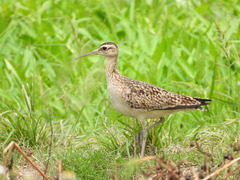
The little curlew (Numenius minutus) is a wader in the large bird family Scolopacidae. It is a very small curlew, which breeds in the far north of Siberia. It is closely related to the North American Eskimo curlew. The word "curlew" is imitative of the Eurasian curlew's call, but may have been influenced by the Old French corliu, "messenger", from courir, "to run". It was first recorded in 1377 in Langland's Piers Plowman. The genus name Numenius is from Ancient Greek noumenios, a bird mentioned by Hesychius. It is associated with the curlews because it appears to be derived from neos, "new", and mene, "moon", referring to the crescent-shaped bill. The species name is from Latin minutus, "small".

It is mainly greyish-brown, including the underwings, with a white belly, and a short, for a curlew, curved bill. It has a head pattern like a Eurasian whimbrel, with crown and superciliary stripes. The call is a repetitive whistle. It is the smallest species of curlew with an average length of 28–31 cm (11–12 in), an average wingspan of 68–71 cm (27–28 in) and an average weight of 175 grams (6.2 oz).

This is a strongly migratory species,... Wikipedia →

Sounds

Alarm call0:25

China · 2023

© Bo Shunqi 薄顺奇 · XC792063 · CC BY-NC-SA 4.0

Call0:06

China · 2014

© Tom Beeke · XC182151 · CC BY-NC-SA 4.0

Alarm call0:14

Russian Federation · 2004

© Albert Lastukhin &amp; I. Fedorov · XC676204 · CC BY-NC-ND 4.0

Global Distribution

Parks Where Found

# Park Country Daily sighting probability
1 Kakadu National Park 🇦🇺 Australia
<5%

More parks will be added in future updates.

Cities Where Found

# City Country Daily sighting probability
1 Suzhou 🇨🇳 China
<5%

Before you go

What are the chances of seeing a Little Curlew in Kakadu National Park?

Rare

Under 5% of wildlife watchers report a Little Curlew sighting in Kakadu National Park on a given day, based on 9 verified sightings from GBIF citizen-science data from 2019 to 2026. It is the 169th most-seen of the 186 birds we can rate there. Over three days the chance rises to under 5%, if each day is a fresh chance.

When is the best time to see a Little Curlew in Kakadu National Park?

November

In that month about 10% of wildlife watchers report a Little Curlew in Kakadu National Park on a given day, against under 5% in March–October and December–January, the lowest months. February has too few records to rate.

What time of day is best to see a Little Curlew?

Between noon and 3 pm

Across all the parks we cover, that three-hour window holds the most Little Curlew sightings with a recorded time, and about 9 in 10 of them come between 6 am and 6 pm: it is a daytime animal.

Where else can you see a Little Curlew?

Only Kakadu National Park, in our data

Kakadu National Park is the only park on Wallace's Line with enough records to rate Little Curlew sightings: under 5% of wildlife watchers there report one on a given day.

Where does the Little Curlew sighting chance come from?

GBIF citizen-science records

It is estimated from how often the Little Curlew is recorded against all the birds logged in Kakadu National Park (9 verified sightings from 2019 to 2026), calibrated against known sighting rates. Figures are rounded to the nearest 10% because citizen-science data supports honest approximations, not decimals, and months with records from fewer than five people show "—". How it works.

← Back to Kakadu National Park