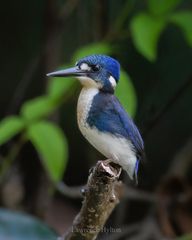
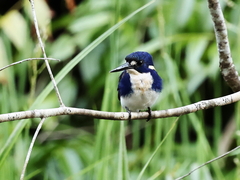
Little Kingfisher

Little Kingfisher

Ceyx pusillus

Silhouette: Rachael Joakim · PhyloPic

LCLeast ConcernNTVUENCR
Daily sighting probability ~10% · With luck
at Kakadu National Park

In 3 days ~20% in a week ~30%

84 Verified sightings at Kakadu National Park From 2019 to 2026
506 In all 3 parks
November Best month
☀️ Diurnal When it's spotted

About the Little Kingfisher

The little kingfisher (Ceyx pusillus) is a species of kingfisher in the subfamily Alcedininae. The first formal description of the little kingfisher was by the Dutch zoologist Coenraad Jacob Temminck in 1836 under the current binomial name Ceyx pusilla. The generic name Ceyx derives from Ancient Greek: Κήϋξ, romanized: Kēüx, a mythological seabird that was drowned at sea and then found washed ashore by his wife Alcyone, after which both were metamorphosed into kingfishers. The specific epithet pusillus is the Latin for 'tiny' or 'very small'.

There are nine recognised subspecies of the little kingfisher (see box at right). The nominate subspecies Ceyx pusillus pusillus is found in Aru Island and Kai Island of Indonesia, southern New Guinea, the Torres Strait Islands, and possibly the tip of Cape York in Queensland. The subspecies C. p. ramsayi is found in coastal Northern Territory and western Cape York; it is a paler blue, with blue patches extending into the sides of the breast. Subspecies C. p. halli is found in coastal north-eastern Queensland from Endeavour River to Keppel Bay; it has small blue patches extending into the sides of the breast. The subspecies C... Wikipedia →

Sounds

Flight call0:34

Australia · 2023

© James Lambert · XC787705 · CC BY-NC-ND 4.0

Call0:08

Indonesia · 2019

© Marc Anderson · XC530368 · CC BY-NC-ND 4.0

Global Distribution

Parks Where Found

# Park Country Daily sighting probability
1 Daintree National Park 🇦🇺 Australia
~20%
2 Kakadu National Park 🇦🇺 Australia
~10%
3 Raja Ampat 🇮🇩 Indonesia
<5%

Before you go

What are the chances of seeing a Little Kingfisher in Kakadu National Park?

With luck

About 10% of wildlife watchers report a Little Kingfisher sighting in Kakadu National Park on a given day, based on 84 verified sightings from GBIF citizen-science data from 2019 to 2026. It is the 117th most-seen of the 186 birds we can rate there. Over three days the chance rises to about 20%, and over a week to about 30%, if each day is a fresh chance.

When is the best time to see a Little Kingfisher in Kakadu National Park?

November

In that month about 20% of wildlife watchers report a Little Kingfisher in Kakadu National Park on a given day, against under 5% in March–August and December, the lowest months. February has too few records to rate.

What time of day is best to see a Little Kingfisher?

Between 7 and 10 am

Across all the parks we cover, that three-hour window holds the most Little Kingfisher sightings with a recorded time, and about 9 in 10 of them come between 6 am and 6 pm: it is a daytime animal.

Is Kakadu National Park the best place to see a Little Kingfisher?

2nd of 3

Of the 3 parks where we can rate Little Kingfisher sightings, Kakadu National Park ranks 2nd at about 10%. The best odds are in Daintree National Park (Australia, about 20%).

Where does the Little Kingfisher sighting chance come from?

GBIF citizen-science records

It is estimated from how often the Little Kingfisher is recorded against all the birds logged in Kakadu National Park (84 verified sightings from 2019 to 2026), calibrated against known sighting rates. Figures are rounded to the nearest 10% because citizen-science data supports honest approximations, not decimals, and months with records from fewer than five people show "—". How it works.

← Back to Kakadu National Park