Rufous Owl

Rufous Owl

Ninox rufa

Silhouette: Rachel T Mason · PhyloPic

LCLeast ConcernNTVUENCR
Daily sighting probability <5% · Rare
at Kakadu National Park

In 3 days <5% in a week ~10%

17 Verified sightings at Kakadu National Park From 2019 to 2026
29 In all 2 parks
July Best month
☀️🌙 Day & Night When it's spotted

About the Rufous Owl

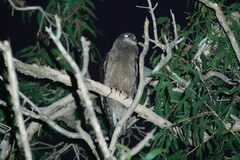
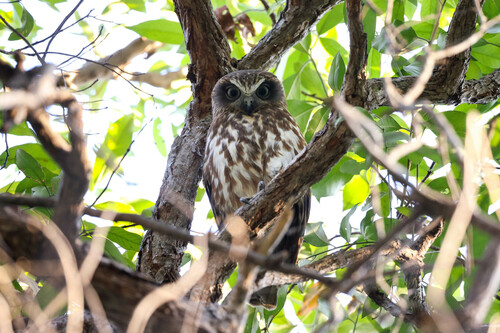
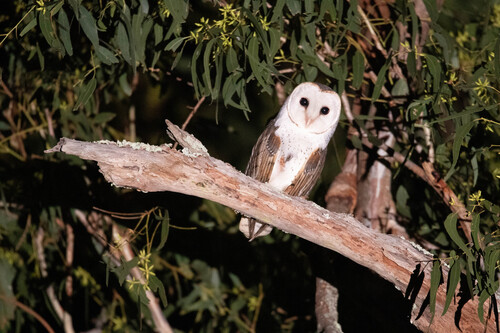
The rufous owl (Ninox rufa), also known as the rufous boobook, is a species of owl in the family Strigidae. It was described in 1846 by John Gould, an English ornithologist. Its common name reflects the rufous-coloured feathers that these owls are covered with in adulthood. While it is uncommon, the species has a wide range, including Australia, Indonesia, and Papua New Guinea.

The rufous owl is a large owl species, ranging in weight from 700 to 1,700 g (25 to 60 oz), depending on sex and age. It is only slightly smaller than the largest owl in Australia, the powerful owl (Ninox strenua), which typically weighs between 1,050 and 1,700 g (37 and 60 oz). The rufous owl is a generalist nocturnal predator and generally solitary. It is seldom aggressive to humans except in situations in which it feels its nest or offspring are threatened.

The rufous owl is a large bird, often growing to 46–57 cm (18–22 in) in length, with a wingspan of 100 to 120 cm (39 to 47 in). Females typically weigh 700–1,050 g (25–37 oz), while the males typically weigh 1,050–1,300 g (37–46 oz). Both sexes have relatively small heads compared to their body and tail, but the head of the male is... Wikipedia →

Sounds

Song0:51

Australia · 2025

© Peter Boesman · XC1066764 · CC BY-NC-ND 4.0

Begging call1:21

Australia · 2020

© András Schmidt · XC620280 · CC BY-NC-SA 4.0

Call0:14

Indonesia · 2019

© Marc Anderson · XC498011 · CC BY-NC-ND 4.0

Global Distribution

Parks Where Found

# Park Country Daily sighting probability
1 Kakadu National Park 🇦🇺 Australia
<5%
2 Daintree National Park 🇦🇺 Australia
<5%

Zoos & Centres Where Found

# Zoo / Centre Country
1 Territory Wildlife Park 🇦🇺 Australia In captivity
2 Featherdale Sydney Wildlife Park 🇦🇺 Australia In captivity

Before you go

What are the chances of seeing a Rufous Owl in Kakadu National Park?

Rare

Under 5% of wildlife watchers report a Rufous Owl sighting in Kakadu National Park on a given day, based on 17 verified sightings from GBIF citizen-science data from 2019 to 2026. It is the 164th most-seen of the 186 birds we can rate there. Over three days the chance rises to under 5%, and over a week to about 10%, if each day is a fresh chance.

When is the best time to see a Rufous Owl in Kakadu National Park?

Any time of year

In every month with enough records, under 5% of wildlife watchers report a Rufous Owl in Kakadu National Park on a given day, so our monthly data shows no clear season. February has too few records to rate.

What time of day is best to see a Rufous Owl?

Between 9 am and noon

Across all the parks we cover, that three-hour window holds the most Rufous Owl sightings with a recorded time, and about 7 in 10 of them come between 6 am and 6 pm: it is seen both by day and at night.

Is Kakadu National Park the best place to see a Rufous Owl?

Yes

Of the 2 parks where we can rate Rufous Owl sightings, Kakadu National Park has the highest daily chance: under 5%. Next come Daintree National Park (Australia, under 5%).

Where does the Rufous Owl sighting chance come from?

GBIF citizen-science records

It is estimated from how often the Rufous Owl is recorded against all the birds logged in Kakadu National Park (17 verified sightings from 2019 to 2026), calibrated against known sighting rates. Figures are rounded to the nearest 10% because citizen-science data supports honest approximations, not decimals, and months with records from fewer than five people show "—". How it works.

← Back to Kakadu National Park