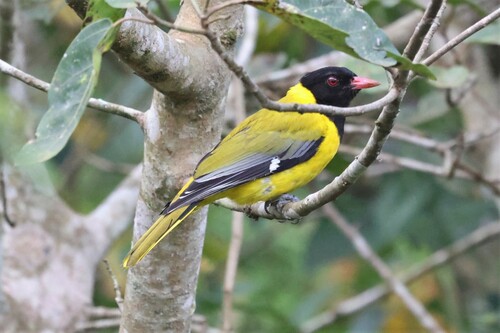
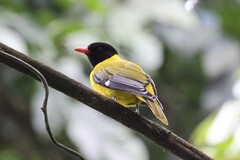
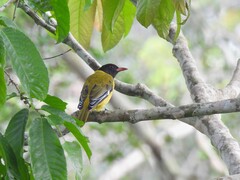
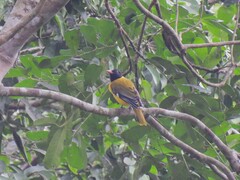
Western Black-headed Oriole

Western Black-headed Oriole

Oriolus brachyrynchus

Silhouette: L. Shyamal · PhyloPic

LCLeast ConcernNTVUENCR
Daily sighting probability ~20% · Possible
at Kakum National Park

In 3 days ~40% in a week ~80%

102 Verified sightings at Kakum National Park From 2019 to 2026
708 In all 7 parks
May Best month
☀️ Diurnal When it's spotted

About the Western Black-headed Oriole

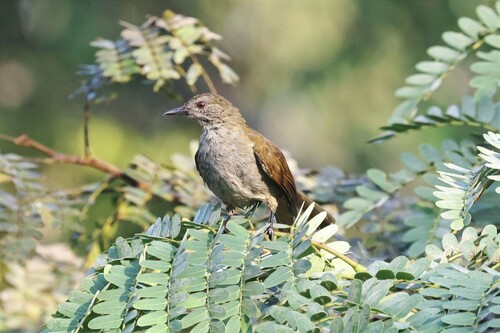
The western oriole (Oriolus brachyrynchus), or western black-headed oriole, is a species of bird in the family Oriolidae that is native to Africa. The adult upperparts are yellow-olive, and the underparts are yellow in colour. It is rated as a species of least concern on the International Union for Conservation of Nature Red List of Endangered Species.

The western oriole was first described in 1837 by the English ornithologist William Swainson. Alternate names for the western oriole include the black-headed oriole (not to be confused with another species of the same name, Oriolus larvatus) and greenish-backed oriole. Two subspecies are recognized:

According to the genetic data, the western oriole and the green-headed oriole (Oriolus chlorocephalus) are sister species. The western oriole measures 21 centimetres (8.3 in) in length, and weighs 42 to 57 g (1.5 to 2...

Wikipedia →

Sounds

Call0:10

Congo (Democratic Republic) · 2025

© Deville Tanguy · XC1006926 · CC BY-NC-SA 4.0

Song0:37

Gabon · 2022

© Étienne Leroy · XC762102 · CC BY-NC-SA 4.0

Recording1:29

Gabon · 2023

© BurBenj · XC1120058 · CC BY-NC-SA 4.0

Global Distribution

Parks Where Found

# Park Country Daily sighting probability
1 Semuliki National Park 🇺🇬 Uganda
~40%
2 Kibale National Park 🇺🇬 Uganda
~20%
3 Taï National Park 🇨🇮 Ivory Coast
~20%
4 Kakum National Park 🇬🇭 Ghana
~20%
5 Kidepo Valley National Park 🇺🇬 Uganda
<5%
6 Bwindi Impenetrable National Park 🇺🇬 Uganda
<5%
7 Murchison Falls National Park 🇺🇬 Uganda
<5%

Before you go

What are the chances of seeing a Western Black-headed Oriole in Kakum National Park?

Possible

About 20% of wildlife watchers report a Western Black-headed Oriole sighting in Kakum National Park on a given day, based on 102 verified sightings from GBIF citizen-science data from 2019 to 2026. It is the 104th most-seen of the 250 birds we can rate there. Over three days the chance rises to about 40%, and over a week to about 80%, if each day is a fresh chance.

When is the best time to see a Western Black-headed Oriole in Kakum National Park?

May

In that month about 30% of wildlife watchers report a Western Black-headed Oriole in Kakum National Park on a given day, against about 10% in February–March and December, the lowest months. That is one of Kakum National Park's wettest months, with about 220 mm of rain against 35 mm in January.

What time of day is best to see a Western Black-headed Oriole?

Between 7 and 10 am

Across all the parks we cover, that three-hour window holds the most Western Black-headed Oriole sightings with a recorded time, and nearly all of them come between 6 am and 6 pm: it is a daytime animal.

Is Kakum National Park the best place to see a Western Black-headed Oriole?

4th of 7

Of the 7 parks where we can rate Western Black-headed Oriole sightings, Kakum National Park ranks 4th at about 20%. The best odds are in Semuliki National Park (Uganda, about 40%), Kibale National Park (Uganda, about 20%) and Taï National Park (Ivory Coast, about 20%).

Where does the Western Black-headed Oriole sighting chance come from?

GBIF citizen-science records

It is estimated from how often the Western Black-headed Oriole is recorded against all the birds logged in Kakum National Park (102 verified sightings from 2019 to 2026), calibrated against known sighting rates. Figures are rounded to the nearest 10% because citizen-science data supports honest approximations, not decimals, and months with records from fewer than five people show "—". How it works.

← Back to Kakum National Park