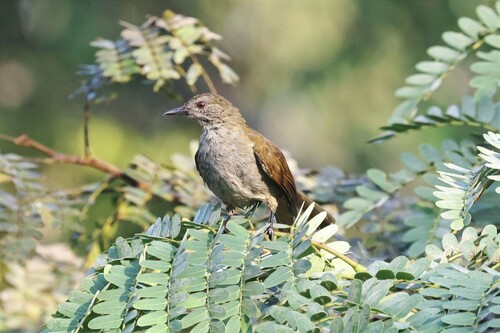
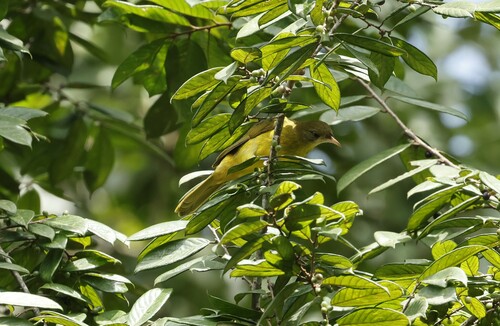
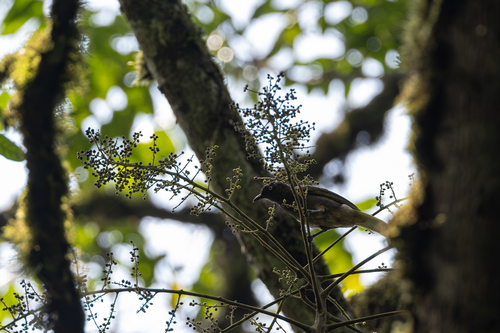
Little Greenbul

Little Greenbul

Eurillas virens

Silhouette: PhyloPic

LCLeast ConcernNTVUENCR
Daily sighting probability ~50% · Likely
at Kakum National Park

In 3 days ~90% in a week >90%

265 Verified sightings at Kakum National Park From 2019 to 2026
2,235 In all 11 parks
August Best month
☀️ Diurnal When it's spotted

About the Little Greenbul

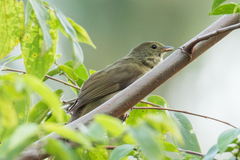
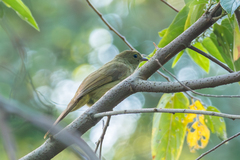
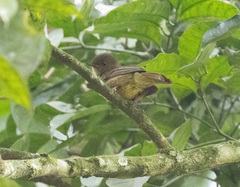
The little greenbul (Eurillas virens) is a species of the bulbul family of passerine birds. It is found in many parts of sub-Saharan Africa. The little greenbul was originally described in the genus Andropadus and was re-classified to the genus Eurillas in 2010. Alternatively, some authorities classify the little greenbul in the genus Pycnonotus.

Includes Hall's greenbul (Eurillas virens [hallae]), named after the British ornithologist Pat Hall and which is only known from a single specimen taken in the Democratic Republic of the Congo. Hall's greenbul may be a melanistic form of E. v. zombensis...

Wikipedia →

Sounds

Alarm call0:40

Congo (Democratic Republic) · 2025

© Deville Tanguy · XC1006990 · CC BY-NC-SA 4.0

Song0:26

Zambia · 2023

© Dries Van de Loock · XC854458 · CC BY-NC-ND 4.0

Call0:23

Uganda · 2022

© Peter Boesman · XC739687 · CC BY-NC-ND 4.0

Global Distribution

Parks Where Found

# Park Country Daily sighting probability
1 Semuliki National Park 🇺🇬 Uganda
~50%
2 Kibale National Park 🇺🇬 Uganda
~50%
3 Kakum National Park 🇬🇭 Ghana
~50%
4 Bwindi Impenetrable National Park 🇺🇬 Uganda
~30%
5 Odzala-Kokoua National Park 🇨🇬 Republic of the Congo
~30%
6 Taï National Park 🇨🇮 Ivory Coast
~20%
7 Arusha National Park 🇹🇿 Tanzania
~10%
8 Virunga National Park 🇨🇩 Democratic Republic of the Congo
<5%
9 Queen Elizabeth National Park 🇺🇬 Uganda
<5%
10 Lake Mburo National Park 🇺🇬 Uganda
<5%
11 Murchison Falls National Park 🇺🇬 Uganda
<5%

Cities Where Found

# City Country Daily sighting probability
1 Kampala 🇺🇬 Uganda
~20%
2 Yaoundé 🇨🇲 Cameroon
~10%
3 Brazzaville 🇨🇬 Republic of the Congo
~10%
4 Serrekunda 🇬🇲 Gambia
~10%
5 Freetown 🇸🇱 Sierra Leone
~10%
6 Accra 🇬🇭 Ghana
<5%

Before you go

What are the chances of seeing a Little Greenbul in Kakum National Park?

Likely

About 50% of wildlife watchers report a Little Greenbul sighting in Kakum National Park on a given day, based on 265 verified sightings from GBIF citizen-science data from 2019 to 2026. It is the 15th most-seen of the 250 birds we can rate there. Over three days the chance rises to about 90%, and over a week to over 90%, if each day is a fresh chance.

When is the best time to see a Little Greenbul in Kakum National Park?

May–August and December

In those months about 60% of wildlife watchers report a Little Greenbul in Kakum National Park on a given day, against about 30% in February, the lowest month.

What time of day is best to see a Little Greenbul?

Between 7 and 10 am

Across all the parks we cover, that three-hour window holds the most Little Greenbul sightings with a recorded time, and about 8 in 10 of them come between 6 am and 6 pm: it is a daytime animal.

Is Kakum National Park the best place to see a Little Greenbul?

Among the best

Of the 11 parks where we can rate Little Greenbul sightings, Kakum National Park ranks 3rd at about 50%, level with the leaders once rounded. The best odds are in Semuliki National Park (Uganda, about 50%) and Kibale National Park (Uganda, about 50%). All parks ranked.

Which relatives of the Little Greenbul live in Kakum National Park?

Same genus: Eurillas

The closest relatives of the Little Greenbul that you can see in Kakum National Park (genus Eurillas, Small Greenbuls) are Yellow-whiskered Greenbul (about 30%), Gray Greenbul (about 30%) and Plain Greenbul (about 20%), with each one's daily chance of a sighting.

Where does the Little Greenbul sighting chance come from?

GBIF citizen-science records

It is estimated from how often the Little Greenbul is recorded against all the birds logged in Kakum National Park (265 verified sightings from 2019 to 2026), calibrated against known sighting rates. Figures are rounded to the nearest 10% because citizen-science data supports honest approximations, not decimals, and months with records from fewer than five people show "—". How it works.

← Back to Kakum National Park