Large Oakblue

Large Oakblue

Arhopala amantes

Daily sighting probability ~20% · Possible
at Kanha National Park

In 3 days ~40% in a week ~70%

6 Verified sightings at Kanha National Park From 2019 to 2026
6 In 1 park
October Best month
☀️ Diurnal When it's spotted

About the Large Oakblue

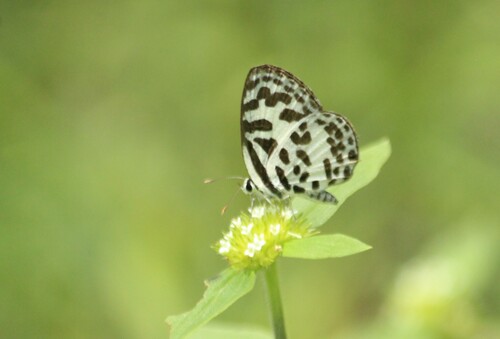
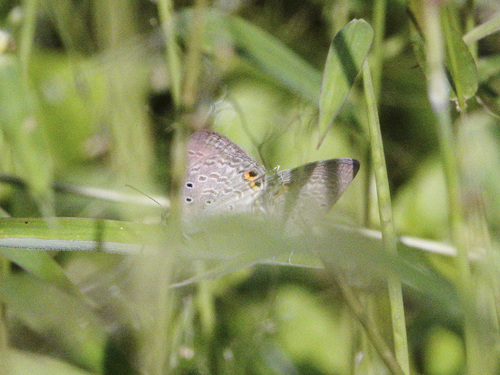
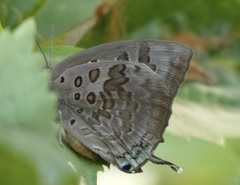
Arhopala amantes, the large oakblue, is a species of lycaenid or blue butterfly found in Asia.(India, Ceylon, Burma, Thailand) Arhopala amantes is the largest lycaenid. It is surprisingly inconspicuous on the wing despite the brilliant metallic blue markings on its upperside. In the female, the blue scales are restricted to the centre and basal part of both wings; the outer margins are marked by a wide black band.

Male. Upperside dark purple-blue, shining in certain lights, coloured somewhat like Arhopala centaurus pirithous, but brighter blue, costal and outer marginal line black. Cilia black, tails black, a rather long tail at the end of vein 2, slight projections at the ends of all the other veins of the hindwing, more pronounced at the ends of veins 1 and 3 than at the ends of the others. Underside grey suffused with pinkish-brown, the lower portion of forewing pale, the hindwing darker than the forewing, but varying much in shade of colour, spots and bands chocolate-brown. Forewing with a small spot in the cell near the base, a larger one in the middle, four conjoined spots at the end, the third from the upper end minute and sometimes absent, a discal band of... Wikipedia →
Global Distribution

Parks Where Found

# Park Country Daily sighting probability
1 Kanha National Park 🇮🇳 India
~20%

More parks will be added in future updates.

Cities Where Found

# City Country Daily sighting probability
1 Dehradun 🇮🇳 India
~10%
2 Bengaluru 🇮🇳 India
~10%
3 Kochi 🇮🇳 India
<5%
4 Chennai 🇮🇳 India
<5%
5 Mumbai 🇮🇳 India
<5%

Before you go

What are the chances of seeing a Large Oakblue in Kanha National Park?

Possible

About 20% of wildlife watchers report a Large Oakblue sighting in Kanha National Park on a given day, based on 6 verified sightings from GBIF citizen-science data from 2019 to 2026. It is the 67th most-seen of the 106 insects we can rate there. Over three days the chance rises to about 40%, and over a week to about 70%, if each day is a fresh chance.

When is the best time to see a Large Oakblue in Kanha National Park?

May and October

In those months about 30% of wildlife watchers report a Large Oakblue in Kanha National Park on a given day, against under 5% in January, March and June–September, the lowest months. Those are among Kanha National Park's driest months, with about 35 mm of rain a month against 430 mm in July.

What time of day is best to see a Large Oakblue?

Between 10 am and 1 pm

Across all the parks we cover, that three-hour window holds the most Large Oakblue sightings with a recorded time, and about 8 in 10 of them come between 6 am and 6 pm: it is a daytime animal.

Where else can you see a Large Oakblue?

Only Kanha National Park, in our data

Kanha National Park is the only park on Wallace's Line with enough records to rate Large Oakblue sightings: about 20% of wildlife watchers there report one on a given day.

Which relatives of the Large Oakblue live in Kanha National Park?

Same family: Lycaenidae

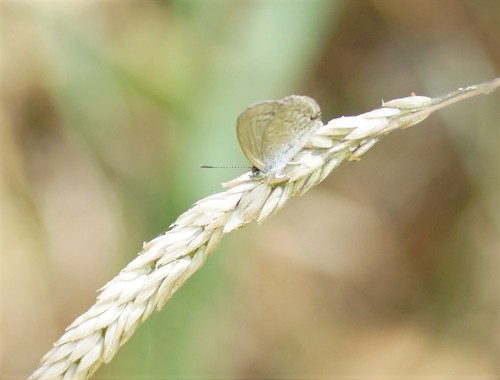
The closest relatives of the Large Oakblue that you can see in Kanha National Park (family Lycaenidae, Gossamer-winged Butterflies) are Common Pierrot (about 20%), Gram Blue (about 20%) and Lesser Grass Blue (about 10%), with each one's daily chance of a sighting.

Where does the Large Oakblue sighting chance come from?

GBIF citizen-science records

It is estimated from how often the Large Oakblue is recorded against all the insects logged in Kanha National Park (6 verified sightings from 2019 to 2026), calibrated against known sighting rates. Figures are rounded to the nearest 10% because citizen-science data supports honest approximations, not decimals, and months with records from fewer than five people show "—". How it works.

← Back to Kanha National Park