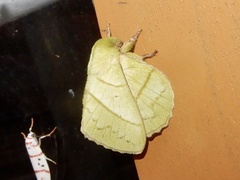
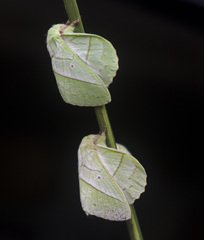
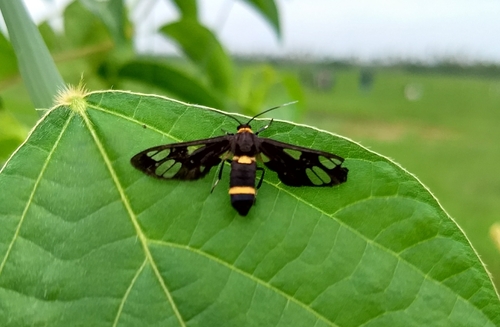
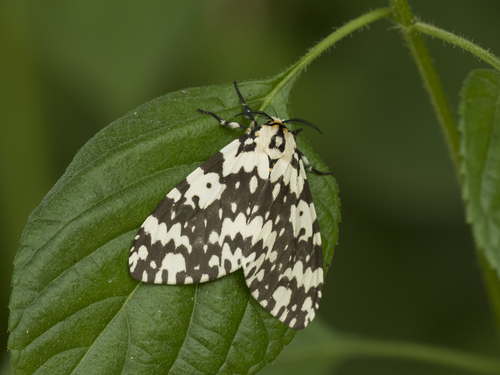
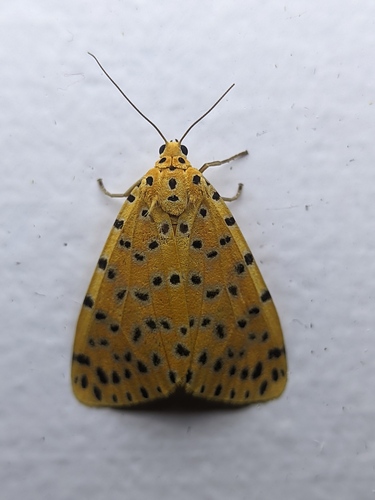
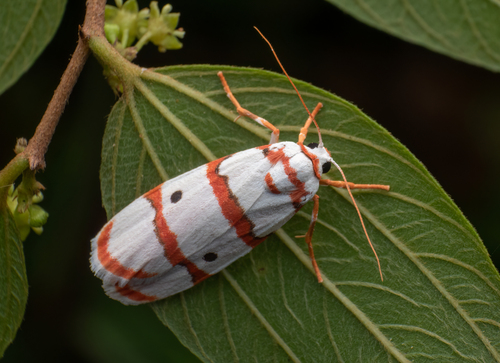
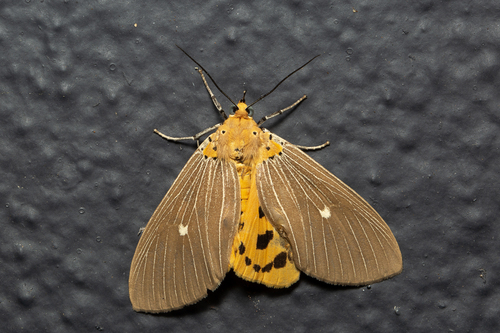
Rose Myrtle Lappet Moth

Rose Myrtle Lappet Moth

Trabala vishnou

Daily sighting probability ~20% · Possible
at Kanha National Park

In 3 days ~50% in a week ~80%

8 Verified sightings at Kanha National Park From 2019 to 2026
44 In all 2 parks
March Best month
☀️ Diurnal When it's spotted

About the Rose Myrtle Lappet Moth

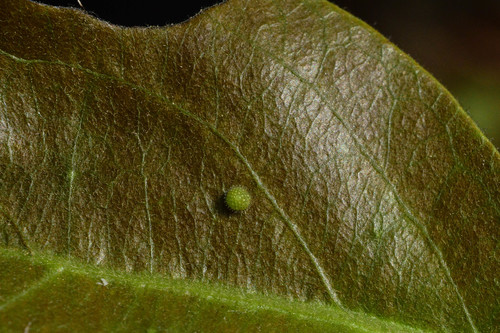
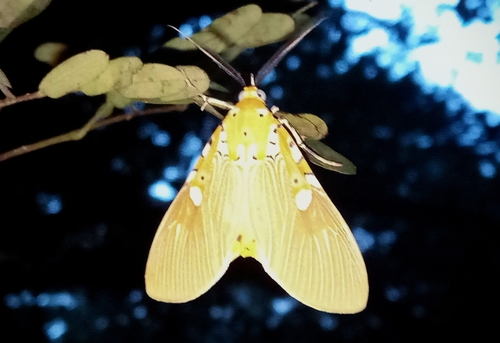
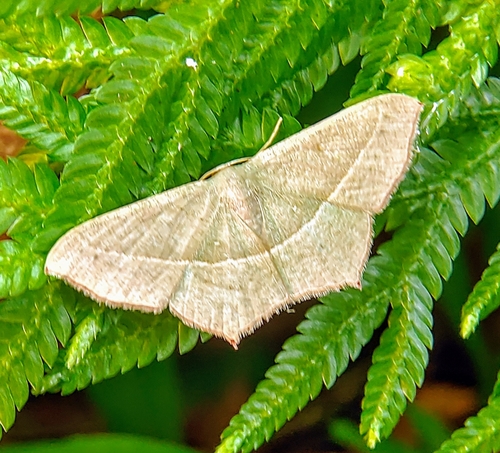
Trabala vishnou, the rose-myrtle lappet moth, is a species of moth in the family Lasiocampidae. It is found in southern Asia, including Pakistan, India, Bangladesh, Thailand, Sri Lanka, Myanmar, China, Japan, Taiwan, Vietnam, and Indonesia. Four subspecies are recognized.

The wingspan is about 67 mm for females and 47 for males. The body colour of the male is apple green. Antennae ochreous brown. The disk of the forewing and the inner margin of the hindwing are whitish. Forewings with a faint pale antemedial line curved below the costa. There is a dark speck at end of cell, and a pale straight oblique postmedial line which becomes medial on the hindwing. Both wings have a series of small submarginal dark spots. The female is yellowish green, which fades to ochreous. Lines and spots of both wings are enlarged and blackish. The spot at the end of the cell of the forewing is large, conspicuous and irrorated (sprinkled) with black scales, and sometimes centered with grey. A reddish-brown patch thickly irrorated with black occupying whole medial inner area from median nervure to inner margin. Cilia of wings are blackish.

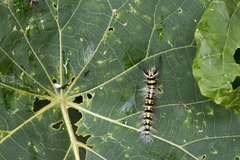
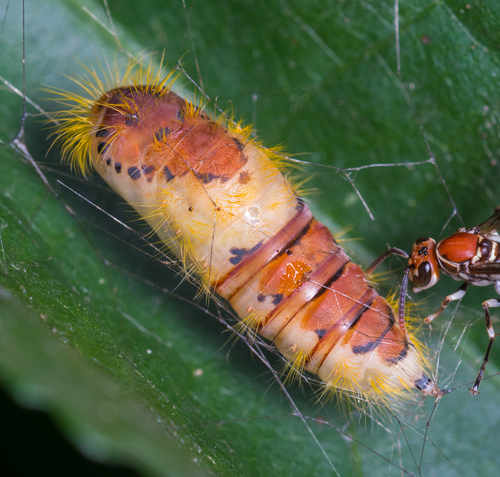
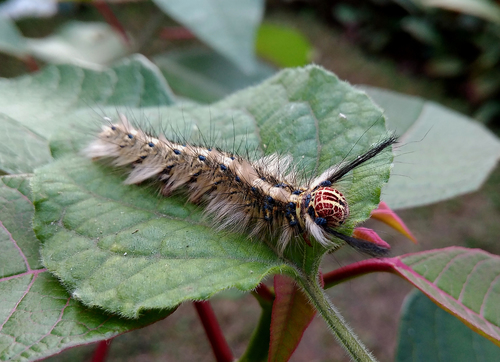
The larva has a yellow... Wikipedia →
Global Distribution

Parks Where Found

# Park Country Daily sighting probability
1 Taroko National Park 🇹🇼 Taiwan
~20%
2 Kanha National Park 🇮🇳 India
~20%

Cities Where Found

# City Country Daily sighting probability
1 Taipei 🇹🇼 Taiwan
~30%
2 Tainan 🇹🇼 Taiwan
~20%
3 Taichung 🇹🇼 Taiwan
~20%
4 Kaohsiung 🇹🇼 Taiwan
~10%
5 Pune 🇮🇳 India
<5%
6 Mumbai 🇮🇳 India
<5%
7 Kochi 🇮🇳 India
<5%

Before you go

What are the chances of seeing a Rose Myrtle Lappet Moth in Kanha National Park?

Possible

About 20% of wildlife watchers report a Rose Myrtle Lappet Moth sighting in Kanha National Park on a given day, based on 8 verified sightings from GBIF citizen-science data from 2019 to 2026. It is the 50th most-seen of the 106 insects we can rate there. Over three days the chance rises to about 50%, and over a week to about 80%, if each day is a fresh chance.

When is the best time to see a Rose Myrtle Lappet Moth in Kanha National Park?

March

In that month about 40% of wildlife watchers report a Rose Myrtle Lappet Moth in Kanha National Park on a given day, against under 5% in April to November, the lowest months. That is one of Kanha National Park's driest months, with about 30 mm of rain against 430 mm in July.

What time of day is best to see a Rose Myrtle Lappet Moth?

Between 7 and 10 am

Across all the parks we cover, that three-hour window holds the most Rose Myrtle Lappet Moth sightings with a recorded time, and about 7 in 10 of them come between 6 am and 6 pm: it is a daytime animal.

Is Kanha National Park the best place to see a Rose Myrtle Lappet Moth?

Among the best

Of the 2 parks where we can rate Rose Myrtle Lappet Moth sightings, Kanha National Park ranks 2nd at about 20%, level with the leaders once rounded. The best odds are in Taroko National Park (Taiwan, about 20%).

Which relatives of the Rose Myrtle Lappet Moth live in Kanha National Park?

Same order: Lepidoptera

The closest relatives of the Rose Myrtle Lappet Moth that you can see in Kanha National Park (order Lepidoptera, Butterflies and Moths) are Handmaiden Moth (about 50%), Hawaiian Beet Webworm Moth (about 40%) and Lymantria marginata (about 40%), with each one's daily chance of a sighting.

Where does the Rose Myrtle Lappet Moth sighting chance come from?

GBIF citizen-science records

It is estimated from how often the Rose Myrtle Lappet Moth is recorded against all the insects logged in Kanha National Park (8 verified sightings from 2019 to 2026), calibrated against known sighting rates. Figures are rounded to the nearest 10% because citizen-science data supports honest approximations, not decimals, and months with records from fewer than five people show "—". How it works.

← Back to Kanha National Park