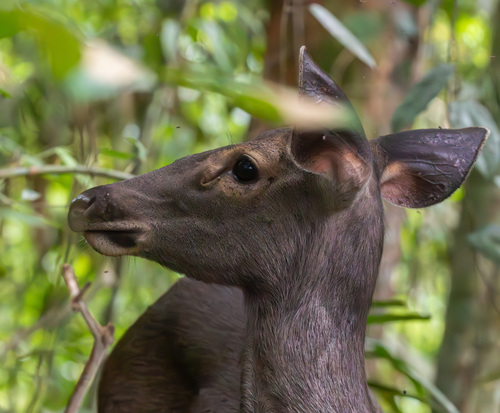
Blackbuck

Blackbuck

Antilope cervicapra

Silhouette: Kai Caspar · PhyloPic

LCLeast ConcernNTVUENCR
Daily sighting probability ~30% · Possible
at Keoladeo National Park

In 3 days ~60% in a week ~90%

9 Verified sightings at Keoladeo National Park From 2019 to 2026
50 In all 4 parks
August Best month
☀️ Diurnal When it's spotted

About the Blackbuck

The blackbuck (Antilope cervicapra), also known as the Indian antelope, is a medium-sized antelope native to India and Nepal. It inhabits grassy plains and lightly forested areas with perennial water sources. It stands up to 74 to 84 cm (29 to 33 in) high at the shoulder. Males weigh 20–57 kg (44–126 lb), with an average of 38 kg (84 lb). Females are lighter, weighing 20–33 kg (44–73 lb) or 27 kg (60 lb) on average. Males have 35–75 cm (14–30 in) long corkscrew horns, and females occasionally develop horns, as well. The white fur on the chin and around the eyes is in sharp contrast with the black stripes on the face. Both sexes' coats feature a two-tone colouration; in males, the majority of the body is dark brown to black, with white circles around the eyes, white ears and tail, and the belly, lower jaw, and inner legs also white. Females and juveniles are yellowish-fawn to tan and display the same white areas, only with more of a beige tone than the males. Females also feature a more pronounced horizontal white side-stripe, starting around the shoulder and ending at the rump. The blackbuck is the sole living member of the genus Antilope and was described by Carl Linnaeus in 1758. Two subspecies are recognized.

The blackbuck is active mainly during the day. It forms three types of small groups: female, male, and young bachelor herds. Males often adopt lekking as a strategy to garner females for mating. While other males are not allowed into these territories, females often visit these places to forage. The male can thus attempt mating with her. The blackbuck is an herbivore and grazes on low grasses, occasionally browsing as well. Females become sexually mature at the age of eight months, but mate no earlier than two years of age. Males mature later, at 1.5 years. Mating takes place throughout the year. Gestation is typically six months long, after which a single calf is born. The lifespan is typically 10 to 15 years.

The antelope is native to and occurs mainly in India, while it is locally extinct in Pakistan and Bangladesh. It was formerly widespread; today small and scattered herds are largely confined to protected areas. During the 20th century, blackbuck numbers declined sharply due to excessive hunting, deforestation, and habitat destruction.

The blackbuck has been introduced in Argentina, Australia and the United States, primarily on hunting ranches. In Argentina, the population is surviving well. In India, hunting of blackbuck is prohibited under Schedule I of the Wildlife Protection Act of 1972. Wikipedia →

Global Distribution

Parks Where Found

# Park Country Daily sighting probability
1 Kanha National Park 🇮🇳 India
~50%
2 Mudumalai National Park 🇮🇳 India
~30%
3 Satpura National Park 🇮🇳 India
~30%
4 Keoladeo National Park 🇮🇳 India
~30%

Cities Where Found

# City Country Daily sighting probability
1 Chennai 🇮🇳 India
~20%
2 Hyderabad 🇮🇳 India
~10%

Zoos & Centres Where Found

# Zoo / Centre Country
1 Disney's Animal Kingdom 🇺🇸 United States In captivity
2 ZooParc de Beauval 🇫🇷 France In captivity
3 Zürich Zoo 🇨🇭 Switzerland In captivity
4 Monarto Zoo 🇦🇺 Australia In captivity
5 Taronga Western Plains Zoo 🇦🇺 Australia In captivity
6 Bioparque Estrella 🇲🇽 Mexico In captivity
7 Sri Venkateswara Zoological Park 🇮🇳 India In captivity
8 Natural Bridge Wildlife Ranch 🇺🇸 United States In captivity
9 San Diego Zoo Safari Park 🇺🇸 United States In captivity
10 Lion Country Safari 🇺🇸 United States In captivity
11 Bioparque Estrella 🇲🇽 Mexico In captivity
12 Werribee Open Range Zoo 🇦🇺 Australia In captivity
13 Taman Safari Indonesia 🇮🇩 Indonesia In captivity
14 Ridiyagama Safari Park 🇱🇰 Sri Lanka In captivity
15 Safaripark Beekse Bergen 🇳🇱 Netherlands In captivity
16 Assam State Zoo cum Botanical Garden 🇮🇳 India In captivity
17 Indroda Nature Park 🇮🇳 India In captivity
18 Global Wildlife Center 🇺🇸 United States In captivity
19 Bondla Zoo 🇮🇳 India In captivity
20 Jallo Park 🇵🇰 Pakistan In captivity
21 Nehru Zoological Park 🇮🇳 India In captivity
22 Port Lympne Wild Animal Park 🇬🇧 United Kingdom In captivity
23 Tennessee Safari Park 🇺🇸 United States In captivity
24 Kyushu African Safari 🇯🇵 Japan In captivity
25 Wildlife Safari 🇺🇸 United States In captivity
26 Yumka' 🇲🇽 Mexico In captivity
27 Lahore Zoo Safari 🇵🇰 Pakistan In captivity
28 West Midland Safari Park 🇬🇧 United Kingdom In captivity
29 West Midlands Safari Park 🇬🇧 United Kingdom In captivity
30 Auto Safari Chapin 🇬🇹 Guatemala In captivity
31 National Zoological Park Delhi 🇮🇳 India In captivity
32 Ecological Center of Sonora 🇲🇽 Mexico In captivity
33 Zoofari 🇲🇽 Mexico In captivity
34 Givskud Zoo 🇩🇰 Denmark In captivity
35 Virginia Safari Park 🇺🇸 United States In captivity
36 Karachi Safari Park 🇵🇰 Pakistan In captivity
37 Curitiba Zoo 🇧🇷 Brazil In captivity
38 Safari Madrid 🇪🇸 Spain In captivity
39 WildFlorida Safaris 🇺🇸 United States In captivity
40 Estación de Cría de Animales Silvestres (ECAS) 🇦🇷 Argentina In captivity
41 Safari World 🇹🇭 Thailand In captivity
42 Wild Animal Safari 🇺🇸 United States In captivity
43 The Exotic Resort Zoo 🇺🇸 United States In captivity
44 Nuremberg Zoo 🇩🇪 Germany In captivity
45 Rajiv Gandhi Zoological Park 🇮🇳 India In captivity
46 Tiergarten Am Tiergarten 28 in Nürnberg 🇩🇪 Germany In captivity
47 Fuji Safari Park 🇯🇵 Japan In captivity
48 Parque Zoológico de León - Zooleón 🇲🇽 Mexico In captivity
49 Lal Suhanra National Park 🇵🇰 Pakistan In captivity
50 Silesian Zoological Garden 🇵🇱 Poland In captivity

Before you go

What are the chances of seeing a Blackbuck in Keoladeo National Park?

Possible

About 30% of wildlife watchers report a Blackbuck sighting in Keoladeo National Park on a given day, based on 9 verified sightings from GBIF citizen-science data from 2019 to 2026. It is the 9th most-seen of the 10 mammals we can rate there. Over three days the chance rises to about 60%, and over a week to about 90%, if each day is a fresh chance.

When is the best time to see a Blackbuck in Keoladeo National Park?

August

In that month about 50% of wildlife watchers report a Blackbuck in Keoladeo National Park on a given day, against under 5% in March, the lowest month. That is one of Keoladeo National Park's wettest months, with about 230 mm of rain against 5 mm in November. May and June have too few records to rate.

What time of day is best to see a Blackbuck?

Between 8 and 11 am

Across all the parks we cover, that three-hour window holds the most Blackbuck sightings with a recorded time, and about 8 in 10 of them come between 6 am and 6 pm: it is a daytime animal.

Where does the Blackbuck sighting chance come from?

GBIF citizen-science records

It is estimated from how often the Blackbuck is recorded against all the mammals logged in Keoladeo National Park (9 verified sightings from 2019 to 2026), calibrated against known sighting rates. Figures are rounded to the nearest 10% because citizen-science data supports honest approximations, not decimals, and months with records from fewer than five people show "—". How it works.

← Back to Keoladeo National Park