Fire-tufted Barbet

Fire-tufted Barbet

Psilopogon pyrolophus

Silhouette: Vijay Cavale (photo), John E. McCormack, Michael G. Harvey, Brant C. Faircloth, Nicholas G. Crawford, Travis C. Glenn, Robb T. Brumfield & T. Michael Keesey · PhyloPic

LCLeast ConcernNTVUENCR
Daily sighting probability ~70% · Very likely
at Kerinci Seblat National Park

In 3 days >90%

519 Verified sightings at Kerinci Seblat National Park From 2019 to 2026
519 In 1 park
July Best month
🌅 Crepuscular When it's spotted

About the Fire-tufted Barbet

The fire-tufted barbet (Psilopogon pyrolophus) is a species of bird in the Asian barbet family Megalaimidae. It is native to Peninsular Malaysia and Sumatra, where it inhabits tropical moist lowland and montane forests. It has been listed as Least Concern on the IUCN Red List since 2004.

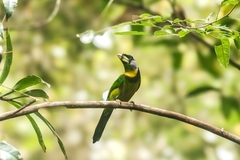
Its scientific name was proposed by Salomon Müller in 1836, who described a barbet from Sumatra. The fire-tufted barbet is green with a brownish-maroon nape, grey lores, and a white band on the forehead. Its throat is green, followed by a bright yellow band before a black band, appearing like a necklace. The bill is fawn coloured with a black vertical band. It has tufts of feathers at the base of beak. The upper tufts of males are fiery orange. The adult fire-tufted barbet is 28 cm (11 in) long.

The fire-tufted barbet inhabits broad-leaved evergreen montane forests between 1,070 and 2,010 m (3,510 and 6,590 ft) on the Malay Peninsula and Sumatra. Three fire-tufted barbets observed on Mount Gede in West Java between 2003 and 2005 are thought to have escaped from aviaries in this area.

The fire-tufted barbet is a resident bird... Wikipedia →

Sounds

Song0:23

Malaysia · 2023

© Lim Ying Hien · XC833554 · CC BY-NC-ND 4.0

Call0:16

Malaysia · 2020

© bryanW · XC595198 · CC BY-NC-SA 4.0

Song0:28

Malaysia · 2022

© GABRIEL LEITE · XC731246 · CC BY-NC-SA 4.0

Global Distribution

Parks Where Found

# Park Country Daily sighting probability
1 Kerinci Seblat National Park 🇮🇩 Indonesia
~70%

More parks will be added in future updates.

Zoos & Centres Where Found

# Zoo / Centre Country
1 Bird Paradise 🇸🇬 Singapore In captivity
2 Rainforest Wild Asia 🇸🇬 Singapore In captivity

Before you go

What are the chances of seeing a Fire-tufted Barbet in Kerinci Seblat National Park?

Very likely

About 70% of wildlife watchers report a Fire-tufted Barbet sighting in Kerinci Seblat National Park on a given day, based on 519 verified sightings from GBIF citizen-science data from 2019 to 2026. It is the 3rd most-seen of the 203 birds we can rate there. Over three days the chance rises to over 90%, if each day is a fresh chance.

When is the best time to see a Fire-tufted Barbet in Kerinci Seblat National Park?

July to November

In those months about 70% of wildlife watchers report a Fire-tufted Barbet in Kerinci Seblat National Park on a given day, against about 40% in December, the lowest month. January has too few records to rate.

What time of day is best to see a Fire-tufted Barbet?

Between 2 and 5 am

Across all the parks we cover, that three-hour window holds the most Fire-tufted Barbet sightings with a recorded time, and about half of them come between 6 pm and 6 am: it is most active around dawn and dusk.

Where else can you see a Fire-tufted Barbet?

Only Kerinci Seblat National Park, in our data

Kerinci Seblat National Park is the only park on Wallace's Line with enough records to rate Fire-tufted Barbet sightings: about 70% of wildlife watchers there report one on a given day.

Which relatives of the Fire-tufted Barbet live in Kerinci Seblat National Park?

Same genus: Psilopogon

The closest relatives of the Fire-tufted Barbet that you can see in Kerinci Seblat National Park (genus Psilopogon, Typical Asian Barbets) are Black-browed Barbet (about 70%), Gold-whiskered Barbet (about 20%) and Black-eared Barbet (about 10%), with each one's daily chance of a sighting.

Where does the Fire-tufted Barbet sighting chance come from?

GBIF citizen-science records

It is estimated from how often the Fire-tufted Barbet is recorded against all the birds logged in Kerinci Seblat National Park (519 verified sightings from 2019 to 2026), calibrated against known sighting rates. Figures are rounded to the nearest 10% because citizen-science data supports honest approximations, not decimals, and months with records from fewer than five people show "—". How it works.

← Back to Kerinci Seblat National Park