Gold-whiskered Barbet

Gold-whiskered Barbet

Psilopogon chrysopogon

Silhouette: Vijay Cavale (photo), John E. McCormack, Michael G. Harvey, Brant C. Faircloth, Nicholas G. Crawford, Travis C. Glenn, Robb T. Brumfield & T. Michael Keesey · PhyloPic

LCLeast ConcernNTVUENCR
Daily sighting probability ~20% · Possible
at Kerinci Seblat National Park

In 3 days ~40% in a week ~70%

99 Verified sightings at Kerinci Seblat National Park From 2019 to 2026
1,705 In all 9 parks
October Best month
🌅 Crepuscular When it's spotted

About the Gold-whiskered Barbet

The golden-whiskered barbet (Psilopogon chrysopogon) is an Asian barbet species native to the western Malay Archipelago, where it inhabits foremost forests up to 1,500 m (4,900 ft) elevation. It has been listed as Least Concern on the IUCN Red List since 2004 because of its wide distribution.

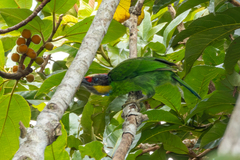
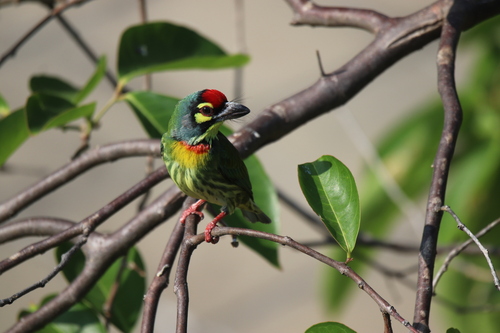
The golden-whiskered barbet has a green plumage of various hues. On both sides of the black beak it has a yellow moustache that extends to the ear canal. Its throat is blue, and it has small blue and red spots on the head. Its eyes are also surrounded by blue. Its forecrown is pale yellow, with red patches on both sides of the beak. It is 30 cm (12 in) long and weighs 110–215 g (3.9–7.6 oz).

Female and male are similar in appearance but display a small degree of sexual dichromatism in that the beaks of the female appear paler with a dusky bluish color. Before reaching maturity birds of both sexes have duller overall plumage.

The golden-whiskered barbet ranges from the Malay Peninsula to Sumatra and Borneo, where it inhabits tropical and subtropical moist broadleaf forests and montane forest. It has also been sighted in cacao plantation and second... Wikipedia →

Sounds

Recording0:47

Malaysia · 2014

© David Edwards · XC1063189 · CC BY-NC-ND 4.0

Song0:45

Malaysia · 2019

© Marc Anderson · XC1041853 · CC BY-NC-ND 4.0

Call0:21

Malaysia · 2024

© Lim Ying Hien · XC915284 · CC BY-NC-ND 4.0

Global Distribution

Parks Where Found

# Park Country Daily sighting probability
1 Khao Luang National Park 🇹🇭 Thailand
~50%
2 Taman Negara National Park 🇲🇾 Malaysia
~40%
3 Danum Valley Conservation Area 🇲🇾 Malaysia
~20%
4 Khao Sok National Park 🇹🇭 Thailand
~20%
5 Kerinci Seblat National Park 🇮🇩 Indonesia
~20%
6 Gunung Leuser National Park 🇮🇩 Indonesia
~10%
7 Kinabalu Park 🇲🇾 Malaysia
~10%
8 Sepilok 🇲🇾 Malaysia
<5%
9 Kinabatangan Wildlife Sanctuary 🇲🇾 Malaysia
<5%

Cities Where Found

# City Country Daily sighting probability
1 Kuala Lumpur 🇲🇾 Malaysia
~10%

Before you go

What are the chances of seeing a Gold-whiskered Barbet in Kerinci Seblat National Park?

Possible

About 20% of wildlife watchers report a Gold-whiskered Barbet sighting in Kerinci Seblat National Park on a given day, based on 99 verified sightings from GBIF citizen-science data from 2019 to 2026. It is the 66th most-seen of the 203 birds we can rate there. Over three days the chance rises to about 40%, and over a week to about 70%, if each day is a fresh chance.

When is the best time to see a Gold-whiskered Barbet in Kerinci Seblat National Park?

October

In that month about 40% of wildlife watchers report a Gold-whiskered Barbet in Kerinci Seblat National Park on a given day, against under 5% in July, the lowest month. January has too few records to rate.

What time of day is best to see a Gold-whiskered Barbet?

Between 1 and 4 am

Across all the parks we cover, that three-hour window holds the most Gold-whiskered Barbet sightings with a recorded time, and about 6 in 10 of them come between 6 pm and 6 am: it is most active around dawn and dusk.

Which relatives of the Gold-whiskered Barbet live in Kerinci Seblat National Park?

Same genus: Psilopogon

The closest relatives of the Gold-whiskered Barbet that you can see in Kerinci Seblat National Park (genus Psilopogon, Typical Asian Barbets) are Black-browed Barbet (about 70%), Fire-tufted Barbet (about 70%) and Black-eared Barbet (about 10%), with each one's daily chance of a sighting.

Where does the Gold-whiskered Barbet sighting chance come from?

GBIF citizen-science records

It is estimated from how often the Gold-whiskered Barbet is recorded against all the birds logged in Kerinci Seblat National Park (99 verified sightings from 2019 to 2026), calibrated against known sighting rates. Figures are rounded to the nearest 10% because citizen-science data supports honest approximations, not decimals, and months with records from fewer than five people show "—". How it works.

← Back to Kerinci Seblat National Park