Siberian Thrush

Siberian Thrush

Geokichla sibirica

Silhouette: Francesco "Architetto" Rollandin · PhyloPic

LCLeast ConcernNTVUENCR
Daily sighting probability <5% · Rare
at Kerinci Seblat National Park

In 3 days <5% in a week ~10%

6 Verified sightings at Kerinci Seblat National Park From 2019 to 2026
61 In all 3 parks
December Best month
☀️ Diurnal When it's spotted

About the Siberian Thrush

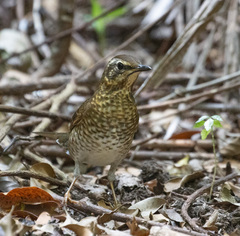
The Siberian thrush (Geokichla sibirica) is a member of the thrush family, Turdidae. The genus name Geokichla comes from Ancient Greek geo-, "ground-" and kikhle, " thrush". The specific sibirica is Latin for Siberia. It breeds in taiga in Siberia. It is strongly migratory, with most birds moving to southeastern Asia during the winter. It is a very rare vagrant to western Europe. It is very secretive.

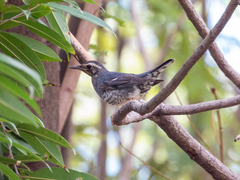
The Siberian thrush is similar in size to the song thrush. It is omnivorous, eating a wide range of insects, earthworms and berries. The male Siberian thrush is a dark blue-grey above and below, with a white stripe above the eye. The lower belly and flanks are white. The female is a much browner bird, with a buff stripe above the eye.

A striking identification feature of both sexes in flight is the black band on the white underwings, a feature shared with the scaly thrush. Wikipedia →

Sounds

Song1:17

China · 2026

© Peter Boesman · XC1147541 · CC BY-NC-ND 4.0

Call1:02

Malaysia · 2020

© Ding Li Yong · XC523024 · CC BY-NC-ND 4.0

Song0:35

Russian Federation · 2017

© Lars Edenius · XC688996 · CC BY-NC-SA 4.0

Global Distribution

Parks Where Found

# Park Country Daily sighting probability
1 Doi Inthanon National Park 🇹🇭 Thailand
<5%
2 Khao Sok National Park 🇹🇭 Thailand
<5%
3 Kerinci Seblat National Park 🇮🇩 Indonesia
<5%

Cities Where Found

# City Country Daily sighting probability
1 Singapore 🇸🇬 Singapore
<5%
2 Bangkok 🇹🇭 Thailand
<5%

Before you go

What are the chances of seeing a Siberian Thrush in Kerinci Seblat National Park?

Rare

Under 5% of wildlife watchers report a Siberian Thrush sighting in Kerinci Seblat National Park on a given day, based on 6 verified sightings from GBIF citizen-science data from 2019 to 2026. It is the 178th most-seen of the 203 birds we can rate there. Over three days the chance rises to under 5%, and over a week to about 10%, if each day is a fresh chance.

When is the best time to see a Siberian Thrush in Kerinci Seblat National Park?

March and November–December

In those months about 10% of wildlife watchers report a Siberian Thrush in Kerinci Seblat National Park on a given day, against under 5% in February and April–October, the lowest months. January has too few records to rate.

What time of day is best to see a Siberian Thrush?

Between 8 and 11 am

Across all the parks we cover, that three-hour window holds the most Siberian Thrush sightings with a recorded time, and about 8 in 10 of them come between 6 am and 6 pm: it is a daytime animal.

Is Kerinci Seblat National Park the best place to see a Siberian Thrush?

Among the best

Of the 3 parks where we can rate Siberian Thrush sightings, Kerinci Seblat National Park ranks 3rd at under 5%, level with the leaders once rounded. The best odds are in Doi Inthanon National Park (Thailand, under 5%) and Khao Sok National Park (Thailand, under 5%).

Where does the Siberian Thrush sighting chance come from?

GBIF citizen-science records

It is estimated from how often the Siberian Thrush is recorded against all the birds logged in Kerinci Seblat National Park (6 verified sightings from 2019 to 2026), calibrated against known sighting rates. Figures are rounded to the nearest 10% because citizen-science data supports honest approximations, not decimals, and months with records from fewer than five people show "—". How it works.

← Back to Kerinci Seblat National Park