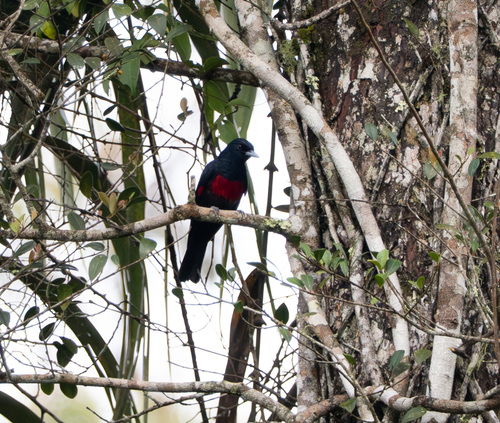
Ashy Drongo

Ashy Drongo

Dicrurus leucophaeus

Silhouette: Ferran Sayol · PhyloPic

LCLeast ConcernNTVUENCR
Daily sighting probability ~40% · Likely
at Kerinci Seblat National Park

In 3 days ~80% in a week >90%

327 Verified sightings at Kerinci Seblat National Park From 2019 to 2026
14,754 In all 33 parks
May Best month
🌅 Crepuscular When it's spotted

About the Ashy Drongo

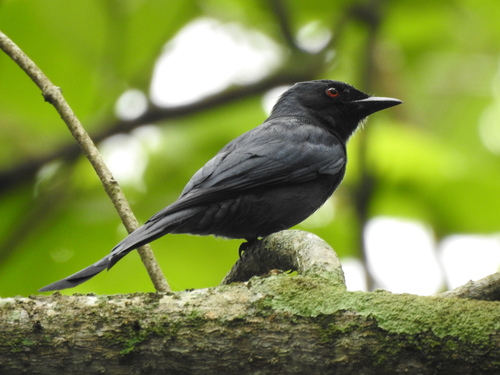
The ashy drongo (Dicrurus leucophaeus) is a species of bird in the drongo family Dicruridae. It is found widely distributed across eastern and Southeast Asia, with several populations that vary in the shade of grey, migration patterns and in the size or presence of white patches around the eye.

The adult ashy drongo is mainly dark grey, and the tail is long and deeply forked, There are a number of subspecies varying in the shade of the grey plumage. Some subspecies have white markings on the head. Young birds are dull brownish grey.

Subspecies longicaudatus of India (which includes beavani of the Himalayas that winters on the peninsula, with one breeding population in central India that Vaurie separates as longicaudatus in the restricted sense) is very dark and almost like the black drongo although this bird is slimmer and has a somewhat longer and less-splayed tail. It is found in more tall forest habitat, has dark grey underside lacking the sheen of black drongo. The iris is crimson and there is no white rictal spot. Subspecies leucogenis and salangensis have a white eye-patch as do several of the island forms that breed further south. The calls are a little more... Wikipedia →

Sounds

Call0:29

Vietnam · 2026

© Tim Dinh / Annambirding · XC1177455 · CC BY-NC-SA 4.0

Song0:05

China · 2025

© Lim Ying Hien 林勇贤 · XC1047024 · CC BY-NC-ND 4.0

Alarm call0:32

Cambodia · 2025

© Ding Li Yong · XC982070 · CC BY-NC-ND 4.0

Global Distribution

Parks Where Found

# Park Country Daily sighting probability
1 Cat Tien National Park 🇻🇳 Vietnam
~70%
2 Kinabalu Park 🇲🇾 Malaysia
~50%
3 Kaeng Krachan National Park 🇹🇭 Thailand
~50%
4 Khao Yai National Park 🇹🇭 Thailand
~50%
5 Namdapha National Park 🇮🇳 India
~40%
6 Kerinci Seblat National Park 🇮🇩 Indonesia
~40%
7 Royal Manas National Park 🇧🇹 Bhutan
~40%
8 Doi Inthanon National Park 🇹🇭 Thailand
~30%
9 Periyar National Park 🇮🇳 India
~30%
10 Bali Barat National Park 🇮🇩 Indonesia
~30%
11 Mudumalai National Park 🇮🇳 India
~20%
12 Nagarhole National Park 🇮🇳 India
~20%
13 Gir National Park 🇮🇳 India
~20%
14 Bandipur National Park 🇮🇳 India
~20%
15 Langtang National Park 🇳🇵 Nepal
~20%
16 Kanha National Park 🇮🇳 India
~20%
17 Cuc Phuong National Park 🇻🇳 Vietnam
~20%
18 Khao Sok National Park 🇹🇭 Thailand
~20%
19 Manas National Park 🇮🇳 India
~20%
20 Bandhavgarh National Park 🇮🇳 India
~20%
21 Jim Corbett National Park 🇮🇳 India
~10%
22 Chitwan National Park 🇳🇵 Nepal
~10%
23 Eravikulam National Park 🇮🇳 India
~10%
24 Satpura National Park 🇮🇳 India
~10%
25 Keoladeo National Park 🇮🇳 India
~10%
26 Royal Bardia National Park 🇳🇵 Nepal
~10%
27 Kaziranga National Park 🇮🇳 India
~10%
28 Yala National Park 🇱🇰 Sri Lanka
<5%
29 Ranthambore National Park 🇮🇳 India
<5%
30 Wilpattu National Park 🇱🇰 Sri Lanka
<5%
31 Sundarbans National Park 🇮🇳 India
<5%
32 Danum Valley Conservation Area 🇲🇾 Malaysia
<5%
33 Sepilok 🇲🇾 Malaysia
<5%

Cities Where Found

# City Country Daily sighting probability
1 Ho Chi Minh City 🇻🇳 Vietnam
~40%
2 Bangkok 🇹🇭 Thailand
~30%
3 Jabalpur 🇮🇳 India
~20%
4 Bengaluru 🇮🇳 India
~20%
5 Kathmandu 🇳🇵 Nepal
~20%
6 Srinagar 🇮🇳 India
~20%
7 Thrissur 🇮🇳 India
~20%
8 Mumbai 🇮🇳 India
~20%
9 Hefei 🇨🇳 China
~20%
10 Pune 🇮🇳 India
~20%

Zoos & Centres Where Found

# Zoo / Centre Country
1 Hong Kong Zoological and Botanical Gardens 🇨🇳 China In captivity
2 Edward Youde Aviary 🇭🇰 Hong Kong SAR China In captivity

Before you go

What are the chances of seeing an Ashy Drongo in Kerinci Seblat National Park?

Likely

About 40% of wildlife watchers report an Ashy Drongo sighting in Kerinci Seblat National Park on a given day, based on 327 verified sightings from GBIF citizen-science data from 2019 to 2026. It is the 13th most-seen of the 203 birds we can rate there. Over three days the chance rises to about 80%, and over a week to over 90%, if each day is a fresh chance.

When is the best time to see an Ashy Drongo in Kerinci Seblat National Park?

March, May and September

In those months about 50% of wildlife watchers report an Ashy Drongo in Kerinci Seblat National Park on a given day, against about 20% in February, the lowest month. January has too few records to rate.

What time of day is best to see an Ashy Drongo?

Between 3 and 6 am

Across all the parks we cover, that three-hour window holds the most Ashy Drongo sightings with a recorded time, and about half of them come between 6 am and 6 pm: it is most active around dawn and dusk.

Which relatives of the Ashy Drongo live in Kerinci Seblat National Park?

Same genus: Dicrurus

The closest relatives of the Ashy Drongo that you can see in Kerinci Seblat National Park (genus Dicrurus, Drongos) are Sumatran Drongo (about 20%) and Lesser Racket-tailed Drongo (about 20%), with each one's daily chance of a sighting.

Where does the Ashy Drongo sighting chance come from?

GBIF citizen-science records

It is estimated from how often the Ashy Drongo is recorded against all the birds logged in Kerinci Seblat National Park (327 verified sightings from 2019 to 2026), calibrated against known sighting rates. Figures are rounded to the nearest 10% because citizen-science data supports honest approximations, not decimals, and months with records from fewer than five people show "—". How it works.
← Back to Kerinci Seblat National Park