Black-tailed Tree Rat

Black-tailed Tree Rat

Thallomys nigricauda

Silhouette: T. Michael Keesey · PhyloPic

LCLeast ConcernNTVUENCR
Daily sighting probability ~10% · With luck
at Kgalagadi Transfrontier Park

In 3 days ~30% in a week ~60%

8 Verified sightings at Kgalagadi Transfrontier Park From 2019 to 2026
14 In all 2 parks
February Best month
🌅 Crepuscular When it's spotted

About the Black-tailed Tree Rat

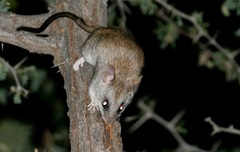
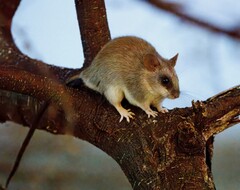
The black-tailed tree rat, also called black-tailed acacia rat or black-tailed thallomys, (Thallomys nigricauda), is a species of rodent in the family Muridae. It is found in Angola, Botswana, Namibia and South Africa, where its natural habitat is subtropical or tropical dry shrubland. It is both nocturnal and arboreal and makes bulky nests in the trees, often acacias, where it feeds on leaves and buds.

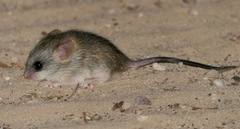
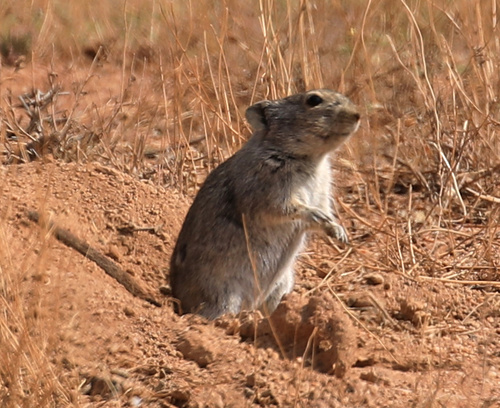
The black-tailed tree rat is a medium-sized rodent with a head-and body length of about 135 mm (5 in) and a tail of about 145 mm (6 in). The sides of the face are grey, and a dark band extends from the muzzle to around the eyes and below the ears. The eyes are large and the whiskers are long. The ears are large, oval, and set at an oblique angle. The dorsal fur is long and woolly, slate grey tinged with yellow. The underparts are white, the limbs are grey and the upper sides of the broad feet are white. The long tail is clad in black scales and black bristles, and tipped with black hairs.

The black-tailed tree rat is endemic to southwestern Africa. Its range includes southwestern Angola, Namibia, Botswana and northwestern South Africa... Wikipedia →

Global Distribution

Parks Where Found

# Park Country Daily sighting probability
1 Kgalagadi Transfrontier Park 🇿🇦 South Africa
~10%
2 Etosha National Park 🇳🇦 Namibia
~10%

Before you go

What are the chances of seeing a Black-tailed Tree Rat in Kgalagadi Transfrontier Park?

With luck

About 10% of wildlife watchers report a Black-tailed Tree Rat sighting in Kgalagadi Transfrontier Park on a given day, based on 8 verified sightings from GBIF citizen-science data from 2019 to 2026. It is the 25th most-seen of the 28 mammals we can rate there. Over three days the chance rises to about 30%, and over a week to about 60%, if each day is a fresh chance.

When is the best time to see a Black-tailed Tree Rat in Kgalagadi Transfrontier Park?

January and February

In those months about 20% of wildlife watchers report a Black-tailed Tree Rat in Kgalagadi Transfrontier Park on a given day, against under 5% in March, May–June, August–September and November, the lowest months. Those are among Kgalagadi Transfrontier Park's wettest months, with about 35 mm of rain a month against almost none in July.

What time of day is best to see a Black-tailed Tree Rat?

Between 5 and 8 pm

Across all the parks we cover, that three-hour window holds the most Black-tailed Tree Rat sightings with a recorded time, and about 6 in 10 of them come between 6 pm and 6 am: it is most active around dawn and dusk.

Is Kgalagadi Transfrontier Park the best place to see a Black-tailed Tree Rat?

Yes

Of the 2 parks where we can rate Black-tailed Tree Rat sightings, Kgalagadi Transfrontier Park has the highest daily chance: about 10%. Next come Etosha National Park (Namibia, about 10%).

Which relatives of the Black-tailed Tree Rat live in Kgalagadi Transfrontier Park?

Same family: Muridae

The closest relatives of the Black-tailed Tree Rat that you can see in Kgalagadi Transfrontier Park (family Muridae, Old World Mice and Rats) are Cape Four-striped Grass Mouse (about 30%) and Brants's Whistling Rat (about 10%), with each one's daily chance of a sighting.

Where does the Black-tailed Tree Rat sighting chance come from?

GBIF citizen-science records

It is estimated from how often the Black-tailed Tree Rat is recorded against all the mammals logged in Kgalagadi Transfrontier Park (8 verified sightings from 2019 to 2026), calibrated against known sighting rates. Figures are rounded to the nearest 10% because citizen-science data supports honest approximations, not decimals, and months with records from fewer than five people show "—". How it works.

← Back to Kgalagadi Transfrontier Park