Springhare

Springhare

Pedetes capensis

Silhouette: Margot Michaud · PhyloPic

LCLeast ConcernNTVUENCR
Daily sighting probability ~10% · With luck
at Kgalagadi Transfrontier Park

In 3 days ~30% in a week ~60%

9 Verified sightings at Kgalagadi Transfrontier Park From 2019 to 2026
43 In all 4 parks
January Best month
🌙 Nocturnal When it's spotted

About the Springhare

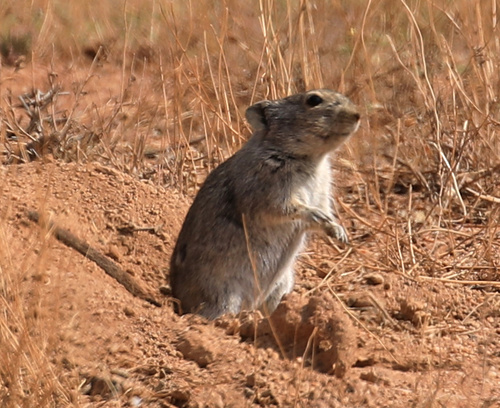
The South African springhare (Pedetes capensis) (Afrikaans: springhaas) is a medium-sized terrestrial and burrowing rodent. Despite the name, it is not a hare. It is one of two extant species in the genus Pedetes, and is native to southern Africa. Formerly, the genus was considered monotypic and the East African springhare (P. surdaster) was included in P. capensis.

Springhares live throughout semi-arid areas in southern Africa, preferentially in sandy plains and pans with short grasses. In agricultural areas, springhares can be considered a pest due to their destructive feeding on crops. However, they are not currently considered under an impending risk of extinction.

The springhare was named in English by William John Burchell in 1822, who derived "springhare" from the Afrikaans name springhaas. The generic name Pedetes comes from the Greek Πηδητές (Pidités), meaning "leaper or dancer". The specific name capensis, a Latin word meaning "of the Cape", refers to the Cape of Good Hope and Cape Province, the species' type locality.

Originally named as Yerbua capensis by Johann Reinhold Forster in 1778, using a genus that was applied to kangaroos in the previous... Wikipedia →

Global Distribution

Parks Where Found

# Park Country Daily sighting probability
1 Hwange National Park 🇿🇼 Zimbabwe
~20%
2 Kgalagadi Transfrontier Park 🇿🇦 South Africa
~10%
3 Kruger National Park 🇿🇦 South Africa
~10%
4 Addo Elephant National Park 🇿🇦 South Africa
~10%

Zoos & Centres Where Found

# Zoo / Centre Country
1 Zoo Pilsen 🇨🇿 Czechia In captivity
2 Omaha’s Henry Doorly Zoo and Aquarium 🇺🇸 United States In captivity
3 Berlin Zoological Garden 🇩🇪 Germany In captivity
4 Racine Zoo 🇺🇸 United States In captivity
5 Bergen County Zoological Park 🇺🇸 United States In captivity
6 Aquarium Berlin 🇩🇪 Germany In captivity

Before you go

What are the chances of seeing a Springhare in Kgalagadi Transfrontier Park?

With luck

About 10% of wildlife watchers report a Springhare sighting in Kgalagadi Transfrontier Park on a given day, based on 9 verified sightings from GBIF citizen-science data from 2019 to 2026. It is the 24th most-seen of the 28 mammals we can rate there. Over three days the chance rises to about 30%, and over a week to about 60%, if each day is a fresh chance.

When is the best time to see a Springhare in Kgalagadi Transfrontier Park?

January and July

In those months about 20% of wildlife watchers report a Springhare in Kgalagadi Transfrontier Park on a given day, against under 5% in February, June, August and October–November, the lowest months.

What time of day is best to see a Springhare?

Between 7 and 10 pm

Across all the parks we cover, that three-hour window holds the most Springhare sightings with a recorded time, and about 7 in 10 of them come between 6 pm and 6 am: it is mostly seen at night.

Is Kgalagadi Transfrontier Park the best place to see a Springhare?

2nd of 4

Of the 4 parks where we can rate Springhare sightings, Kgalagadi Transfrontier Park ranks 2nd at about 10%. The best odds are in Hwange National Park (Zimbabwe, about 20%).

Where does the Springhare sighting chance come from?

GBIF citizen-science records

It is estimated from how often the Springhare is recorded against all the mammals logged in Kgalagadi Transfrontier Park (9 verified sightings from 2019 to 2026), calibrated against known sighting rates. Figures are rounded to the nearest 10% because citizen-science data supports honest approximations, not decimals, and months with records from fewer than five people show "—". How it works.

← Back to Kgalagadi Transfrontier Park