Ludwig's Bustard

Ludwig's Bustard

Neotis ludwigii

Silhouette: Kai Caspar · PhyloPic

LCNTVUENEndangeredCR
Daily sighting probability <5% · Rare
at Kgalagadi Transfrontier Park

In 3 days ~10% in a week ~20%

19 Verified sightings at Kgalagadi Transfrontier Park From 2019 to 2026
252 In all 4 parks
April Best month
☀️ Diurnal When it's spotted

About the Ludwig's Bustard

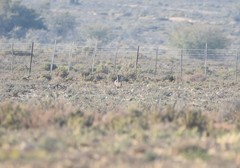
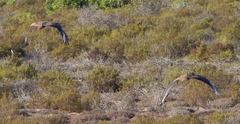
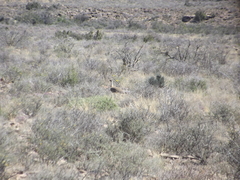
Ludwig's bustard (Neotis ludwigii) is a species of bird in the bustard family, and named after Baron von Ludwig. It is a medium-to-large sized species. The Ludwig's bustard can weigh from 3 to 7.3 kg (6.6 to 16.1 lb), with a mean of 6.3 kg (14 lb) for the much larger male and 3.4 kg (7.5 lb) for the female. Length ranges from 76 to 85 cm (30 to 33 in) in females and 80 to 95 cm (31 to 37 in) in males.

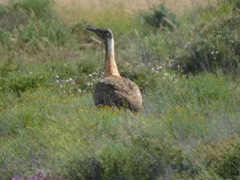
The bird's face and front neck are coloured grey-brown while the back of the neck and face is white. The nape of the neck is coloured a dull orange. Females and juveniles vary from the male adults by their smaller size and slightly lighter coloured front neck and face.

The Ludwig's bustard is frequently confused with Stanley's bustard (more commonly known as the Denham's bustard), Neotis denhami. The Denham's bustard, however, has a paler grey on its face and front neck, a browner nape, and is also marked with unique crown stripes of black and white on its head.

Ludwig's bustard is a member of the Otididae family, which comprises the bustards. General bustard characteristics include short, stout bills; camouflaged bodies; and dwelling in savannas and grasslands... Wikipedia →

Sounds

Call0:09

South Africa · 2022

© Lynette Rudman · XC758156 · CC BY-NC-SA 4.0

Global Distribution

Parks Where Found

# Park Country Daily sighting probability
1 Namib-Naukluft National Park 🇳🇦 Namibia
~10%
2 Addo Elephant National Park 🇿🇦 South Africa
~10%
3 Etosha National Park 🇳🇦 Namibia
<5%
4 Kgalagadi Transfrontier Park 🇿🇦 South Africa
<5%

Before you go

What are the chances of seeing a Ludwig's Bustard in Kgalagadi Transfrontier Park?

Rare

Under 5% of wildlife watchers report a Ludwig's Bustard sighting in Kgalagadi Transfrontier Park on a given day, based on 19 verified sightings from GBIF citizen-science data from 2019 to 2026. It is the 101st most-seen of the 122 birds we can rate there. Over three days the chance rises to about 10%, and over a week to about 20%, if each day is a fresh chance.

When is the best time to see a Ludwig's Bustard in Kgalagadi Transfrontier Park?

January, April and June

In those months about 10% of wildlife watchers report a Ludwig's Bustard in Kgalagadi Transfrontier Park on a given day, against under 5% in February–March and July–December, the lowest months. Those are among Kgalagadi Transfrontier Park's wettest months, with about 20 mm of rain a month against almost none in July. May has too few records to rate.

What time of day is best to see a Ludwig's Bustard?

Between 10 am and 1 pm

Across all the parks we cover, that three-hour window holds the most Ludwig's Bustard sightings with a recorded time, and about 9 in 10 of them come between 6 am and 6 pm: it is a daytime animal.

Which relatives of the Ludwig's Bustard live in Kgalagadi Transfrontier Park?

Same family: Otididae

The closest relatives of the Ludwig's Bustard that you can see in Kgalagadi Transfrontier Park (family Otididae, Bustards) are Kori Bustard (about 50%), White-Quilled Bustard (about 30%) and Crested Bustard (about 10%), with each one's daily chance of a sighting.

Where does the Ludwig's Bustard sighting chance come from?

GBIF citizen-science records

It is estimated from how often the Ludwig's Bustard is recorded against all the birds logged in Kgalagadi Transfrontier Park (19 verified sightings from 2019 to 2026), calibrated against known sighting rates. Figures are rounded to the nearest 10% because citizen-science data supports honest approximations, not decimals, and months with records from fewer than five people show "—". How it works.

← Back to Kgalagadi Transfrontier Park