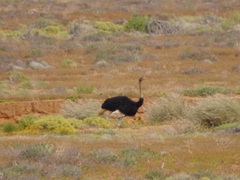
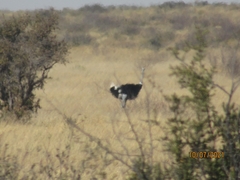
Common Ostrich

Common Ostrich

Struthio camelus

Silhouette: Matt Martyniuk (vectorized by T. Michael Keesey) · PhyloPic

LCLeast ConcernNTVUENCR
Daily sighting probability ~70% · Very likely
at Kgalagadi Transfrontier Park

In 3 days >90%

463 Verified sightings at Kgalagadi Transfrontier Park From 2019 to 2026
17,001 In all 27 parks
June Best month
☀️ Diurnal When it's spotted

About the Common Ostrich

The common ostrich (Struthio camelus), or simply ostrich, is a species of flightless bird native to certain areas of Africa (and historically, Arabia) and is the largest living species of bird. The common ostrich is one of two extant species of ostriches, the only living members of the genus Struthio in the ratite group of birds. The other is the Somali ostrich (Struthio molybdophanes), which has been recognised as a distinct species by BirdLife International since 2014, having been previously considered a distinctive subspecies of ostrich.

The common ostrich belongs to the order Struthioniformes. Struthioniformes previously contained all the ratites, such as the kiwis, emus, rheas, and cassowaries. However, a recent genetic analysis has found that the group is not monophyletic, as it is paraphyletic with respect to the tinamous, so the ostriches are now classified as the only members of the order. Phylogenetic studies have shown that it is the sister group to all other members of Palaeognathae, and that the flighted tinamous are the sister group to the extinct moa. It is distinctive in its appearance, with a long neck and legs, and can run for a long time at a speed of 55 km/h (34 mph) with short bursts up to about 70 km/h (43 mph), the fastest land speed of any bipedal animal. It lays the largest eggs of any living bird, though the extinct giant elephant bird (Aepyornis maximus) of Madagascar and the South Island giant moa (Dinornis robustus) of New Zealand both laid larger eggs.

The common ostrich's diet consists mainly of plant matter, though it also eats invertebrates and small reptiles. It lives in nomadic groups of 5 to 50 birds. When threatened, the ostrich will either hide itself by lying flat against the ground or run away. If cornered, it can attack with a kick of its powerful legs. Mating patterns differ by geographical region, but territorial males fight for a harem of two to seven females.

The common ostrich is farmed around the world, particularly for its feathers, which are decorative and are also used as feather dusters. Its skin is used for leather products and its meat is sold commercially, with its leanness a common marketing point. Wikipedia →

Sounds

Song0:42

Botswana · 2023

© Marc Anderson · XC1080577 · CC BY-NC-ND 4.0

Call0:53

South Africa · 2019

© Frank Lambert · XC516153 · CC BY-NC-ND 4.0

Call0:11

South Africa · 2010

© Derek Solomon · XC46725 · CC BY-NC-ND 2.5

Global Distribution

Parks Where Found

# Park Country Daily sighting probability
1 De Hoop Nature Reserve 🇿🇦 South Africa
~70%
2 Kgalagadi Transfrontier Park 🇿🇦 South Africa
~70%
3 Nairobi National Park 🇰🇪 Kenya
~70%
4 West Coast National Park 🇿🇦 South Africa
~70%
5 Tarangire National Park 🇹🇿 Tanzania
~70%
6 Amboseli National Park 🇰🇪 Kenya
~60%
7 Etosha National Park 🇳🇦 Namibia
~60%
8 Masai Mara National Reserve 🇰🇪 Kenya
~50%
9 Ngorongoro Conservation Area 🇹🇿 Tanzania
~50%
10 Serengeti National Park 🇹🇿 Tanzania
~50%
11 Addo Elephant National Park 🇿🇦 South Africa
~40%
12 Namib-Naukluft National Park 🇳🇦 Namibia
~40%
13 Mkomazi National Park 🇹🇿 Tanzania
~30%
14 Hwange National Park 🇿🇼 Zimbabwe
~20%
15 Moremi Game Reserve 🇧🇼 Botswana
~20%
16 Tsavo West National Park 🇰🇪 Kenya
~20%
17 Waterberg Plateau Park 🇳🇦 Namibia
~20%
18 Kruger National Park 🇿🇦 South Africa
~10%
19 Ruaha National Park 🇹🇿 Tanzania
~10%
20 Table Mountain National Park 🇿🇦 South Africa
~10%
21 Kidepo Valley National Park 🇺🇬 Uganda
~10%
22 Chobe National Park 🇧🇼 Botswana
~10%
23 Tsavo East National Park 🇰🇪 Kenya
~10%
24 Lake Nakuru National Park 🇰🇪 Kenya
~10%
25 Lake Manyara National Park 🇹🇿 Tanzania
<5%
26 Garden Route National Park 🇿🇦 South Africa
<5%
27 Samburu National Reserve 🇰🇪 Kenya
<5%

Cities Where Found

# City Country Daily sighting probability
1 Nairobi 🇰🇪 Kenya
<5%
2 Pretoria 🇿🇦 South Africa
<5%

Zoos & Centres Where Found

# Zoo / Centre Country
1 Disney's Animal Kingdom 🇺🇸 United States In captivity
2 Ragunan Zoo 🇮🇩 Indonesia In captivity
3 Busch Gardens Tampa 🇺🇸 United States In captivity
4 San Diego Zoo 🇺🇸 United States In captivity
5 Six Flags Great Adventure 🇺🇸 United States In captivity
6 Moscow Zoo 🇷🇺 Russia In captivity
7 Pairi Daiza 🇧🇪 Belgium In captivity
8 Prague Zoo 🇨🇿 Czechia In captivity
9 National Zoological Park 🇺🇸 United States In captivity
10 Yangon Zoological Gardens 🇲🇲 Myanmar (Burma) In captivity
11 Basel Zoo 🇨🇭 Switzerland In captivity
12 ZooParc de Beauval 🇫🇷 France In captivity
13 Leipzig Zoological Garden 🇩🇪 Germany In captivity
14 Denver Zoo 🇺🇸 United States In captivity
15 Copenhagen Zoo 🇩🇰 Denmark In captivity
16 Natura Artis Magistra 🇳🇱 Netherlands In captivity
17 Dublin Zoo 🇮🇪 Ireland In captivity
18 Cleveland Metroparks Zoo 🇺🇸 United States In captivity
19 Cincinnati Zoo and Botanical Garden 🇺🇸 United States In captivity
20 Zürich Zoo 🇨🇭 Switzerland In captivity
21 California Academy of Sciences 🇺🇸 United States In captivity
22 Barcelona Zoo 🇪🇸 Spain In captivity
23 Le Pal 🇫🇷 France In captivity
24 North Carolina Zoo 🇺🇸 United States In captivity
25 Zlín-Lešná Zoo 🇨🇿 Czechia In captivity
26 Cabarceno Natural Park 🇪🇸 Spain In captivity
27 Ostrava Zoo 🇨🇿 Czechia In captivity
28 Kolmården Wildlife Park 🇸🇪 Sweden In captivity
29 Dvůr Králové Zoo 🇨🇿 Czechia In captivity
30 Paris Zoological Park 🇫🇷 France In captivity
31 Zoo Pilsen 🇨🇿 Czechia In captivity
32 Taman Safari Bali (Bali Safari) 🇮🇩 Indonesia In captivity
33 Fota Wildlife Park 🇮🇪 Ireland In captivity
34 Bali Zoo 🇮🇩 Indonesia In captivity
35 Réserve africaine de Sigean 🇫🇷 France In captivity
36 Parc des oiseaux 🇫🇷 France In captivity
37 Abilene Zoological Gardens 🇺🇸 United States In captivity
38 Aquarium du palais de la Porte Dorée 🇫🇷 France In captivity
39 Zoobotánico Jerez 🇪🇸 Spain In captivity
40 Zoo d'Amiens 🇫🇷 France In captivity
41 Karagandy Zoo 🇰🇿 Kazakhstan In captivity
42 The Wilds 🇺🇸 United States In captivity
43 清远长隆动物大越野 🇨🇳 China In captivity
44 Monarto Zoo 🇦🇺 Australia In captivity
45 Parque Temático Hacienda Nápoles 🇨🇴 Colombia In captivity
46 Taronga Western Plains Zoo 🇦🇺 Australia In captivity
47 Vinpearl Safari 🇻🇳 Vietnam In captivity
48 Knuthenborg Safaripark 🇩🇰 Denmark In captivity
49 Bioparque Estrella 🇲🇽 Mexico In captivity
50 Mohamed bin Zayed Nature Reserve 🇧🇭 Bahrain In captivity

Before you go

What are the chances of seeing a Common Ostrich in Kgalagadi Transfrontier Park?

Very likely

About 70% of wildlife watchers report a Common Ostrich sighting in Kgalagadi Transfrontier Park on a given day, based on 463 verified sightings from GBIF citizen-science data from 2019 to 2026. It is the 4th most-seen of the 122 birds we can rate there. Over three days the chance rises to over 90%, if each day is a fresh chance.

When is the best time to see a Common Ostrich in Kgalagadi Transfrontier Park?

June, September and November

In those months about 80% of wildlife watchers report a Common Ostrich in Kgalagadi Transfrontier Park on a given day, against about 60% in March, July and October, the lowest months. Those are among Kgalagadi Transfrontier Park's driest months, with almost no rain against 40 mm in January. May has too few records to rate.

What time of day is best to see a Common Ostrich?

Between 2 and 5 pm

Across all the parks we cover, that three-hour window holds the most Common Ostrich sightings with a recorded time, and about 9 in 10 of them come between 6 am and 6 pm: it is a daytime animal.

Is Kgalagadi Transfrontier Park the best place to see a Common Ostrich?

Among the best

Of the 27 parks where we can rate Common Ostrich sightings, Kgalagadi Transfrontier Park ranks 2nd at about 70%, level with the leaders once rounded. The best odds are in De Hoop Nature Reserve (South Africa, about 70%). All parks ranked.

Where does the Common Ostrich sighting chance come from?

GBIF citizen-science records

It is estimated from how often the Common Ostrich is recorded against all the birds logged in Kgalagadi Transfrontier Park (463 verified sightings from 2019 to 2026), calibrated against known sighting rates. Figures are rounded to the nearest 10% because citizen-science data supports honest approximations, not decimals, and months with records from fewer than five people show "—". How it works.

← Back to Kgalagadi Transfrontier Park