White-Quilled Bustard

White-Quilled Bustard

Afrotis afraoides

Daily sighting probability ~30% · Possible
at Kgalagadi Transfrontier Park

In 3 days ~70% in a week ~90%

259 Verified sightings at Kgalagadi Transfrontier Park From 2019 to 2026
1,867 In all 4 parks
November Best month
☀️ Diurnal When it's spotted

About the White-Quilled Bustard

The northern black korhaan (Afrotis afraoides), also known as the white-quilled bustard, is a species of bird in the bustard family, Otididae. It is widely distributed across Southern Africa. Its habitat is primarily open grassland and scrub.

The northern black korhaan was first described in 1831 by the Scottish surgeon, explorer and zoologist Andrew Smith, who gave it the specific name "afraoides". He placed it in the genus Eupodotis, where it was one of two species, the other being the southern black korhaan (Eupodotis afra). Then in 2014, del Hoyo and Collar transferred both species to the genus Afrotis.

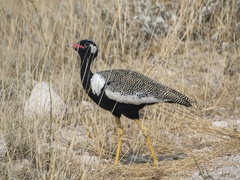
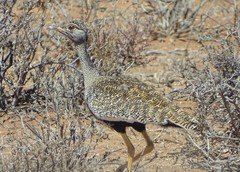
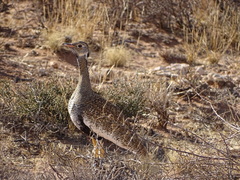
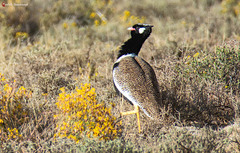
The male's plumage has regularly-arranged black and white barring on the back and wings, the head, neck and underparts being black. The female has the head, neck, breast and upper parts barred or chequered in black and buff, the belly being black. The primary feathers are largely white, which distinguishes this species from the southern black korhaan where they are black. Both the female and the male... Wikipedia →

Sounds

Recording0:06

South Africa · 2025

© janet_taylor · iNaturalist · CC BY-NC 4.0

Recording0:09

South Africa · 2025

© Luke Goddard · iNaturalist · CC BY-NC 4.0

Recording0:19

Namibia · 2025

© Nick Helme · iNaturalist · CC BY-NC 4.0

Global Distribution

Parks Where Found

# Park Country Daily sighting probability
1 Etosha National Park 🇳🇦 Namibia
~60%
2 Kgalagadi Transfrontier Park 🇿🇦 South Africa
~30%
3 Chobe National Park 🇧🇼 Botswana
~10%
4 Moremi Game Reserve 🇧🇼 Botswana
<5%

Before you go

What are the chances of seeing a White-Quilled Bustard in Kgalagadi Transfrontier Park?

Possible

About 30% of wildlife watchers report a White-Quilled Bustard sighting in Kgalagadi Transfrontier Park on a given day, based on 259 verified sightings from GBIF citizen-science data from 2019 to 2026. It is the 28th most-seen of the 122 birds we can rate there. Over three days the chance rises to about 70%, and over a week to about 90%, if each day is a fresh chance.

When is the best time to see a White-Quilled Bustard in Kgalagadi Transfrontier Park?

August and November–December

In those months about 50% of wildlife watchers report a White-Quilled Bustard in Kgalagadi Transfrontier Park on a given day, against about 20% in January–March and June–July, the lowest months. May has too few records to rate.

What time of day is best to see a White-Quilled Bustard?

Between 8 and 11 am

Across all the parks we cover, that three-hour window holds the most White-Quilled Bustard sightings with a recorded time, and about 8 in 10 of them come between 6 am and 6 pm: it is a daytime animal.

Is Kgalagadi Transfrontier Park the best place to see a White-Quilled Bustard?

2nd of 4

Of the 4 parks where we can rate White-Quilled Bustard sightings, Kgalagadi Transfrontier Park ranks 2nd at about 30%. The best odds are in Etosha National Park (Namibia, about 60%).

Which relatives of the White-Quilled Bustard live in Kgalagadi Transfrontier Park?

Same family: Otididae

The closest relatives of the White-Quilled Bustard that you can see in Kgalagadi Transfrontier Park (family Otididae, Bustards) are Kori Bustard (about 50%) and Crested Bustard (about 10%), with each one's daily chance of a sighting.

Where does the White-Quilled Bustard sighting chance come from?

GBIF citizen-science records

It is estimated from how often the White-Quilled Bustard is recorded against all the birds logged in Kgalagadi Transfrontier Park (259 verified sightings from 2019 to 2026), calibrated against known sighting rates. Figures are rounded to the nearest 10% because citizen-science data supports honest approximations, not decimals, and months with records from fewer than five people show "—". How it works.

← Back to Kgalagadi Transfrontier Park