Pririt Batis

Pririt Batis

Batis pririt

Silhouette: Mathieu Pélissié · PhyloPic

LCLeast ConcernNTVUENCR
Daily sighting probability ~10% · With luck
at Kgalagadi Transfrontier Park

In 3 days ~40% in a week ~70%

78 Verified sightings at Kgalagadi Transfrontier Park From 2019 to 2026
347 In all 4 parks
July Best month
☀️ Diurnal When it's spotted

About the Pririt Batis

The pririt batis (Batis pririt) also known as the pririt puff-back flycatcher or pririt puffback, is a small passerine bird in the wattle-eye family. It is resident in Southern Africa and southwestern Angola. It is a small stout insect-eating bird, found in dry broadleaf woodland and thorn scrub. The nest is a small neat cup low in a tree or bush.

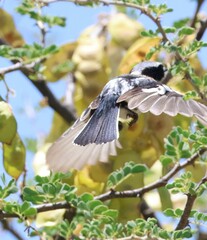
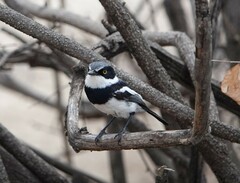
The pririt batis is strikingly patterned. The adult male has a dark grey crown and back, black eye mask and white throat. It has a black rump and tail, and its wing are black with white edging to the flight feathers and a long white shoulder patch. The underparts are white with a broad black breast band and black speckles on the flanks. The female and juvenile plumages differ in that there is no black breast band, but the throat and breast are a warm buff colour.

The pririt batis hunts by flycatching, or by taking prey from the ground like a shrike. The song is typically a slow descending series of whistled notes: teuu, teuu, teuu, teuu. Ian Sinclair, Phil Hockey and Warwick Tarboton, SASOL Birds of Southern Africa (Struik 2002) ISBN 1-86872-721-1 Pririt batis - Species text in The Atlas of Southern... Wikipedia →

Sounds

Duet0:26

Botswana · 2026

© Ehren Eksteen · XC1185162 · CC BY-NC-SA 4.0

Song0:12

South Africa · 2022

© Lynette Rudman · XC741518 · CC BY-NC-SA 4.0

Call0:06

South Africa · 2022

© Tony Archer · XC709661 · CC BY-NC-SA 4.0

Global Distribution

Parks Where Found

# Park Country Daily sighting probability
1 Waterberg Plateau Park 🇳🇦 Namibia
~60%
2 Namib-Naukluft National Park 🇳🇦 Namibia
~20%
3 Kgalagadi Transfrontier Park 🇿🇦 South Africa
~10%
4 Etosha National Park 🇳🇦 Namibia
~10%

Before you go

What are the chances of seeing a Pririt Batis in Kgalagadi Transfrontier Park?

With luck

About 10% of wildlife watchers report a Pririt Batis sighting in Kgalagadi Transfrontier Park on a given day, based on 78 verified sightings from GBIF citizen-science data from 2019 to 2026. It is the 60th most-seen of the 122 birds we can rate there. Over three days the chance rises to about 40%, and over a week to about 70%, if each day is a fresh chance.

When is the best time to see a Pririt Batis in Kgalagadi Transfrontier Park?

July

In that month about 30% of wildlife watchers report a Pririt Batis in Kgalagadi Transfrontier Park on a given day, against under 5% in January, the lowest month. That is one of Kgalagadi Transfrontier Park's driest months, with almost no rain against 40 mm in January. May has too few records to rate.

What time of day is best to see a Pririt Batis?

Between 7 and 10 am

Across all the parks we cover, that three-hour window holds the most Pririt Batis sightings with a recorded time, and about 9 in 10 of them come between 6 am and 6 pm: it is a daytime animal.

Is Kgalagadi Transfrontier Park the best place to see a Pririt Batis?

3rd of 4

Of the 4 parks where we can rate Pririt Batis sightings, Kgalagadi Transfrontier Park ranks 3rd at about 10%. The best odds are in Waterberg Plateau Park (Namibia, about 60%) and Namib-Naukluft National Park (Namibia, about 20%).

Which relatives of the Pririt Batis live in Kgalagadi Transfrontier Park?

Same order: Passeriformes

The closest relatives of the Pririt Batis that you can see in Kgalagadi Transfrontier Park (order Passeriformes, Perching Birds) are Fork-tailed Drongo (about 80%), White-browed Sparrow-Weaver (about 70%) and Social Weaver (about 70%), with each one's daily chance of a sighting.

Where does the Pririt Batis sighting chance come from?

GBIF citizen-science records

It is estimated from how often the Pririt Batis is recorded against all the birds logged in Kgalagadi Transfrontier Park (78 verified sightings from 2019 to 2026), calibrated against known sighting rates. Figures are rounded to the nearest 10% because citizen-science data supports honest approximations, not decimals, and months with records from fewer than five people show "—". How it works.

← Back to Kgalagadi Transfrontier Park