Red-headed Finch

Red-headed Finch

Amadina erythrocephala

Silhouette: Sheatherius · PhyloPic

LCLeast ConcernNTVUENCR
Daily sighting probability ~40% · Likely
at Kgalagadi Transfrontier Park

In 3 days ~70% in a week >90%

218 Verified sightings at Kgalagadi Transfrontier Park From 2019 to 2026
1,139 In all 4 parks
March Best month
☀️ Diurnal When it's spotted

About the Red-headed Finch

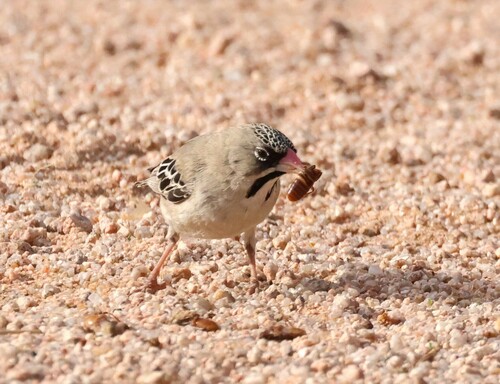
The red-headed finch (Amadina erythrocephala) (also known as the paradise finch) is a common species of estrildid finch found in Africa. It has an estimated global extent of occurrence of 1,600,000 km2 (620,000 sq mi). It is found in Angola, Botswana, Lesotho, Namibia, South Africa and Zimbabwe.

Males have vibrant red heads and chests while the females are duller. The resemblance to the cut-throat finch is unmistakable. The red-headed and cut-throat finch are the only members of the genus Amadina. Amadinas with their heavy beaks resemble members of the Lonchura, so they are actually more closely related to the Pytilias such as the Melba finch.

The red-headed finch was formally described by the Swedish naturalist Carl Linnaeus in 1758 in the tenth edition of his Systema Naturae under the binomial name Loxia eryocephala, a misspelling of Loxia erythrocephala. The specific epithet combines the Ancient Greek eruthros meaning "red" with -kephalos meaning "headed". Linnaeus based his description on "The Sparrow of Paradise" that had been described and illustrated in 1751 by the English naturalist George Edwards in his A Natural History of Uncommon Birds. Edwards' specimen had... Wikipedia →

Sounds

Call0:28

South Africa · 2021

© Tony Archer · XC681601 · CC BY-NC-SA 4.0

Song0:45

South Africa · 2017

© Lynette Rudman · XC386823 · CC BY-NC-SA 4.0

Flight call0:04

South Africa · 2017

© Faansie Peacock · XC382941 · CC BY-NC-SA 4.0

Global Distribution

Parks Where Found

# Park Country Daily sighting probability
1 Etosha National Park 🇳🇦 Namibia
~40%
2 Kgalagadi Transfrontier Park 🇿🇦 South Africa
~40%
3 Chobe National Park 🇧🇼 Botswana
<5%
4 Kruger National Park 🇿🇦 South Africa
<5%

Cities Where Found

# City Country Daily sighting probability
1 Johannesburg 🇿🇦 South Africa
~20%
2 Durban 🇿🇦 South Africa
~10%
3 Pretoria 🇿🇦 South Africa
~10%
4 Cape Town 🇿🇦 South Africa
<5%

Zoos & Centres Where Found

# Zoo / Centre Country
1 Parc des oiseaux 🇫🇷 France In captivity

Before you go

What are the chances of seeing a Red-headed Finch in Kgalagadi Transfrontier Park?

Likely

About 40% of wildlife watchers report a Red-headed Finch sighting in Kgalagadi Transfrontier Park on a given day, based on 218 verified sightings from GBIF citizen-science data from 2019 to 2026. It is the 24th most-seen of the 122 birds we can rate there. Over three days the chance rises to about 70%, and over a week to over 90%, if each day is a fresh chance.

When is the best time to see a Red-headed Finch in Kgalagadi Transfrontier Park?

March

In that month about 50% of wildlife watchers report a Red-headed Finch in Kgalagadi Transfrontier Park on a given day, against about 20% in January, the lowest month. That is one of Kgalagadi Transfrontier Park's wettest months, with about 25 mm of rain against almost none in July. May has too few records to rate.

What time of day is best to see a Red-headed Finch?

Between 9 am and noon

Across all the parks we cover, that three-hour window holds the most Red-headed Finch sightings with a recorded time, and nearly all of them come between 6 am and 6 pm: it is a daytime animal.

Is Kgalagadi Transfrontier Park the best place to see a Red-headed Finch?

Among the best

Of the 4 parks where we can rate Red-headed Finch sightings, Kgalagadi Transfrontier Park ranks 2nd at about 40%, level with the leaders once rounded. The best odds are in Etosha National Park (Namibia, about 40%).

Where does the Red-headed Finch sighting chance come from?

GBIF citizen-science records

It is estimated from how often the Red-headed Finch is recorded against all the birds logged in Kgalagadi Transfrontier Park (218 verified sightings from 2019 to 2026), calibrated against known sighting rates. Figures are rounded to the nearest 10% because citizen-science data supports honest approximations, not decimals, and months with records from fewer than five people show "—". How it works.

← Back to Kgalagadi Transfrontier Park