
Great Eared-Nightjar

Great Eared-Nightjar

Lyncornis macrotis

Silhouette: Sheatherius · PhyloPic

LCLeast ConcernNTVUENCR
Daily sighting probability ~20% · Possible
at Khao Yai National Park

In 3 days ~40% in a week ~70%

372 Verified sightings at Khao Yai National Park From 2019 to 2026
1,264 In all 5 parks
March Best month
☀️ Diurnal When it's spotted

About the Great Eared-Nightjar

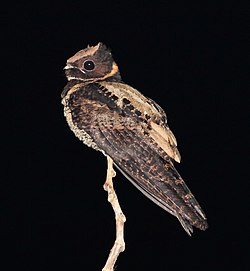
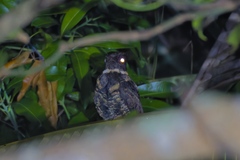
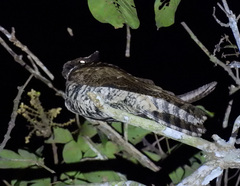
The great eared nightjar (Lyncornis macrotis) is a species of nightjar in the genus Lyncornis. It is found in southwest India and in parts of Southeast Asia. This very large nightjar has long barred wings, a barred tail and long ear-tufts which are often recumbent. It has a white throat band but has no white on its wings or on its tail.

The great eared nightjar was formally described in 1831 by the Irish zoologist Nicholas Aylward Vigors based on a sample collected in the neighbourhood of Manila in the Philippines. Vigors coined the binomial name Caprimulgus macrotis. The great eared nightjar was formerly placed in the genus Eurostopodus. It and the closely related Malaysian eared nightjar were moved to the resurrected genus Lyncornis based on the results of a molecular phylogenetic study published in 2010 that found large genetic differences between the great eared nightjar and other species in Eurostopodus. The genus name Lyncornis combines the Ancient Greek λύγξ /lunx/ (meaning "lynx") with ὄρνις /ornis/, meaning "bird". The specific epithet macrotis is from the Ancient Greek μακρὦτης /makrōtēs/, meaning "long-eared" (from μακρός /makros/ meaning "long" and οὖς /ous/... Wikipedia →

Sounds

Uncertain0:32

Indonesia · 2024

© Hamas Fathani · XC942192 · CC BY-SA 4.0

Song0:07

Indonesia · 2024

© Ding Li Yong · XC931271 · CC BY-NC-ND 4.0

Call0:12

Thailand · 2015

© Ross Gallardy · XC295014 · CC BY-NC-SA 4.0

Global Distribution

Parks Where Found

# Park Country Daily sighting probability
1 Cat Tien National Park 🇻🇳 Vietnam
~30%
2 Tangkoko Nature Reserve 🇮🇩 Indonesia
~20%
3 Khao Yai National Park 🇹🇭 Thailand
~20%
4 Periyar National Park 🇮🇳 India
~10%
5 Kaeng Krachan National Park 🇹🇭 Thailand
<5%

Before you go

What are the chances of seeing a Great Eared-Nightjar in Khao Yai National Park?

Possible

About 20% of wildlife watchers report a Great Eared-Nightjar sighting in Khao Yai National Park on a given day, based on 372 verified sightings from GBIF citizen-science data from 2019 to 2026. It is the 85th most-seen of the 278 birds we can rate there. Over three days the chance rises to about 40%, and over a week to about 70%, if each day is a fresh chance.

When is the best time to see a Great Eared-Nightjar in Khao Yai National Park?

March

In that month about 30% of wildlife watchers report a Great Eared-Nightjar in Khao Yai National Park on a given day, against under 5% in April and September, the lowest months. That is one of Khao Yai National Park's driest months, with about 85 mm of rain against 330 mm in September.

What time of day is best to see a Great Eared-Nightjar?

Between 11 am and 2 pm

Across all the parks we cover, that three-hour window holds the most Great Eared-Nightjar sightings with a recorded time, and about 7 in 10 of them come between 6 am and 6 pm: it is a daytime animal.

Is Khao Yai National Park the best place to see a Great Eared-Nightjar?

3rd of 5

Of the 5 parks where we can rate Great Eared-Nightjar sightings, Khao Yai National Park ranks 3rd at about 20%. The best odds are in Cat Tien National Park (Vietnam, about 30%) and Tangkoko Nature Reserve (Indonesia, about 20%).

Where does the Great Eared-Nightjar sighting chance come from?

GBIF citizen-science records

It is estimated from how often the Great Eared-Nightjar is recorded against all the birds logged in Khao Yai National Park (372 verified sightings from 2019 to 2026), calibrated against known sighting rates. Figures are rounded to the nearest 10% because citizen-science data supports honest approximations, not decimals, and months with records from fewer than five people show "—". How it works.

← Back to Khao Yai National Park