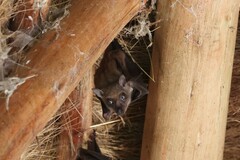
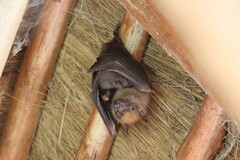
Angolan Rousette

Angolan Rousette

Myonycteris angolensis

Silhouette: Steven Traver · PhyloPic

Daily sighting probability ~20% · Possible
at Kibale National Park

In 3 days ~50% in a week ~80%

7 Verified sightings at Kibale National Park From 2019 to 2026
7 In 1 park
April Best month
☀️ Diurnal When it's spotted

About the Angolan Rousette

The Angolan fruit bat, Angolan rousette or silky bat (Myonycteris angolensis) is a species of megabat in the family Pteropodidae. It is found in Angola, Burundi, Cameroon, Central African Republic, Republic of Congo, Democratic Republic of Congo, Kenya, Nigeria, Rwanda, Sudan, Tanzania, Uganda, and Zambia. Its natural habitats are subtropical or tropical moist lowland forest, moist savanna, and rocky areas.

It was described in 1898 by Portuguese zoologist José Vicente Barbosa du Bocage. Bocage initially placed it in the now-defunct genus Cynonycteris, with a binomial of C. angolensis. Its species name "angolensis" is Latin for "Angolan," likely in reference to the fact that the holotype was collected near Pungo Andongo in Angola.

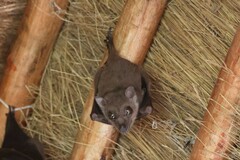
Its forearm length is 68–90 mm (2.7–3.5 in) and it weighs 60–87 g (2.1–3.1 oz). It is frugivorous. Consumed fruits include fruits of various trees, including fig trees, Anthocleista, Milicia excelsa, and Adenia. The Angolan rousette has a wide range encompassing parts of West, East, and Central Africa. It is found from sea level to 4,000 m (13,000 ft) above sea... Wikipedia →
Global Distribution

Parks Where Found

# Park Country Daily sighting probability
1 Kibale National Park 🇺🇬 Uganda
~20%

More parks will be added in future updates.

Closest Relatives at Kibale National Park

No species of the same family or order lives in Kibale National Park, so these are its closest relatives here: other mammals.

Before you go

What are the chances of seeing an Angolan Rousette in Kibale National Park?

Possible

About 20% of wildlife watchers report an Angolan Rousette sighting in Kibale National Park on a given day, based on 7 verified sightings from GBIF citizen-science data from 2019 to 2026. It is the 12th most-seen of the 13 mammals we can rate there. Over three days the chance rises to about 50%, and over a week to about 80%, if each day is a fresh chance.

When is the best time to see an Angolan Rousette in Kibale National Park?

April

In that month about 60% of wildlife watchers report an Angolan Rousette in Kibale National Park on a given day, against under 5% in February–March, May and July–December, the lowest months.

What time of day is best to see an Angolan Rousette?

Between 9 am and noon

Across all the parks we cover, that three-hour window holds the most Angolan Rousette sightings with a recorded time, and about 7 in 10 of them come between 6 am and 6 pm: it is a daytime animal.

Where else can you see an Angolan Rousette?

Only Kibale National Park, in our data

Kibale National Park is the only park on Wallace's Line with enough records to rate Angolan Rousette sightings: about 20% of wildlife watchers there report one on a given day.

Where does the Angolan Rousette sighting chance come from?

GBIF citizen-science records

It is estimated from how often the Angolan Rousette is recorded against all the mammals logged in Kibale National Park (7 verified sightings from 2019 to 2026), calibrated against known sighting rates. Figures are rounded to the nearest 10% because citizen-science data supports honest approximations, not decimals, and months with records from fewer than five people show "—". How it works.

← Back to Kibale National Park