African Forest Elephant

African Forest Elephant

Loxodonta cyclotis

Silhouette: Richard Ruggiero, vectorized by Zimices · PhyloPic

LCNTVUENCRCritically Endangered
Daily sighting probability ~20% · Possible
at Kibale National Park

In 3 days ~40% in a week ~70%

6 Verified sightings at Kibale National Park From 2019 to 2026
56 In all 2 parks
May Best month
☀️ Diurnal When it's spotted

About the African Forest Elephant

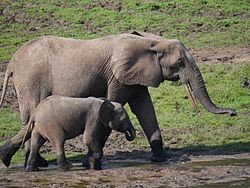
The African forest elephant (Loxodonta cyclotis) is an elephant species native to humid tropical forests in West Africa and the Congo Basin. It was first described in 1900. With an average shoulder height of 2.16 m (7 ft 1 in), it is the smallest of the three extant elephant species. Both sexes have straight, down-pointing tusks, which begin to grow at the age of 1–3 years.

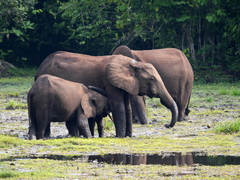
The African forest elephant lives in highly sociable family groups of up to 20 individuals comprising adult cows, their daughters and sons. When young bulls reach sexual maturity, they separate from the family group and form loose bachelor groups for a short time, but usually stay alone. Adult bulls associate with family groups only during the mating season.

The African forest elephant forages on leaves, seeds, fruit, and tree bark of at least 96 plant species. Since it disseminates partly digested seeds for at least 5 km (3.1 mi) through its droppings, it contributes significantly to maintaining the diversity and structure of the Guinean Forests of West Africa and the Congolese rainforests.

During the 20th century, overhunting caused a sharp decline of the African forest elephant population, and by 2013 it was estimated that fewer than 30,000 individuals remained. It is threatened by habitat loss, fragmentation, and poaching. The conservation status of populations varies across range countries. Since 2021, it has been listed as Critically Endangered on the IUCN Red List. Wikipedia →

Sounds

Alarm call0:20

Central African Republic · 2025

© Antoine Ede · XC1059781 · CC BY-NC-SA 4.0

Defensive call0:20

Central African Republic · 2025

© Antoine Ede, Dzanga-Sangha protected Areas · XC1037635 · CC BY-NC-SA 4.0

Recording1:21

Central African Republic · 2019

© Mathias D'haen · iNaturalist · CC BY-NC 4.0

Global Distribution

Parks Where Found

# Park Country Daily sighting probability
1 Odzala-Kokoua National Park 🇨🇬 Republic of the Congo
~50%
2 Kibale National Park 🇺🇬 Uganda
~20%

Zoos & Centres Where Found

# Zoo / Centre Country
1 Friguia Park 🇹🇳 Tunisia In captivity
2 Abidjan zoo 🇨🇮 Côte d’Ivoire In captivity

Closest Relatives at Kibale National Park

No species of the same family or order lives in Kibale National Park, so these are its closest relatives here: other mammals.

Before you go

What are the chances of seeing an African Forest Elephant in Kibale National Park?

Possible

About 20% of wildlife watchers report an African Forest Elephant sighting in Kibale National Park on a given day, based on 6 verified sightings from GBIF citizen-science data from 2019 to 2026. It is the 13th most-seen of the 13 mammals we can rate there. Over three days the chance rises to about 40%, and over a week to about 70%, if each day is a fresh chance.

When is the best time to see an African Forest Elephant in Kibale National Park?

May

In that month about 40% of wildlife watchers report an African Forest Elephant in Kibale National Park on a given day, against under 5% in February–April, June and August–November, the lowest months.

What time of day is best to see an African Forest Elephant?

Between 4 and 7 pm

Across all the parks we cover, that three-hour window holds the most African Forest Elephant sightings with a recorded time, and about 9 in 10 of them come between 6 am and 6 pm: it is a daytime animal.

Is Kibale National Park the best place to see an African Forest Elephant?

2nd of 2

Of the 2 parks where we can rate African Forest Elephant sightings, Kibale National Park ranks 2nd at about 20%. The best odds are in Odzala-Kokoua National Park (Republic of the Congo, about 50%).

Where does the African Forest Elephant sighting chance come from?

GBIF citizen-science records

It is estimated from how often the African Forest Elephant is recorded against all the mammals logged in Kibale National Park (6 verified sightings from 2019 to 2026), calibrated against known sighting rates. Figures are rounded to the nearest 10% because citizen-science data supports honest approximations, not decimals, and months with records from fewer than five people show "—". How it works.

← Back to Kibale National Park