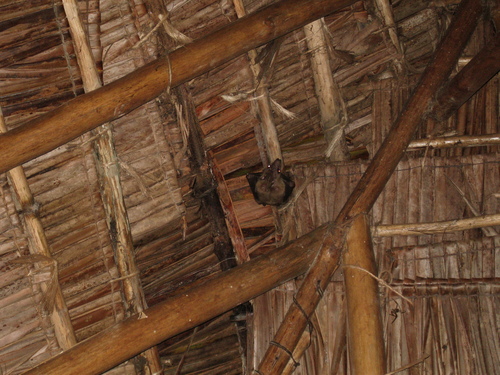
L'Hoest's Guenon

L'Hoest's Guenon

Allochrocebus lhoesti

Silhouette: PhyloPic

LCNTVUVulnerableENCR
Daily sighting probability ~30% · Possible
at Kibale National Park

In 3 days ~70% in a week ~90%

22 Verified sightings at Kibale National Park From 2019 to 2026
278 In all 3 parks
April Best month
☀️ Diurnal When it's spotted

About the L'Hoest's Guenon

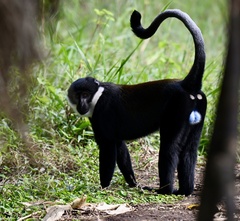
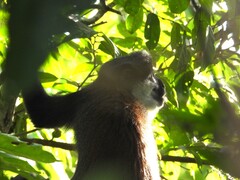
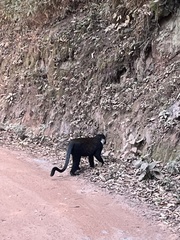
L'Hoest's monkey (Allochrocebus lhoesti), also known as the mountain monkey, is a guenon found in the upper eastern Congo Basin. They mostly live in mountainous forest areas in small, female-dominated groups. They have a dark coat and can be distinguished by a characteristic white beard.

Philip Lutley Sclater originally gave the specific name Cercopithecus lhoesti in honor of François L'Hoëst, director of the Antwerp Zoo, in 1898. L'Hoest's monkey is currently classified as a member of the genus Allochrocebus. Formerly, L'Hoest's monkey included the taxon preussi from the Gulf of Guinea region as a subspecies, but it is now considered a separate species, Preuss's monkey (A. preussi).

L'Hoest's monkey was formerly included in the genus Cercopithecus. Molecular studies published by Anthony Tosi in 2003 had raised doubts about the classification of L'Hoest's monkey as a member of the genus Cercopithecus. The studies indicated that L'Hoest's monkey (along with the others in its species group) is more closely related to the vervet monkeys of the genus Chlorocebus and the patas monkey (genus Erythrocebus) than to the other guenons of the genus Cercopithecus. Wikipedia →

Global Distribution

Parks Where Found

# Park Country Daily sighting probability
1 Nyungwe National Park 🇷🇼 Rwanda
~80%
2 Bwindi Impenetrable National Park 🇺🇬 Uganda
~70%
3 Kibale National Park 🇺🇬 Uganda
~30%

Zoos & Centres Where Found

# Zoo / Centre Country
1 Aquarium de Lyon 🇫🇷 France In captivity
2 Parco Natura Viva 🇮🇹 Italy In captivity
3 Nanning Zoo 🇨🇳 China In captivity
4 Colchester Zoo 🇬🇧 United Kingdom In captivity
5 Edinburgh Zoo 🇬🇧 United Kingdom In captivity
6 Twycross Zoo 🇬🇧 United Kingdom In captivity
7 Parken Zoo 🇸🇪 Sweden In captivity
8 Apenheul Primate Park 🇳🇱 Netherlands In captivity
9 Monkey Town 🇿🇦 South Africa In captivity
10 Aquarium de Paris 🇫🇷 France In captivity

Before you go

What are the chances of seeing a L'Hoest's Guenon in Kibale National Park?

Possible

About 30% of wildlife watchers report a L'Hoest's Guenon sighting in Kibale National Park on a given day, based on 22 verified sightings from GBIF citizen-science data from 2019 to 2026. It is the 9th most-seen of the 13 mammals we can rate there. Over three days the chance rises to about 70%, and over a week to about 90%, if each day is a fresh chance.

When is the best time to see a L'Hoest's Guenon in Kibale National Park?

April

In that month about 50% of wildlife watchers report a L'Hoest's Guenon in Kibale National Park on a given day, against under 5% in October and December, the lowest months.

What time of day is best to see a L'Hoest's Guenon?

Between 3 and 6 pm

Across all the parks we cover, that three-hour window holds the most L'Hoest's Guenon sightings with a recorded time, and about 9 in 10 of them come between 6 am and 6 pm: it is a daytime animal.

Is Kibale National Park the best place to see a L'Hoest's Guenon?

3rd of 3

Of the 3 parks where we can rate L'Hoest's Guenon sightings, Kibale National Park ranks 3rd at about 30%. The best odds are in Nyungwe National Park (Rwanda, about 80%) and Bwindi Impenetrable National Park (Uganda, about 70%).

Which relatives of the L'Hoest's Guenon live in Kibale National Park?

Same family: Cercopithecidae

The closest relatives of the L'Hoest's Guenon that you can see in Kibale National Park (family Cercopithecidae, Old World Monkeys) are Olive Baboon (about 80%), Red-tailed Monkey (about 80%) and Ashy Red Colobus (about 70%), with each one's daily chance of a sighting.

Where does the L'Hoest's Guenon sighting chance come from?

GBIF citizen-science records

It is estimated from how often the L'Hoest's Guenon is recorded against all the mammals logged in Kibale National Park (22 verified sightings from 2019 to 2026), calibrated against known sighting rates. Figures are rounded to the nearest 10% because citizen-science data supports honest approximations, not decimals, and months with records from fewer than five people show "—". How it works.

← Back to Kibale National Park