Banded Snake-Eagle

Banded Snake-Eagle

Circaetus cinerascens

Silhouette: Sheatherius · PhyloPic

LCLeast ConcernNTVUENCR
Daily sighting probability <5% · Rare
at Kibale National Park

In 3 days ~10% in a week ~30%

69 Verified sightings at Kibale National Park From 2019 to 2026
1,410 In all 19 parks
February Best month
☀️ Diurnal When it's spotted

About the Banded Snake-Eagle

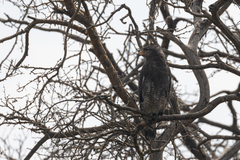
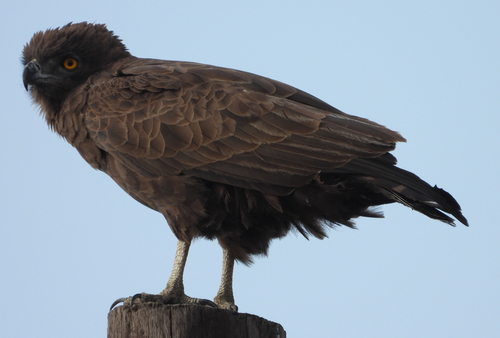
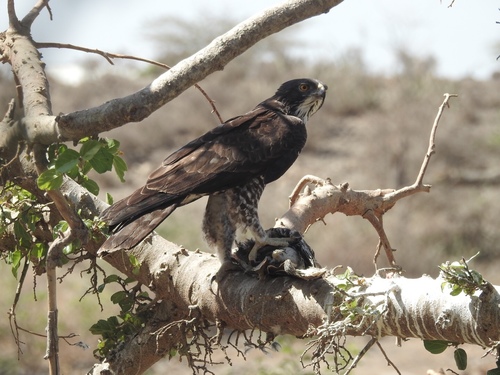
The western banded snake eagle (Circaetus cinerascens) is a grey-brown African raptor with a short tail and a large head. Juveniles have paler and browner upper parts than adults, with white-edged feathers. The eagle's head, neck and breast are dark-streaked. The underparts are white with pale brown streaks, mainly on belly and thighs. Subadults may be all dark grey-brown without any streak on underparts. The eyes, ears, and legs are yellow. They have crested chests.

It has a total length of 50-58 cm (19 to 22 in) and a wingspan of 120-134 cm (3 ft 11 in to 4 ft 4 in) Western banded snake eagles live in woodlands, mainly along rivers, but they avoid dense forests. Western banded snake eagles mainly hunt snakes, but also other small vertebrates, ambushing from a perch. They drop from the perch to trunk, foliage or ground. They are solitary birds, and very secretive. Due to their sedentary lifestyle, they are often detected only by their calls.

The western banded snake eagle sometimes rises to soar, while it calls above the canon. They utter a loud, high-pitched 'kok-kok-kok-kok-kok'. They are found in Africa in the... Wikipedia →

Sounds

Flight call0:29

Zambia · 2005

© Derek Solomon · XC39308 · CC BY-NC-ND 2.5

Call0:59

Ghana · 2022

© Peter Boesman · XC719017 · CC BY-NC-ND 4.0

Call0:24

Malawi · 2015

© Frank Lambert · XC365263 · CC BY-NC-ND 4.0

Global Distribution

Parks Where Found

# Park Country Daily sighting probability
1 Liwonde National Park 🇲🇼 Malawi
~30%
2 Niokolo-Koba National Park 🇸🇳 Senegal
~30%
3 South Luangwa National Park 🇿🇲 Zambia
~20%
4 Kafue National Park 🇿🇲 Zambia
~20%
5 Meru National Park 🇰🇪 Kenya
~20%
6 Queen Elizabeth National Park 🇺🇬 Uganda
~20%
7 Lower Zambezi National Park 🇿🇲 Zambia
~20%
8 Murchison Falls National Park 🇺🇬 Uganda
~10%
9 Mana Pools National Park 🇿🇼 Zimbabwe
~10%
10 Lake Mburo National Park 🇺🇬 Uganda
~10%
11 Akagera National Park 🇷🇼 Rwanda
~10%
12 Semuliki National Park 🇺🇬 Uganda
~10%
13 Kibale National Park 🇺🇬 Uganda
<5%
14 Ruaha National Park 🇹🇿 Tanzania
<5%
15 Virunga National Park 🇨🇩 Democratic Republic of the Congo
<5%
16 Masai Mara National Reserve 🇰🇪 Kenya
<5%
17 Kidepo Valley National Park 🇺🇬 Uganda
<5%
18 Moremi Game Reserve 🇧🇼 Botswana
<5%
19 Serengeti National Park 🇹🇿 Tanzania
<5%

Cities Where Found

# City Country Daily sighting probability
1 Kigali 🇷🇼 Rwanda
<5%
2 Kampala 🇺🇬 Uganda
<5%

Before you go

What are the chances of seeing a Banded Snake-Eagle in Kibale National Park?

Rare

Under 5% of wildlife watchers report a Banded Snake-Eagle sighting in Kibale National Park on a given day, based on 69 verified sightings from GBIF citizen-science data from 2019 to 2026. It is the 192nd most-seen of the 366 birds we can rate there. Over three days the chance rises to about 10%, and over a week to about 30%, if each day is a fresh chance.

When is the best time to see a Banded Snake-Eagle in Kibale National Park?

February, August and October

In those months about 10% of wildlife watchers report a Banded Snake-Eagle in Kibale National Park on a given day, against under 5% in March–July, September and November–January, the lowest months.

What time of day is best to see a Banded Snake-Eagle?

Between 9 am and noon

Across all the parks we cover, that three-hour window holds the most Banded Snake-Eagle sightings with a recorded time, and about 9 in 10 of them come between 6 am and 6 pm: it is a daytime animal.

Where does the Banded Snake-Eagle sighting chance come from?

GBIF citizen-science records

It is estimated from how often the Banded Snake-Eagle is recorded against all the birds logged in Kibale National Park (69 verified sightings from 2019 to 2026), calibrated against known sighting rates. Figures are rounded to the nearest 10% because citizen-science data supports honest approximations, not decimals, and months with records from fewer than five people show "—". How it works.

← Back to Kibale National Park