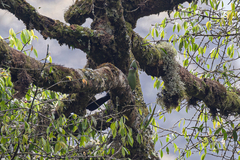
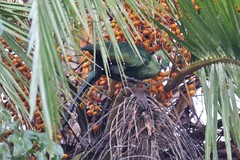
Black-billed Turaco

Black-billed Turaco

Tauraco schuettii

Silhouette: Lisa M. "Pixxl" (photo), John E. McCormack, Michael G. Harvey, Brant C. Faircloth, Nicholas G. Crawford, Travis C. Glenn, Robb T. Brumfield & T. Michael Keesey · PhyloPic

LCLeast ConcernNTVUENCR
Daily sighting probability ~20% · Possible
at Kibale National Park

In 3 days ~50% in a week ~80%

308 Verified sightings at Kibale National Park From 2019 to 2026
1,957 In all 6 parks
September Best month
☀️ Diurnal When it's spotted

About the Black-billed Turaco

The black-billed turaco (Tauraco schuettii) is a medium-sized turaco, an endemic family to sub-Saharan Africa. It is a resident breeder in the forests of central Africa, found in the Democratic Republic of Congo, Uganda, West Kenya, Burundi, Rwanda and South Sudan.

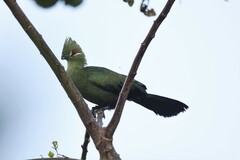
The bird is 40 cm (16 in) long; ranging in weight from 199–272 g (7.0–9.6 oz). Adult similar to green turaco, distinguished by small all-black bill and rounded whitish crest. It lays two eggs in a platform of twigs around 3 to 5 m (9.8 to 16.4 ft) above the ground. Both the male and female defend a territory and share incubation duties.

Its call is a distinctive feature of the forests of the Congo, a resonant kwah khaw kwah. In areas where its range overlaps with the Rwenzori turaco it will aggressively respond to the calls of that species. It is a widespread species and is not threatened globally (CITES II).

Del Hoyo, Elliott and Sargatal (editors), Handbook of the Birds of the World, Vol 4, ISBN 84-87334-22-9 Wikipedia →

Sounds

Song0:13

Uganda · 2015

© Martin St-Michel · XC236325 · CC BY-NC-SA 4.0

Uncertain1:26

Uganda · 2005

© András Schmidt · XC700619 · CC BY-NC-SA 4.0

Call0:29

Rwanda · 2010

© Marcell Claassen · XC67421 · CC BY-NC-ND 2.5

Global Distribution

Parks Where Found

# Park Country Daily sighting probability
1 Bwindi Impenetrable National Park 🇺🇬 Uganda
~40%
2 Nyungwe National Park 🇷🇼 Rwanda
~40%
3 Kibale National Park 🇺🇬 Uganda
~20%
4 Semuliki National Park 🇺🇬 Uganda
~20%
5 Virunga National Park 🇨🇩 Democratic Republic of the Congo
<5%
6 Volcanoes National Park 🇷🇼 Rwanda
<5%

Zoos & Centres Where Found

# Zoo / Centre Country
1 Zoo d'Amnéville 🇫🇷 France In captivity
2 Aquarium d'Amnéville 🇫🇷 France In captivity

Before you go

What are the chances of seeing a Black-billed Turaco in Kibale National Park?

Possible

About 20% of wildlife watchers report a Black-billed Turaco sighting in Kibale National Park on a given day, based on 308 verified sightings from GBIF citizen-science data from 2019 to 2026. It is the 79th most-seen of the 366 birds we can rate there. Over three days the chance rises to about 50%, and over a week to about 80%, if each day is a fresh chance.

When is the best time to see a Black-billed Turaco in Kibale National Park?

May and September–October

In those months about 30% of wildlife watchers report a Black-billed Turaco in Kibale National Park on a given day, against under 5% in November, the lowest month. Those are among Kibale National Park's wettest months, with about 110 mm of rain a month against 20 mm in February.

What time of day is best to see a Black-billed Turaco?

Between 6 and 9 am

Across all the parks we cover, that three-hour window holds the most Black-billed Turaco sightings with a recorded time, and about 9 in 10 of them come between 6 am and 6 pm: it is a daytime animal.

Which relatives of the Black-billed Turaco live in Kibale National Park?

Same family: Musophagidae

The closest relatives of the Black-billed Turaco that you can see in Kibale National Park (family Musophagidae, Turacos) are Great Blue Turaco (about 60%), Eastern Grey Plantain-eater (about 30%) and Ross' Turaco (about 20%), with each one's daily chance of a sighting.

Where does the Black-billed Turaco sighting chance come from?

GBIF citizen-science records

It is estimated from how often the Black-billed Turaco is recorded against all the birds logged in Kibale National Park (308 verified sightings from 2019 to 2026), calibrated against known sighting rates. Figures are rounded to the nearest 10% because citizen-science data supports honest approximations, not decimals, and months with records from fewer than five people show "—". How it works.

← Back to Kibale National Park