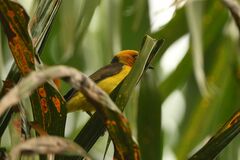
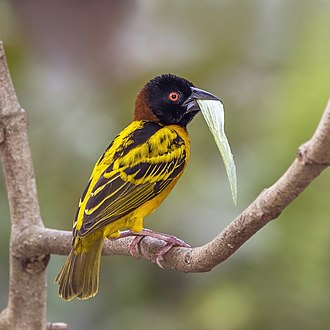
Black-necked Weaver

Black-necked Weaver

Ploceus nigricollis

Silhouette: Sheatherius · PhyloPic

LCLeast ConcernNTVUENCR
Daily sighting probability ~40% · Likely
at Kibale National Park

In 3 days ~80% in a week >90%

684 Verified sightings at Kibale National Park From 2019 to 2026
2,168 In all 19 parks
March Best month
☀️ Diurnal When it's spotted

About the Black-necked Weaver

The black-necked weaver (Ploceus nigricollis) is a resident breeding bird species in much of central Africa from Cameroon in the west to Kenya and southern Somalia in the east. The species was formally described in 1805 by the French ornithologist Louis Pierre Vieillot, who named it Malimbus nigricollis. The description was based on a specimen that had been collected near Malimbe, now Malembo, in the Cabinda Province of Angola. The species epithet nigricollis combines the Latin words Latin words, niger meaning "black" and collis meaning "necked".

Also on the island of on Bioko The black-necked weaver was formerly considered to be conspecific with the olive-naped weaver. The two species differ in plumage and in the colour of the iris. A molecular study published in 2019 found that the two... Wikipedia →

Sounds

Begging call0:10

Senegal · 2023

© Alain Malengreau · XC862006 · CC BY-NC-SA 4.0

Call0:40

Ghana · 2019

© Phil Gregory · XC612381 · CC BY-NC-SA 4.0

Song0:07

Kenya · 2020

© isaac kilusu · XC603442 · CC BY-NC-SA 4.0

Global Distribution

Parks Where Found

# Park Country Daily sighting probability
1 Kibale National Park 🇺🇬 Uganda
~40%
2 Bwindi Impenetrable National Park 🇺🇬 Uganda
~30%
3 Mkomazi National Park 🇹🇿 Tanzania
~30%
4 Tsavo West National Park 🇰🇪 Kenya
~20%
5 Ruaha National Park 🇹🇿 Tanzania
~10%
6 Samburu National Reserve 🇰🇪 Kenya
~10%
7 Tarangire National Park 🇹🇿 Tanzania
~10%
8 Lake Mburo National Park 🇺🇬 Uganda
~10%
9 Semuliki National Park 🇺🇬 Uganda
~10%
10 Amboseli National Park 🇰🇪 Kenya
~10%
11 Virunga National Park 🇨🇩 Democratic Republic of the Congo
~10%
12 Tsavo East National Park 🇰🇪 Kenya
~10%
13 Lake Manyara National Park 🇹🇿 Tanzania
<5%
14 Queen Elizabeth National Park 🇺🇬 Uganda
<5%
15 Murchison Falls National Park 🇺🇬 Uganda
<5%
16 Serengeti National Park 🇹🇿 Tanzania
<5%
17 Akagera National Park 🇷🇼 Rwanda
<5%
18 Masai Mara National Reserve 🇰🇪 Kenya
<5%
19 Nyungwe National Park 🇷🇼 Rwanda
<5%

Cities Where Found

# City Country Daily sighting probability
1 Brazzaville 🇨🇬 Republic of the Congo
~30%
2 Yaoundé 🇨🇲 Cameroon
~20%
3 Kampala 🇺🇬 Uganda
~10%
4 Kigali 🇷🇼 Rwanda
<5%

Before you go

What are the chances of seeing a Black-necked Weaver in Kibale National Park?

Likely

About 40% of wildlife watchers report a Black-necked Weaver sighting in Kibale National Park on a given day, based on 684 verified sightings from GBIF citizen-science data from 2019 to 2026. It is the 21st most-seen of the 366 birds we can rate there. Over three days the chance rises to about 80%, and over a week to over 90%, if each day is a fresh chance.

When is the best time to see a Black-necked Weaver in Kibale National Park?

February–March and June

In those months about 50% of wildlife watchers report a Black-necked Weaver in Kibale National Park on a given day, against about 20% in November, the lowest month.

What time of day is best to see a Black-necked Weaver?

Between 5 and 8 am

Across all the parks we cover, that three-hour window holds the most Black-necked Weaver sightings with a recorded time, and about 8 in 10 of them come between 6 am and 6 pm: it is a daytime animal.

Is Kibale National Park the best place to see a Black-necked Weaver?

Yes

Of the 19 parks where we can rate Black-necked Weaver sightings, Kibale National Park has the highest daily chance: about 40%. Next come Bwindi Impenetrable National Park (Uganda, about 30%) and Mkomazi National Park (Tanzania, about 30%).

Which relatives of the Black-necked Weaver live in Kibale National Park?

Same genus: Ploceus

The closest relatives of the Black-necked Weaver that you can see in Kibale National Park (genus Ploceus, Typical Weavers) are Vieillot's Weaver (about 50%), Village Weaver (about 30%) and Black-headed Weaver (about 20%), with each one's daily chance of a sighting.

Where does the Black-necked Weaver sighting chance come from?

GBIF citizen-science records

It is estimated from how often the Black-necked Weaver is recorded against all the birds logged in Kibale National Park (684 verified sightings from 2019 to 2026), calibrated against known sighting rates. Figures are rounded to the nearest 10% because citizen-science data supports honest approximations, not decimals, and months with records from fewer than five people show "—". How it works.

← Back to Kibale National Park