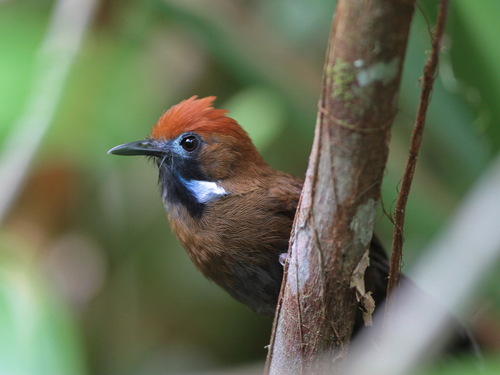
Bare-headed Babbler

Bare-headed Babbler

Melanocichla calva

Silhouette: Sheatherius · PhyloPic

LCLeast ConcernNTVUENCR
Daily sighting probability ~10% · With luck
at Kinabalu Park

In 3 days ~40% in a week ~70%

377 Verified sightings at Kinabalu Park From 2019 to 2026
377 In 1 park
March Best month
☀️ Diurnal When it's spotted

About the Bare-headed Babbler

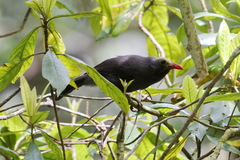
The bare-headed laughingthrush (Melanocichla calva) is a species of bird in the Old World babbler family Timaliidae. It is endemic to highland forests at elevations of 750–1,800 m (2,460–5,910 ft) in the mountain ranges of north-central Borneo, along with some outlying peaks. It is 25–26 cm (9.8–10.2 in) long, with both sexes similar in appearance. The head is brownish to greenish yellow and featherless. The area along the lower mandible has a bluish tinge. The rest of the body is dull blackish-brown tinged with grey. Juveniles have more feathers on the head, extending from the forehead to the crown.

Described by the British ornithologist Richard Bowdler Sharpe in 1888, the bare-headed laughingthrush was then treated as a subspecies of the black laughingthrush from 1935 to 2006, when it was restored to full species status. It feeds on insects such as crickets, cicadas, and ants in dense columns of vegetation formed by vines growing around trees. Although it is classified as being of least concern by the International Union for Conservation of Nature, it is threatened by habitat destruction and fragmentation and its population is thought to be decreasing. Wikipedia →

Sounds

Song0:15

Malaysia · 2022

© Wai Loon Wong · XC775426 · CC BY-NC-SA 4.0

Call0:14

Malaysia · 1982

© Jelle Scharringa · XC665100 · CC BY-NC-SA 4.0

Call?0:15

Malaysia · 2009

© Sander Pieterse · XC36300 · CC BY-NC-ND 2.5

Global Distribution

Parks Where Found

# Park Country Daily sighting probability
1 Kinabalu Park 🇲🇾 Malaysia
~10%

More parks will be added in future updates.

Before you go

What are the chances of seeing a Bare-headed Babbler in Kinabalu Park?

With luck

About 10% of wildlife watchers report a Bare-headed Babbler sighting in Kinabalu Park on a given day, based on 377 verified sightings from GBIF citizen-science data from 2019 to 2026. It is the 55th most-seen of the 247 birds we can rate there. Over three days the chance rises to about 40%, and over a week to about 70%, if each day is a fresh chance.

When is the best time to see a Bare-headed Babbler in Kinabalu Park?

March

In that month about 30% of wildlife watchers report a Bare-headed Babbler in Kinabalu Park on a given day, against under 5% in December and January, the lowest months.

What time of day is best to see a Bare-headed Babbler?

Between 9 am and noon

Across all the parks we cover, that three-hour window holds the most Bare-headed Babbler sightings with a recorded time, and about 8 in 10 of them come between 6 am and 6 pm: it is a daytime animal.

Where else can you see a Bare-headed Babbler?

Only Kinabalu Park, in our data

Kinabalu Park is the only park on Wallace's Line with enough records to rate Bare-headed Babbler sightings: about 10% of wildlife watchers there report one on a given day.

Where does the Bare-headed Babbler sighting chance come from?

GBIF citizen-science records

It is estimated from how often the Bare-headed Babbler is recorded against all the birds logged in Kinabalu Park (377 verified sightings from 2019 to 2026), calibrated against known sighting rates. Figures are rounded to the nearest 10% because citizen-science data supports honest approximations, not decimals, and months with records from fewer than five people show "—". How it works.

← Back to Kinabalu Park