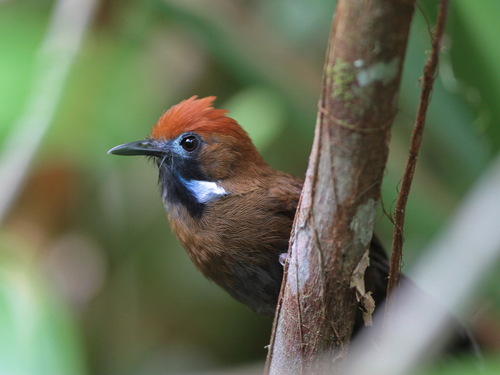
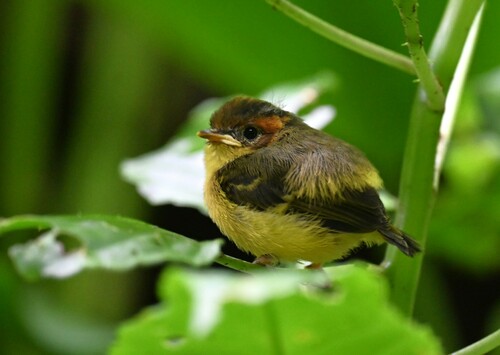
Gray-throated Babbler

Gray-throated Babbler

Stachyris nigriceps

Silhouette: Sheatherius · PhyloPic

LCLeast ConcernNTVUENCR
Daily sighting probability ~50% · Likely
at Kinabalu Park

In 3 days ~90% in a week >90%

1,565 Verified sightings at Kinabalu Park From 2019 to 2026
3,397 In all 10 parks
February Best month
🌅 Crepuscular When it's spotted

About the Gray-throated Babbler

The grey-throated babbler (Stachyris nigriceps) is a species of passerine bird in the Old World babbler family Timaliidae. It is found in Bangladesh, Bhutan, China, India, Indonesia, Laos, Malaysia, Myanmar, Nepal, Thailand, and Vietnam. Its natural habitats are subtropical or tropical moist lowland forest and subtropical or tropical moist montane forest.

The grey-throated babbler was formally described in 1844 by the English zoologist Edward Blyth under the current binomial name Stachyris nigriceps. He specified the locality as Nepal. The genus name combines the Ancient Greek stakhus meaning "ear of wheat" and rhis, rhinos meaning "nostrils". The specific epithet nigriceps is from Latin niger meaning "black" and "-ceps" meaning "-headed".

Twelve subspecies are recognised: Stachyris nigriceps nigriceps Blyth, 1844 – central, east Himalayas Stachyris nigriceps coltarti Harington, 1913 – northeast India, north Myanmar and southwest China Stachyris nigriceps spadix Ripley, 1948 – east, south Assam (northeast India), east Bangladesh, south, southeast Myanmar and northwest, west Thailand

Stachyris nigriceps yunnanensis La Touche, 1921 – east Myanmar, north Thailand and south... Wikipedia →

Sounds

Alarm call0:36

Malaysia · 2026

© Ding Li Yong · XC1103260 · CC BY-NC-ND 4.0

Song0:58

China · 2024

© Dave GUO · XC973773 · CC BY-NC-SA 4.0

Call0:28

Malaysia · 2022

© Wai Loon Wong · XC739090 · CC BY-NC-SA 4.0

Global Distribution

Parks Where Found

# Park Country Daily sighting probability
1 Kerinci Seblat National Park 🇮🇩 Indonesia
~60%
2 Kinabalu Park 🇲🇾 Malaysia
~50%
3 Namdapha National Park 🇮🇳 India
~30%
4 Royal Manas National Park 🇧🇹 Bhutan
~20%
5 Doi Inthanon National Park 🇹🇭 Thailand
~20%
6 Cuc Phuong National Park 🇻🇳 Vietnam
~20%
7 Khao Sok National Park 🇹🇭 Thailand
~10%
8 Gunung Leuser National Park 🇮🇩 Indonesia
<5%
9 Kaeng Krachan National Park 🇹🇭 Thailand
<5%
10 Manas National Park 🇮🇳 India
<5%

Cities Where Found

# City Country Daily sighting probability
1 Kathmandu 🇳🇵 Nepal
<5%

Before you go

What are the chances of seeing a Gray-throated Babbler in Kinabalu Park?

Likely

About 50% of wildlife watchers report a Gray-throated Babbler sighting in Kinabalu Park on a given day, based on 1,565 verified sightings from GBIF citizen-science data from 2019 to 2026. It is the 14th most-seen of the 247 birds we can rate there. Over three days the chance rises to about 90%, and over a week to over 90%, if each day is a fresh chance.

When is the best time to see a Gray-throated Babbler in Kinabalu Park?

February

In that month about 70% of wildlife watchers report a Gray-throated Babbler in Kinabalu Park on a given day, against about 40% in May and June, the lowest months. That is one of Kinabalu Park's driest months, with about 180 mm of rain against 550 mm in June.

What time of day is best to see a Gray-throated Babbler?

Between 2 and 5 am

Across all the parks we cover, that three-hour window holds the most Gray-throated Babbler sightings with a recorded time, and about 6 in 10 of them come between 6 pm and 6 am: it is most active around dawn and dusk.

Is Kinabalu Park the best place to see a Gray-throated Babbler?

2nd of 10

Of the 10 parks where we can rate Gray-throated Babbler sightings, Kinabalu Park ranks 2nd at about 50%. The best odds are in Kerinci Seblat National Park (Indonesia, about 60%). All parks ranked.

Where does the Gray-throated Babbler sighting chance come from?

GBIF citizen-science records

It is estimated from how often the Gray-throated Babbler is recorded against all the birds logged in Kinabalu Park (1,565 verified sightings from 2019 to 2026), calibrated against known sighting rates. Figures are rounded to the nearest 10% because citizen-science data supports honest approximations, not decimals, and months with records from fewer than five people show "—". How it works.

← Back to Kinabalu Park