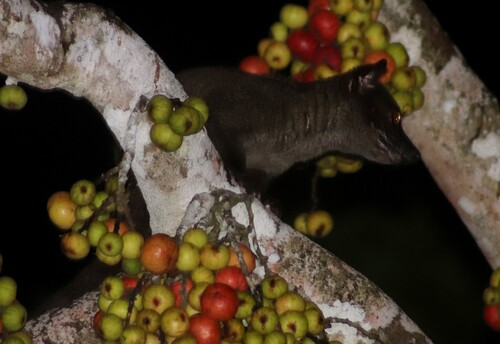
Borneo Black-banded Squirrel

Borneo Black-banded Squirrel

Callosciurus orestes

Silhouette: Kai Caspar · PhyloPic

LCLeast ConcernNTVUENCR
Daily sighting probability ~50% · Likely
at Kinabalu Park

In 3 days ~80% in a week >90%

92 Verified sightings at Kinabalu Park From 2019 to 2026
92 In 1 park
April Best month
🌅 Crepuscular When it's spotted

About the Borneo Black-banded Squirrel

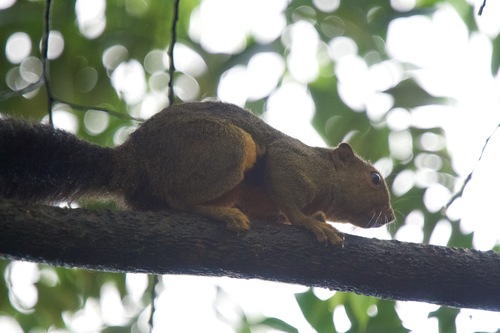
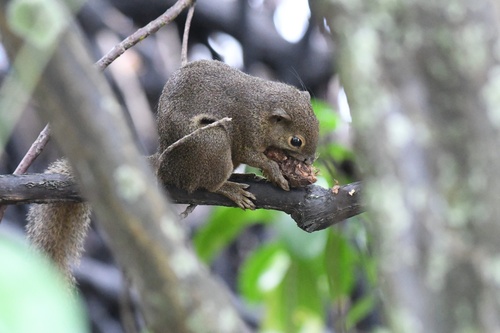
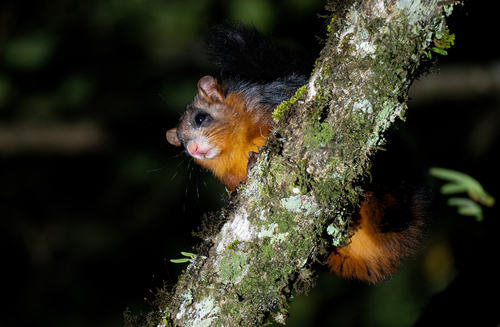
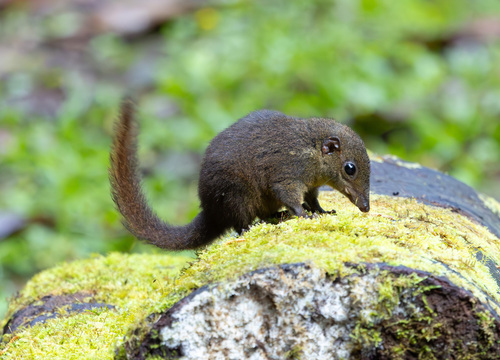
The Borneo black-banded squirrel (Callosciurus orestes) is a species of rodent in the family Sciuridae. It is endemic to northern Borneo. This species is found in northern Borneo at middle elevations (Payne et al. 1985). It was known from G. Dulit (above 1,000 metres (3,300 ft)) and reported from similar altitude on Usun Apau, the Kelabit Highlands and the upper S. Terusan, all montane localities in northern Sarawak. It was also known from Mount Kinabalu (1,000–1,700 metres (3,300–5,600 ft)) and Mount Trusmadi (about 1,500 metres (4,900 ft)) in Sabah. It appears to be restricted to lower montane forest and to upper dipterocarp forest.

The upper part is finely speckled brown. A pale buffy spot behind each ears. The underside is grey, sometimes with a reddish tinge. It also has a black and buffy-white side stripe. Callosciurus orestes is diurnal. They are active in small to medium-sized trees. Recently, fruit and black ants were found out in the two species of Mount Kinabalu.

Based on The IUCN Red List Threatened Species, Callosciurus orestes is of Least Concern. It is listed as Least Concern as it is a middle montane... Wikipedia →

Sounds

Alarm call1:11

Malaysia · 2023

© Daan Drukker · XC959734 · CC BY-NC-ND 4.0

Global Distribution

Parks Where Found

# Park Country Daily sighting probability
1 Kinabalu Park 🇲🇾 Malaysia
~50%

More parks will be added in future updates.

Before you go

What are the chances of seeing a Borneo Black-banded Squirrel in Kinabalu Park?

Likely

About 50% of wildlife watchers report a Borneo Black-banded Squirrel sighting in Kinabalu Park on a given day, based on 92 verified sightings from GBIF citizen-science data from 2019 to 2026. It is the 2nd most-seen of the 18 mammals we can rate there. Over three days the chance rises to about 80%, and over a week to over 90%, if each day is a fresh chance.

When is the best time to see a Borneo Black-banded Squirrel in Kinabalu Park?

April–May and September–October

In those months about 60% of wildlife watchers report a Borneo Black-banded Squirrel in Kinabalu Park on a given day, against under 5% in March, the lowest month.

What time of day is best to see a Borneo Black-banded Squirrel?

Between 3 and 6 am

Across all the parks we cover, that three-hour window holds the most Borneo Black-banded Squirrel sightings with a recorded time, and about 7 in 10 of them come between 6 pm and 6 am: it is most active around dawn and dusk.

Where else can you see a Borneo Black-banded Squirrel?

Only Kinabalu Park, in our data

Kinabalu Park is the only park on Wallace's Line with enough records to rate Borneo Black-banded Squirrel sightings: about 50% of wildlife watchers there report one on a given day.

Which relatives of the Borneo Black-banded Squirrel live in Kinabalu Park?

Same genus: Callosciurus

The closest relatives of the Borneo Black-banded Squirrel that you can see in Kinabalu Park (genus Callosciurus, Beautiful Squirrels) are Prevost's Squirrel (about 20%), Kinabalu Squirrel (about 20%) and Plantain Squirrel (about 20%), with each one's daily chance of a sighting.

Where does the Borneo Black-banded Squirrel sighting chance come from?

GBIF citizen-science records

It is estimated from how often the Borneo Black-banded Squirrel is recorded against all the mammals logged in Kinabalu Park (92 verified sightings from 2019 to 2026), calibrated against known sighting rates. Figures are rounded to the nearest 10% because citizen-science data supports honest approximations, not decimals, and months with records from fewer than five people show "—". How it works.

← Back to Kinabalu Park