Mountain Treeshrew

Mountain Treeshrew

Tupaia montana

Silhouette: Margot Michaud · PhyloPic

LCLeast ConcernNTVUENCR
Daily sighting probability ~30% · Possible
at Kinabalu Park

In 3 days ~70% in a week ~90%

36 Verified sightings at Kinabalu Park From 2019 to 2026
36 In 1 park
October Best month
🌅 Crepuscular When it's spotted

About the Mountain Treeshrew

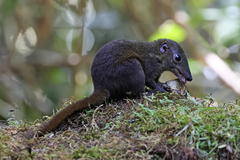
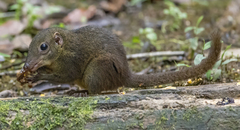
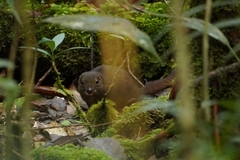
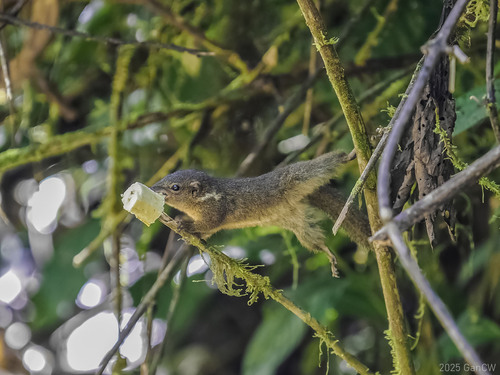
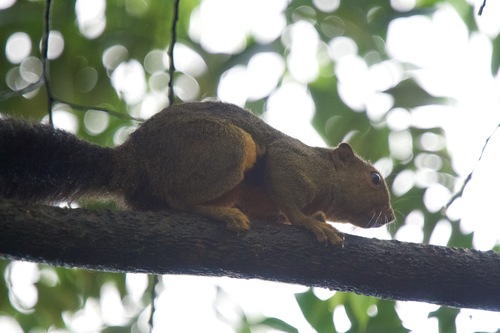
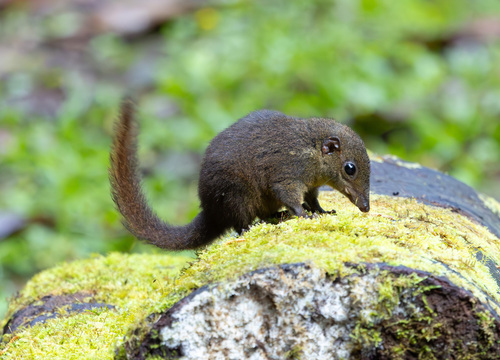
The mountain treeshrew (Tupaia montana) is a treeshrew species within the Tupaiidae. It is endemic to Borneo and inhabits montane forests in Sarawak and Sabah, Malaysia, and Kalimantan, Indonesia, as well as a part of southeastern Brunei.

The first specimen was described by Oldfield Thomas and was part of a zoological collection from northern Borneo obtained by the British Museum of Natural History. The mountain treeshrew is dark grizzled rufous above with an indistinct black line along the back. Its tail is rather short and grizzled rufous above, but below more olivaceous yellow with a black tip. The lateral tail hairs are ringed. The head and body length measures 15–33 cm and the tail length measures 13–19 cm.

Charles Hose collected the first specimen at about 4,000 ft (1,200 m) on Mount Dulit. Mountain treeshrews have mostly been recorded in montane outcrops above 600 m (2,000 ft). In their natural habitat, mountain treeshrews were observed being active during the day. They forage on the ground among fallen logs and branches where they feed mostly on arthropods. They also consume large quantities of... Wikipedia →
Global Distribution

Parks Where Found

# Park Country Daily sighting probability
1 Kinabalu Park 🇲🇾 Malaysia
~30%

More parks will be added in future updates.

Zoos & Centres Where Found

# Zoo / Centre Country
1 Ueno Zoo 🇯🇵 Japan In captivity

Before you go

What are the chances of seeing a Mountain Treeshrew in Kinabalu Park?

Possible

About 30% of wildlife watchers report a Mountain Treeshrew sighting in Kinabalu Park on a given day, based on 36 verified sightings from GBIF citizen-science data from 2019 to 2026. It is the 5th most-seen of the 18 mammals we can rate there. Over three days the chance rises to about 70%, and over a week to about 90%, if each day is a fresh chance.

When is the best time to see a Mountain Treeshrew in Kinabalu Park?

June–July, October and December

In those months about 40% of wildlife watchers report a Mountain Treeshrew in Kinabalu Park on a given day, against about 20% in January–February and November, the lowest months.

What time of day is best to see a Mountain Treeshrew?

Between 2 and 5 am

Across all the parks we cover, that three-hour window holds the most Mountain Treeshrew sightings with a recorded time, and about 6 in 10 of them come between 6 pm and 6 am: it is most active around dawn and dusk.

Where else can you see a Mountain Treeshrew?

Only Kinabalu Park, in our data

Kinabalu Park is the only park on Wallace's Line with enough records to rate Mountain Treeshrew sightings: about 30% of wildlife watchers there report one on a given day.

Where does the Mountain Treeshrew sighting chance come from?

GBIF citizen-science records

It is estimated from how often the Mountain Treeshrew is recorded against all the mammals logged in Kinabalu Park (36 verified sightings from 2019 to 2026), calibrated against known sighting rates. Figures are rounded to the nearest 10% because citizen-science data supports honest approximations, not decimals, and months with records from fewer than five people show "—". How it works.

← Back to Kinabalu Park