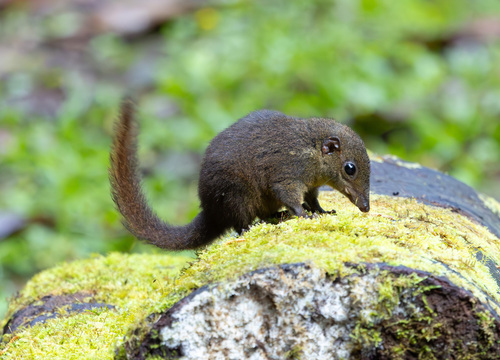
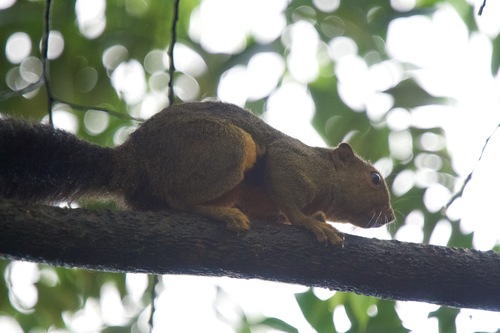
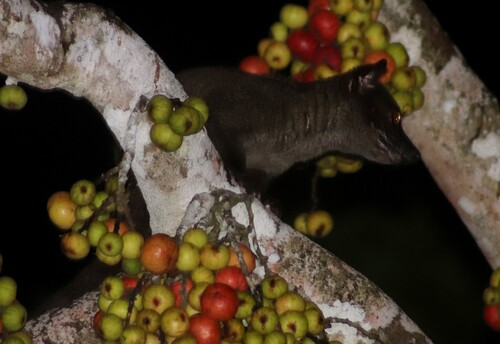
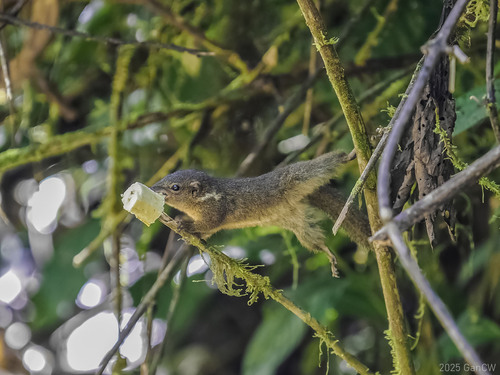
Maroon Leaf Monkey

Maroon Leaf Monkey

Presbytis rubicunda

Silhouette: PhyloPic

LCNTVUVulnerableENCR
Daily sighting probability ~20% · Possible
at Kinabalu Park

In 3 days ~40% in a week ~70%

11 Verified sightings at Kinabalu Park From 2019 to 2026
293 In all 4 parks
June Best month
🌅 Crepuscular When it's spotted

About the Maroon Leaf Monkey

The maroon langur, maroon leaf monkey, or red leaf monkey (Presbytis rubicunda) is a member of the family Cercopithecidae. It is found on the southeast Asian island of Borneo and the nearby smaller Karimata. P. rubicunda mostly live in forests at altitudes below 2,000 m. They feed on leaves, seeds, and fruits.

Maroon leaf monkeys (Presbytis rubicunda) are endemic to the island of Borneo in Southeast Asia. Their habitat is dense dipterocarp evergreen forest. Borneo has a healthy tropical rainforest. It also contains shallow swampy areas made up of acidic, decomposed plant matter. These swampy areas have seasonal bouts of dry weather; during the wet season the rivers rise around two meters. Maroon leaf monkeys are arboreal primates and spend most of their time in the canopy. They have a large home ranges and low population densities compared to other primates. This is believed to be because they rely on specific trees which are rare and widely dispersed.

Maroon leaf monkeys are herbivores. Their main diet is fruits, seeds, young leaves, and flowers. They are selective feeders, as food becomes limited they will feed on certain types... Wikipedia →

Sounds

Uncertain0:07

Malaysia · 2025

© Nick Talbot · XC1034068 · CC BY-NC-SA 4.0

Call0:11

Malaysia · 2009

© Frank Lambert · XC1031647 · CC BY-NC-ND 4.0

Social call0:43

Malaysia · 2023

© Daan Drukker · XC959720 · CC BY-NC-ND 4.0

Global Distribution

Parks Where Found

# Park Country Daily sighting probability
1 Danum Valley Conservation Area 🇲🇾 Malaysia
~80%
2 Kinabatangan Wildlife Sanctuary 🇲🇾 Malaysia
~30%
3 Sepilok 🇲🇾 Malaysia
~30%
4 Kinabalu Park 🇲🇾 Malaysia
~20%

Zoos & Centres Where Found

# Zoo / Centre Country
1 Ralph Perkins II Wildlife Center and Woods Garden 🇺🇸 United States In captivity

Before you go

What are the chances of seeing a Maroon Leaf Monkey in Kinabalu Park?

Possible

About 20% of wildlife watchers report a Maroon Leaf Monkey sighting in Kinabalu Park on a given day, based on 11 verified sightings from GBIF citizen-science data from 2019 to 2026. It is the 10th most-seen of the 18 mammals we can rate there. Over three days the chance rises to about 40%, and over a week to about 70%, if each day is a fresh chance.

When is the best time to see a Maroon Leaf Monkey in Kinabalu Park?

June

In that month about 30% of wildlife watchers report a Maroon Leaf Monkey in Kinabalu Park on a given day, against under 5% in July and September–December, the lowest months. That is one of Kinabalu Park's wettest months, with about 550 mm of rain against 180 mm in February.

What time of day is best to see a Maroon Leaf Monkey?

Between 9 am and noon

Across all the parks we cover, that three-hour window holds the most Maroon Leaf Monkey sightings with a recorded time, and about half of them come between 6 am and 6 pm: it is most active around dawn and dusk.

Where does the Maroon Leaf Monkey sighting chance come from?

GBIF citizen-science records

It is estimated from how often the Maroon Leaf Monkey is recorded against all the mammals logged in Kinabalu Park (11 verified sightings from 2019 to 2026), calibrated against known sighting rates. Figures are rounded to the nearest 10% because citizen-science data supports honest approximations, not decimals, and months with records from fewer than five people show "—". How it works.

← Back to Kinabalu Park