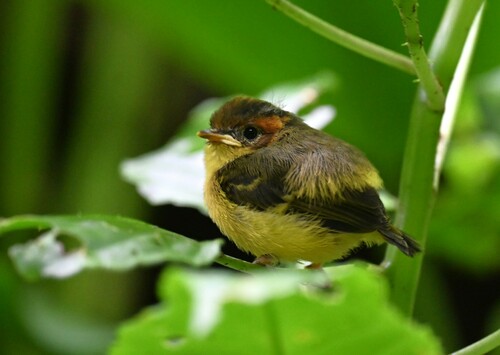
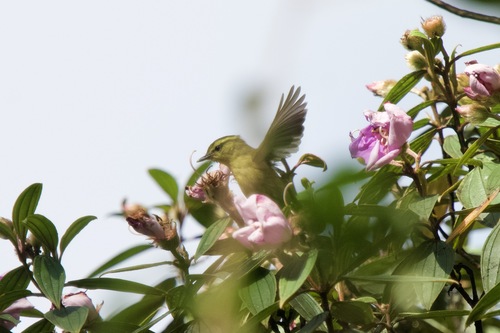
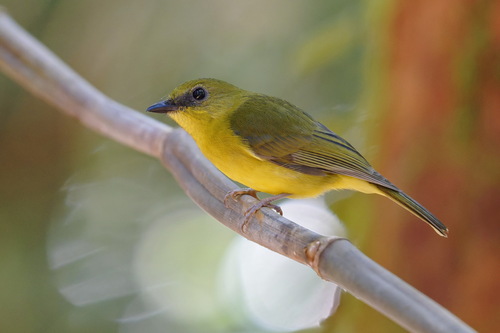
White-throated Fantail

White-throated Fantail

Rhipidura albicollis

Silhouette: Michael Scroggie · PhyloPic

LCLeast ConcernNTVUENCR
Daily sighting probability ~60% · Likely
at Kinabalu Park

In 3 days ~90% in a week >90%

1,719 Verified sightings at Kinabalu Park From 2019 to 2026
5,192 In all 15 parks
December Best month
🌅 Crepuscular When it's spotted

About the White-throated Fantail

The white-throated fantail (Rhipidura albicollis) is a small passerine bird. It is found in forest, scrub and cultivation across tropical southern Asia from the Himalayas, India and Bangladesh east to Indonesia. The white-spotted fantail (R. albogularis) until recently was considered a subspecies.

The adult white-throated fantail is about 19 cm (7.5 in) long. It has a dark fan-shaped tail, edged in white, and white supercilium and throat. There is otherwise much variation in plumage between races. Most resemble the Himalayan R. a. canescans, which is primarily slate grey above and below, featuring a black eye mask, and a white throat and eyebrow.

Local names for the bird in India include Nasoni sorai (Assamese). The white-throated fantail lays three eggs in a small cup nest in a tree. It is insectivorous, and often fans its tail as it moves through the undergrowth.

The eggs are approximately 2 cm (0.79 in) in length. They are white in colour, with a band of brown spots around the middle, closer towards the base of the egg. Birds use the same song year after year, with progressively small changes, with the result that the song sounds very different... Wikipedia →

Sounds

Song0:27

China · 2026

© Bo Shunqi 薄顺奇 · XC1172695 · CC BY-NC-SA 4.0

Call0:32

Malaysia · 2026

© Ding Li Yong · XC1104202 · CC BY-NC-ND 4.0

Song0:08

Malaysia · 2024

© Greg Irving · XC917794 · CC BY-NC-SA 4.0

Global Distribution

Parks Where Found

# Park Country Daily sighting probability
1 Kinabalu Park 🇲🇾 Malaysia
~60%
2 Kerinci Seblat National Park 🇮🇩 Indonesia
~40%
3 Namdapha National Park 🇮🇳 India
~40%
4 Jim Corbett National Park 🇮🇳 India
~30%
5 Sundarbans National Park 🇮🇳 India
~30%
6 Manas National Park 🇮🇳 India
~20%
7 Cuc Phuong National Park 🇻🇳 Vietnam
~20%
8 Doi Inthanon National Park 🇹🇭 Thailand
~10%
9 Royal Manas National Park 🇧🇹 Bhutan
~10%
10 Chitwan National Park 🇳🇵 Nepal
~10%
11 Royal Bardia National Park 🇳🇵 Nepal
~10%
12 Langtang National Park 🇳🇵 Nepal
<5%
13 Kaeng Krachan National Park 🇹🇭 Thailand
<5%
14 Danum Valley Conservation Area 🇲🇾 Malaysia
<5%
15 Sepilok 🇲🇾 Malaysia
<5%

Cities Where Found

# City Country Daily sighting probability
1 Hanoi 🇻🇳 Vietnam
~60%
2 Dehradun 🇮🇳 India
~50%
3 Tamluk 🇮🇳 India
~50%
4 Hajipur 🇮🇳 India
~40%
5 Berhampore 🇮🇳 India
~20%
6 Savar 🇧🇩 Bangladesh
~20%
7 Chandigarh 🇮🇳 India
~20%
8 Kunming 🇨🇳 China
~20%
9 Islamabad 🇵🇰 Pakistan
~10%
10 Chattogram 🇧🇩 Bangladesh
~10%

Before you go

What are the chances of seeing a White-throated Fantail in Kinabalu Park?

Likely

About 60% of wildlife watchers report a White-throated Fantail sighting in Kinabalu Park on a given day, based on 1,719 verified sightings from GBIF citizen-science data from 2019 to 2026. It is the 12th most-seen of the 247 birds we can rate there. Over three days the chance rises to about 90%, and over a week to over 90%, if each day is a fresh chance.

When is the best time to see a White-throated Fantail in Kinabalu Park?

March, May and August–December

In those months about 60% of wildlife watchers report a White-throated Fantail in Kinabalu Park on a given day, against about 40% in January and June, the lowest months.

What time of day is best to see a White-throated Fantail?

Between 2 and 5 am

Across all the parks we cover, that three-hour window holds the most White-throated Fantail sightings with a recorded time, and about half of them come between 6 am and 6 pm: it is most active around dawn and dusk.

Where does the White-throated Fantail sighting chance come from?

GBIF citizen-science records

It is estimated from how often the White-throated Fantail is recorded against all the birds logged in Kinabalu Park (1,719 verified sightings from 2019 to 2026), calibrated against known sighting rates. Figures are rounded to the nearest 10% because citizen-science data supports honest approximations, not decimals, and months with records from fewer than five people show "—". How it works.

← Back to Kinabalu Park