
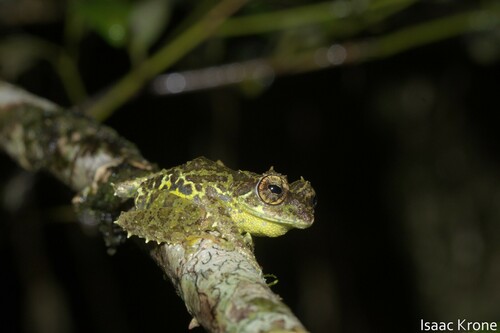
Hole-in-the-head Frog

Hole-in-the-head Frog

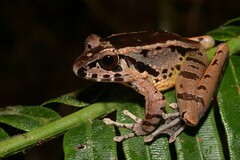
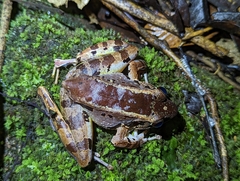
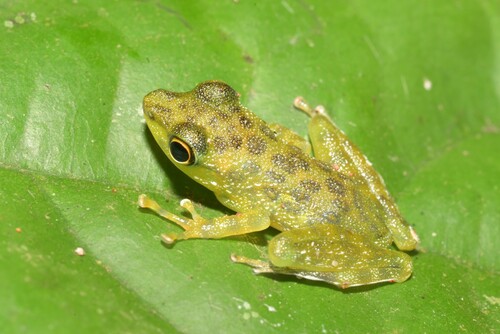
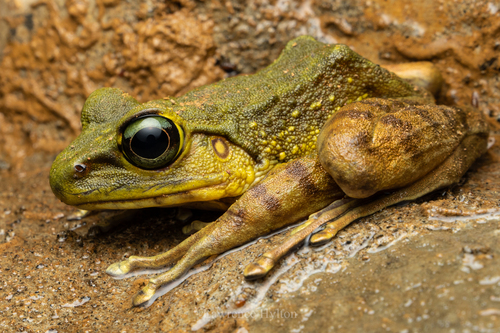
Huia cavitympanum

Silhouette: Michael Scroggie, from original photograph by John Bettaso, USFWS (original photograph in public domain). · PhyloPic

LCLeast ConcernNTVUENCR
Daily sighting probability ~30% · Possible
at Kinabalu Park

In 3 days ~60% in a week ~90%

30 Verified sightings at Kinabalu Park From 2019 to 2026
30 In 1 park
August Best month
☀️ Diurnal When it's spotted

About the Hole-in-the-head Frog

The hole-in-the-head frog (Huia cavitympanum) is a species of frog in the family Ranidae. It is the only member of the genus Huia. It is found on the island of Borneo. Its natural habitats are subtropical or tropical moist lowland forests, subtropical or tropical moist montane forests, and torrential rivers. It is threatened by habitat loss. The genus name honors Chinese herpetologist Shuchin Hu.

H. cavitympanum is the only known species of frog to vocalize at only an ultrasonic level. The frogs have eardrums recessed in the side of the skull, with an ear canal similar to mammals' anatomy. It appears to have evolved this higher pitch (more than 20 kHz) frequency of communication to circumvent the background noise of its waterfall habitat.

H. cavitympanum is now considered the only member of this genus, but it was formerly a polyphyletic "wastebin taxon" with up to some 55 species. These included some originally placed into the genera Odorrana and Eburana, which formed a paraphyletic cluster; indeed these two genera are sometimes treated as junior synonyms of Huia. But many of the moves to Huia are now considered premature and Odorrana is now treated as valid as opposed... Wikipedia →

Global Distribution

Parks Where Found

# Park Country Daily sighting probability
1 Kinabalu Park 🇲🇾 Malaysia
~30%

More parks will be added in future updates.

Before you go

What are the chances of seeing a Hole-in-the-head Frog in Kinabalu Park?

Possible

About 30% of wildlife watchers report a Hole-in-the-head Frog sighting in Kinabalu Park on a given day, based on 30 verified sightings from GBIF citizen-science data from 2019 to 2026. It is the 16th most-seen of the 40 amphibians we can rate there. Over three days the chance rises to about 60%, and over a week to about 90%, if each day is a fresh chance.

When is the best time to see a Hole-in-the-head Frog in Kinabalu Park?

February and July–October

In those months about 40% of wildlife watchers report a Hole-in-the-head Frog in Kinabalu Park on a given day, against under 5% in March and November, the lowest months.

What time of day is best to see a Hole-in-the-head Frog?

Between 1 and 4 pm

Across all the parks we cover, that three-hour window holds the most Hole-in-the-head Frog sightings with a recorded time, and about 9 in 10 of them come between 6 am and 6 pm: it is a daytime animal.

Where else can you see a Hole-in-the-head Frog?

Only Kinabalu Park, in our data

Kinabalu Park is the only park on Wallace's Line with enough records to rate Hole-in-the-head Frog sightings: about 30% of wildlife watchers there report one on a given day.

Where does the Hole-in-the-head Frog sighting chance come from?

GBIF citizen-science records

It is estimated from how often the Hole-in-the-head Frog is recorded against all the amphibians logged in Kinabalu Park (30 verified sightings from 2019 to 2026), calibrated against known sighting rates. Figures are rounded to the nearest 10% because citizen-science data supports honest approximations, not decimals, and months with records from fewer than five people show "—". How it works.

← Back to Kinabalu Park