
Copper-cheeked Frog

Copper-cheeked Frog

Chalcorana raniceps

Silhouette: Michael Scroggie, from original photograph by John Bettaso, USFWS (original photograph in public domain). · PhyloPic

LCLeast ConcernNTVUENCR
Daily sighting probability ~10% · With luck
at Kinabalu Park

In 3 days ~30% in a week ~60%

8 Verified sightings at Kinabalu Park From 2019 to 2026
72 In all 4 parks
September Best month
☀️ Diurnal When it's spotted

About the Copper-cheeked Frog

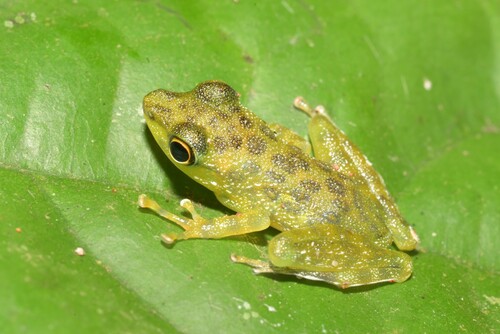
Chalcorana raniceps, also known as the copper-cheeked frog, white-lipped frog, or Peters' Malaysian frog, is a species of "true frog" in the family Ranidae. It is endemic to Borneo, including Brunei Darussalam, Kalimantan (Indonesia), Sabah and Sarawak (Malaysia), although it is likely to occur more widely. Previously mixed with Chalcorana chalconota (treated as a junior synonym or a subspecies) and believed to have much wider distribution, its range was delimited to Borneo in the revision of "Rana chalconota" complex by Robert Inger and colleagues in 2009.

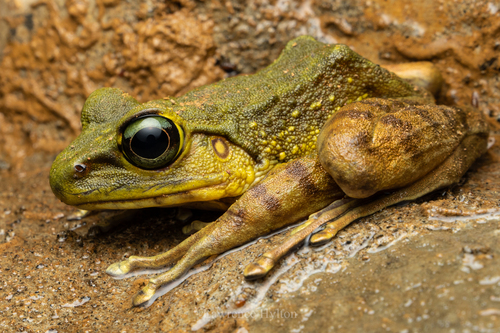
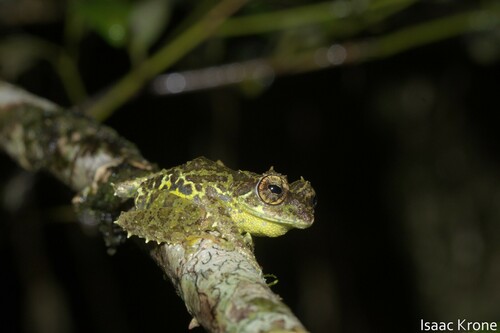
Chalcorana raniceps are relatively small frogs: adult males measure 28–34 mm (1.1–1.3 in) and females 33–42 mm (1.3–1.7 in) in snout–vent length. Colouration is mostly green, sometimes with brown back. The snout is long and pointed. Finger and toe tips have adhesive disks. The thighs may be reddish undersides. It resembles Chalcorana megalonesa but is much smaller. Tadpoles are conspicuous with dark markings and red gills on light brown to yellow background; presumably, they are poisonous.

Chalcorana raniceps inhabits a broad range of lowland primary and secondary rainforest habitats. It breeds in... Wikipedia →

Global Distribution

Parks Where Found

# Park Country Daily sighting probability
1 Bako National Park 🇲🇾 Malaysia
~50%
2 Kinabatangan Wildlife Sanctuary 🇲🇾 Malaysia
~30%
3 Kinabalu Park 🇲🇾 Malaysia
~10%
4 Sepilok 🇲🇾 Malaysia
~10%

Before you go

What are the chances of seeing a Copper-cheeked Frog in Kinabalu Park?

With luck

About 10% of wildlife watchers report a Copper-cheeked Frog sighting in Kinabalu Park on a given day, based on 8 verified sightings from GBIF citizen-science data from 2019 to 2026. It is the 36th most-seen of the 40 amphibians we can rate there. Over three days the chance rises to about 30%, and over a week to about 60%, if each day is a fresh chance.

When is the best time to see a Copper-cheeked Frog in Kinabalu Park?

September

In that month about 30% of wildlife watchers report a Copper-cheeked Frog in Kinabalu Park on a given day, against under 5% in April–May and October–January, the lowest months.

What time of day is best to see a Copper-cheeked Frog?

Between 1 and 4 pm

Across all the parks we cover, that three-hour window holds the most Copper-cheeked Frog sightings with a recorded time, and about 9 in 10 of them come between 6 am and 6 pm: it is a daytime animal.

Is Kinabalu Park the best place to see a Copper-cheeked Frog?

3rd of 4

Of the 4 parks where we can rate Copper-cheeked Frog sightings, Kinabalu Park ranks 3rd at about 10%. The best odds are in Bako National Park (Malaysia, about 50%) and Kinabatangan Wildlife Sanctuary (Malaysia, about 30%).

Where does the Copper-cheeked Frog sighting chance come from?

GBIF citizen-science records

It is estimated from how often the Copper-cheeked Frog is recorded against all the amphibians logged in Kinabalu Park (8 verified sightings from 2019 to 2026), calibrated against known sighting rates. Figures are rounded to the nearest 10% because citizen-science data supports honest approximations, not decimals, and months with records from fewer than five people show "—". How it works.

← Back to Kinabalu Park