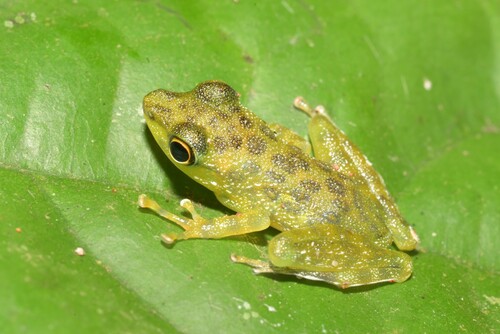
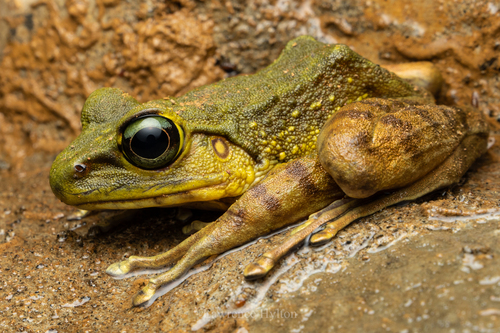
Yellow-spotted Narrow-mouthed Frog

Yellow-spotted Narrow-mouthed Frog

Chaperina fusca

Silhouette: Dmitry Bogdanov (vectorized by T. Michael Keesey) · PhyloPic

LCLeast ConcernNTVUENCR
Daily sighting probability ~40% · Likely
at Kinabalu Park

In 3 days ~70% in a week >90%

55 Verified sightings at Kinabalu Park From 2019 to 2026
88 In all 4 parks
November Best month
☀️ Diurnal When it's spotted

About the Yellow-spotted Narrow-mouthed Frog

Chaperina is a genus of frogs in the family Microhylidae. It is the only genus in the subfamily Chaperininae. It is also itself monotypic, being represented by the single species, Chaperina fusca, commonly known as the brown thorny frog, spiny-heeled froglet, and saffron-bellied frog.

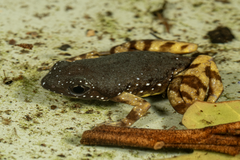
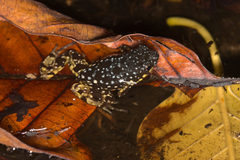
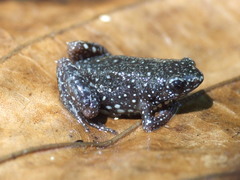
It is found on the Malay Peninsula, in Borneo and in the Philippines (Palawan, Mindanao, and Jolo islands). It is abundant in Borneo but uncommon on the Malay Peninsula and patchily distributed in the Philippines. Chaperina fusca are small frogs: males measure 18–21 mm (0.71–0.83 in) in snout–vent length and females 20–26 mm (0.79–1.02 in). They are black above with minute white, light blue, or greenish spots. The skin is smooth with scattered tubercles; they have a sharp dermal projection on elbows and heel.

These frogs are active after rainfall on forest floor and low vegetation; they are good climbers. Its natural habitats are primary lowland and montane rainforests as well as edge habitats; it has also been found in rural gardens. It breeds in small, temporary water bodies rich in decaying organic matter.

Threats to this species include deforestation... Wikipedia →

Sounds

Recording

Malaysia · 2018

© Marc Anderson · Xeno · CC BY-NC-ND 4.0

Global Distribution

Parks Where Found

# Park Country Daily sighting probability
1 Kinabalu Park 🇲🇾 Malaysia
~40%
2 Danum Valley Conservation Area 🇲🇾 Malaysia
~30%
3 Kinabatangan Wildlife Sanctuary 🇲🇾 Malaysia
~10%
4 Sepilok 🇲🇾 Malaysia
~10%

Cities Where Found

# City Country Daily sighting probability
1 Kuching 🇲🇾 Malaysia
~20%

Before you go

What are the chances of seeing a Yellow-spotted Narrow-mouthed Frog in Kinabalu Park?

Likely

About 40% of wildlife watchers report a Yellow-spotted Narrow-mouthed Frog sighting in Kinabalu Park on a given day, based on 55 verified sightings from GBIF citizen-science data from 2019 to 2026. It is the 11th most-seen of the 40 amphibians we can rate there. Over three days the chance rises to about 70%, and over a week to over 90%, if each day is a fresh chance.

When is the best time to see a Yellow-spotted Narrow-mouthed Frog in Kinabalu Park?

November

In that month about 60% of wildlife watchers report a Yellow-spotted Narrow-mouthed Frog in Kinabalu Park on a given day, against about 20% in May, the lowest month.

What time of day is best to see a Yellow-spotted Narrow-mouthed Frog?

Between 1 and 4 pm

Across all the parks we cover, that three-hour window holds the most Yellow-spotted Narrow-mouthed Frog sightings with a recorded time, and about 9 in 10 of them come between 6 am and 6 pm: it is a daytime animal.

Is Kinabalu Park the best place to see a Yellow-spotted Narrow-mouthed Frog?

Yes

Of the 4 parks where we can rate Yellow-spotted Narrow-mouthed Frog sightings, Kinabalu Park has the highest daily chance: about 40%. Next come Danum Valley Conservation Area (Malaysia, about 30%) and Kinabatangan Wildlife Sanctuary (Malaysia, about 10%).

Which relatives of the Yellow-spotted Narrow-mouthed Frog live in Kinabalu Park?

Same family: Microhylidae

The closest relatives of the Yellow-spotted Narrow-mouthed Frog that you can see in Kinabalu Park (family Microhylidae, Narrow-mouthed Frogs) are Kinabalu Sticky Frog (about 40%), Tree Hole Frog (about 30%) and Bornean Sticky Frog (about 20%), with each one's daily chance of a sighting.

Where does the Yellow-spotted Narrow-mouthed Frog sighting chance come from?

GBIF citizen-science records

It is estimated from how often the Yellow-spotted Narrow-mouthed Frog is recorded against all the amphibians logged in Kinabalu Park (55 verified sightings from 2019 to 2026), calibrated against known sighting rates. Figures are rounded to the nearest 10% because citizen-science data supports honest approximations, not decimals, and months with records from fewer than five people show "—". How it works.

← Back to Kinabalu Park